Why Pre-Payroll Validation Matters in Multi-Country Payroll
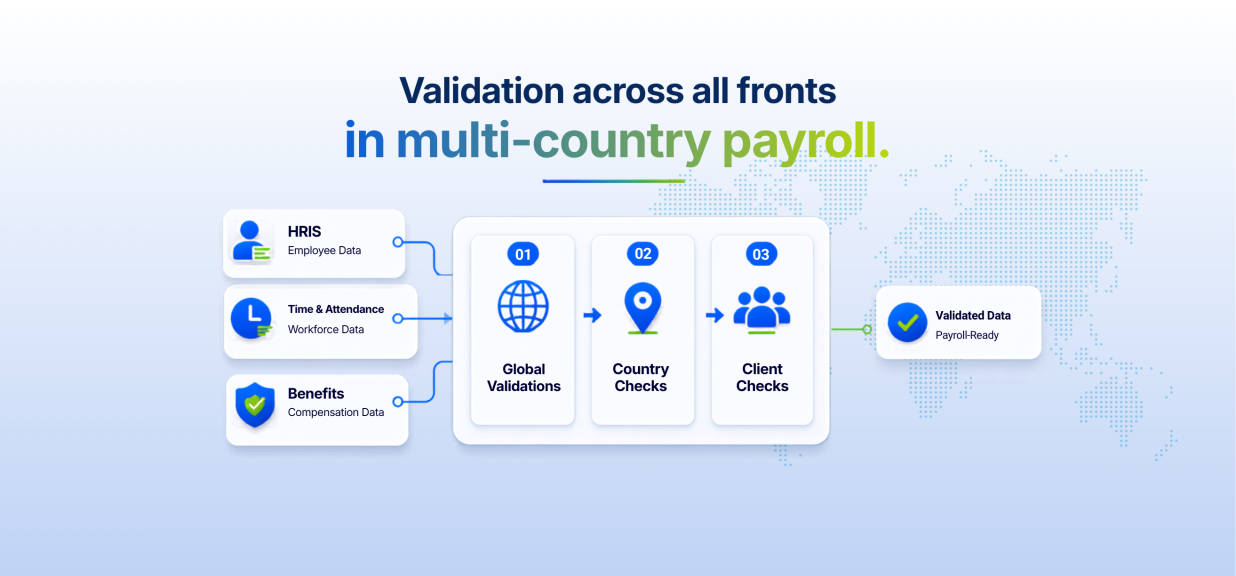
Navigating a multi-country payroll cycle presents a significant challenge: data fragmentation. Global payroll teams are constantly forced to merge inputs from a disparate mix of HRIS platforms, regional time and attendance systems, and localized benefits portals.
Without a unified payroll ecosystem, this process becomes difficult to manage and largely reactive. It traps teams in endless manual spreadsheet reconciliations. The financial risk of this fragmentation is severe; according to Ernst & Young (EY), the average cost to rectify just a single payroll error is $291, a figure that compounds exponentially across global workforces.
When unscrutinized data slips through the cracks and enters the payroll engine, the system blindly applies its mathematical formulas and runs the cycle. The result is a flawlessly incorrect payroll. This is precisely why pre-payroll validation, the automated interrogation of input data executed right before any calculation takes place, is the most critical control gate in modern multi-country payroll architecture.
What Is Pre-Payroll Validation?
Pre-payroll validation is the automated process of checking and correcting employee input data before it reaches the payroll calculation engine. Rather than allowing raw, unverified data from HRIS, time and attendance, and benefits systems to flow directly into payroll processing, a validation layer intercepts it first, screening for missing fields, incorrect formats, non-compliant values, and statistical anomalies. Only data that passes these checks is allowed to proceed to calculation. In effect, it acts as a quality gate: catching errors at their source, before they can compound into an incorrect payroll run.
The Three Levels of Pre-Payroll Validation
A robust and unified pre-payroll control framework evaluates incoming data across three distinct and automated levels. This tiered structure ensures validation is globally governed, locally compliant, and organizationally intelligent.

01. Global Validations
Global validations establish a universal minimum standard of data integrity across the entire organizational landscape. Before localized calculations occur, the system executes a comprehensive rule check to identify fundamental structural flaws in the input data.
Key global validations include:
- Mandatory Fields Validation: Ensuring that universally required structural data is present before proceeding, such as instantly flagging a new hire record that is missing a core bank routing number.
- Non-blank fields and Floor-Ceiling Values check: Confirming that essential fields are not left empty and that numerical inputs fall within universally acceptable boundaries. For example, a floor check might universally reject any standard base pay entered as a negative value. This acts as a foundational safety net against egregious keystroke errors regardless of the operating country.
02. Country Checks
While global validations ensure foundational integrity, multi-country payroll must account for severe jurisdictional variability. The second level evaluates inputs against the specific statutory and regulatory requirements of the local country.
Country checks ensure strict local compliance by validating:
- Country-specific fields availability and validity: Confirming that locally required data points are present and formatted correctly for the specific tax jurisdiction.
- National Identifiers: Validating complex statutory formats. For instance, a system must rigorously validate an identifier format like X-YYMMDD-ZZZZ. This ensures that the prefix X is restricted strictly to permitted digits (1, 2, 3, or 4) and that the YYMMDD segment aligns perfectly with the employee's exact date of birth.
03. Client Checks
Statutory compliance alone does not equal payroll accuracy. The third level consists of automated client checks, which are systemic and configurable rules designed to enforce an organization's unique business tolerances and specific compensation policies.
Automated client checks apply exact organizational logic, such as:
- Client-Specific Allowance Rules:: Establishing strict minimum value thresholds, such as enforcing a minimum input of 6,000 HUF for a specific localized allowance.
- Targeted Bonus Rules: Restricting inputs to highly specific approved tiers. For example, an internal "ABN Bónusz" rule might mandate that an entry can only be exactly 200,000 HUF or 400,000 HUF, outright rejecting any variance in between.
Elevating Controls: Point-of-Processing Validation and AI/ML
Within a unified payroll ecosystem, automated input validations are executed dynamically at the critical point of processing. The exact moment a payroll professional initiates the payroll run, the validation engine acts as an immediate interception layer. It rigorously interrogates the entire dataset before any calculations occur.
This pre-calculation phase is elevated by Artificial Intelligence (AI) and Machine Learning (ML) embedded directly into the validation engine. The system leverages ML models that have already established dynamic baselines by continuously learning from historical payroll cycles. As data flows through the engine, and before input transformation steps like time evaluation or gross-ups take place, the AI instantly evaluates the current inputs against these learned behaviors.
This shifts the framework from static rules to dynamic anomaly detection. Even if an input successfully passes a structural global rule check and a rigid country check, the ML model still evaluates its behavioral context. It can flag a structurally valid input as a highly probable anomaly if it deviates from historical seasonal trends, individual earning trajectories, or peer-group patterns. This allows the engine to catch subtle and context-driven errors at the point of processing that hard-coded rules inevitably miss.
Categorizing Exceptions and Variance Analysis
To prevent alert fatigue, the AI-enhanced validation engine categorizes anomalies by severity using probability scoring.
- Errors identify critical issues that mathematically or legally prevent calculation. An invalid National Identifier or a missing mandatory field represents a hard stop, meaning the data must be corrected before the payroll run can proceed.
- Warnings highlight unusual values that require human review. The unified system ranks these warnings and prioritizes the actionable insights that deviate most significantly from historical patterns.
Furthermore, pre-payroll validation requires deep visibility into variance through intelligent input summaries:
- Component-Wise Analysis allows teams to track how specific pay elements have shifted across the global population by comparing current inputs against historically adjusted ML baselines.
- Employee-Wise Analysis pinpoints the specific individuals driving those aggregate variances, identifying exactly whose gross inputs increased beyond their forecasted trajectory before the calculation engine ever runs.
Operationalizing a Pre-Payroll Ecosystem
Moving from a fragmented, reactive operation to a proactive payroll model requires an ecosystem built for automated interception from the ground up. This is the architecture behind modern unified payroll platforms. Neeyamo, for example, natively embeds over 300 standard validations directly into its processing engine.
When a user initiates the cycle, incoming data from disparate sources is systematically transformed and filtered through the validation engine: global validations first, then localized country checks, then configurable client rules. The goal of combining structured rules with AI is not to replace human judgment, but to direct it. By unifying fragmented data and validating it at the point of processing, organizations enable their payroll professionals to practice true exception-based management. Teams resolve genuine anomalies instead of continuously searching for them.
The difference is simple. A payroll engine will always run the numbers it is given. A validated payroll engine runs the right ones. Organizations that build this control gate before the calculation, not after the error, turn payroll from a monthly risk into a quiet, reliable outcome.
Ready to see what pre-payroll validation looks like in practice? Write to us at irene.jones@neeyamo.com to schedule a walkthrough of Neeyamo Payroll and see how our built-in validation controls can work for your global payroll.

Frequently Asked Questions
Pre-payroll validation acts as a control gate before calculation. It checks fragmented payroll inputs for missing, incorrect, or non-compliant data so errors can be resolved before they affect employee pay.
There are three levels: Global Validations, Country Checks, and Client Checks. Together, they ensure data is structurally sound, locally compliant, and aligned with an organization's own business policies.
AI shifts validation from static rules to dynamic anomaly detection. It compares real-time inputs against learned historical baselines to flag subtle, context-driven errors.
By categorizing anomalies by severity. Critical Errors trigger a hard stop for immediate correction, while Warnings are intelligently ranked and prioritized for human review.
It provides immediate visibility into component-level and employee-level shifts, allowing teams to understand exactly what changed and who is driving the variance before the engine ever runs.