It is August 2026. The year is already more than halfway through.
For Global Capability Centers, this is an important moment to pause and take stock. The GCC trends that began the year as predictions are now becoming operational realities. AI is moving beyond experimentation, GCC mandates are expanding, talent strategies are being reshaped, and global enterprises are placing greater ownership of products, platforms, data, and business outcomes in their capability centers.
The numbers reflect the scale of this shift. India alone now hosts 2,117 GCCs, with around 2.36 million professionals working across the ecosystem, as GCCs continue their evolution from delivery engines into increasingly strategic enterprise hubs. Research from Accenture also shows that more than 75% of GCCs have moved beyond AI and automation experimentation, while 66% are increasingly being evaluated on their ability to accelerate speed to market and create tangible business impact.
So, with four months still left in 2026, the question for GCC leaders is no longer simply, "What trends will shape the year ahead?"
A more important question is: Which of these trends have already reshaped the GCC mandate, and what capability are organizations still missing?
Because while GCCs are building stronger capabilities in AI, engineering, data, cybersecurity, and product ownership, one enterprise-critical function continues to remain fragmented in many global organizations: global payroll.
And that is where a new capability model comes into the conversation: the Global Payroll Capability Center, GpCC.
Introduced by Neeyamo, GpCC brings a new perspective to how global payroll can be managed within the broader GCC ecosystem. But why does this capability matter now?
The answer lies in how GCCs themselves are evolving. The trends shaping GCCs in 2026 reveal a clear shift in their mandate, operating models, and expectations. As organizations move toward greater ownership, intelligence, automation, and enterprise-wide impact, they are also redefining the capabilities required to support that transformation.
Here are the key GCC trends shaping 2026 and why they make the case for a new approach to global payroll stronger than ever.
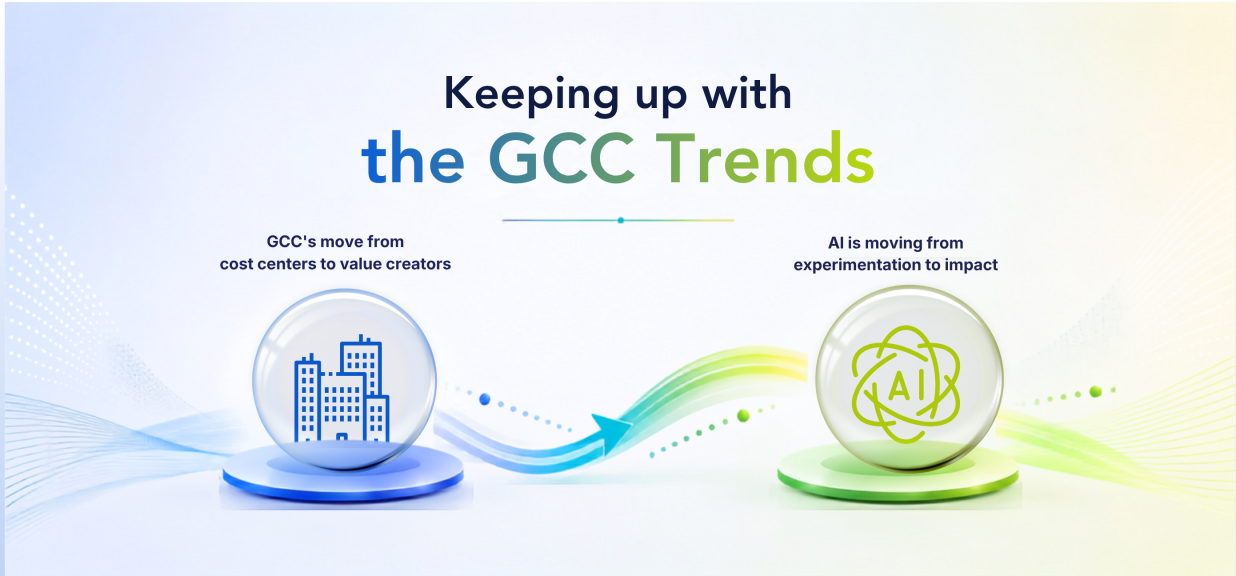
Trend 1: GCCs Are Moving From Cost Centers to Enterprise Value Creators
One of the clearest GCC trends of 2026 is the shift from execution to ownership.
GCCs are no longer being evaluated purely on efficiency or cost optimization. They are increasingly taking responsibility for AI platforms, engineering, products, data, and enterprise outcomes. Recent industry perspectives point to a fundamental change in expectations: organizations are moving from asking what their GCCs can execute to asking what they can own.
This changes the role of the GCC itself.
A future-ready GCC needs to do more than centralize talent. It needs the capabilities, governance, and operating model required to manage complex global functions at scale.
Trend 2: AI Is Moving From Experimentation to Business Impact
At the beginning of the year, AI was already high on every GCC agenda. By August, the conversation had moved further.
The focus is increasingly on operationalizing AI, building AI-ready talent, and connecting AI investments to measurable business outcomes. GCCs are also taking on a greater role in developing enterprise AI capabilities, with AI skills continuing to drive hiring and capability expansion.
But AI also exposes an important reality.
Technology alone cannot solve operational complexity. To create value at scale, organizations need the right data, clear ownership, standardized processes, governance, and controls around the technology.
This becomes particularly important for global payroll.
Trend 3: Governance and Capability Ownership Are Becoming Critical
As GCC mandates expand, governance is becoming a key differentiator.
The most mature GCCs are not simply bringing more work under one roof. They are creating structured capability models around the functions they own. This means establishing common standards, improving visibility, defining accountability, and creating the ability to manage complexity across markets and business units.
Yet global payroll is often still managed as a collection of country-specific operations.
Multiple vendors, different payroll systems, varying processes, disconnected data, and local compliance requirements can make payroll difficult to govern as one enterprise capability.
This is the gap that Neeyamo has identified and addressed through the concept of the Global Payroll Capability Center, or GpCC.
Source: GCC Trends 2026, Hexaware
The Missing Capability: The Global Payroll Capability Center
A GpCC is not simply a centralized payroll team.
Introduced by Neeyamo, the Global Payroll Capability Center is a model for bringing governance, intelligence, visibility, and orchestration to global payroll. It recognizes that while payroll must remain locally compliant, it does not have to remain globally fragmented.
The objective is to create a capability that can provide greater oversight across the global payroll ecosystem, standardize what can be standardized, orchestrate what must remain local, and establish clearer control across countries, providers, systems, and processes.
In other words, GpCC shifts the conversation from processing global payroll to building the capability to govern it globally.
The Question for the Rest of 2026
As we enter the final stretch of 2026, GCC leaders have an opportunity to look beyond the trends dominating the conversation today.
AI, talent, product ownership, and innovation will continue to shape the future of GCCs. But the next phase of GCC maturity will also depend on how effectively organizations build capabilities around complex, enterprise-critical functions.
That is why the Global Payroll Capability Center matters.
Neeyamo introduced GpCC as a new way to think about global payroll within the GCC ecosystem. At a time when GCCs are evolving from execution centers into strategic capability hubs, global payroll needs to evolve too.
The question is no longer whether global payroll can be managed across multiple countries.
The question is whether it can be governed, orchestrated, and scaled as a true enterprise capability.
For many GCCs, that may be the missing capability they need next. Want to learn more about GPCC? We are just a mail away. Contact us at irene.jones@neeyamo.com