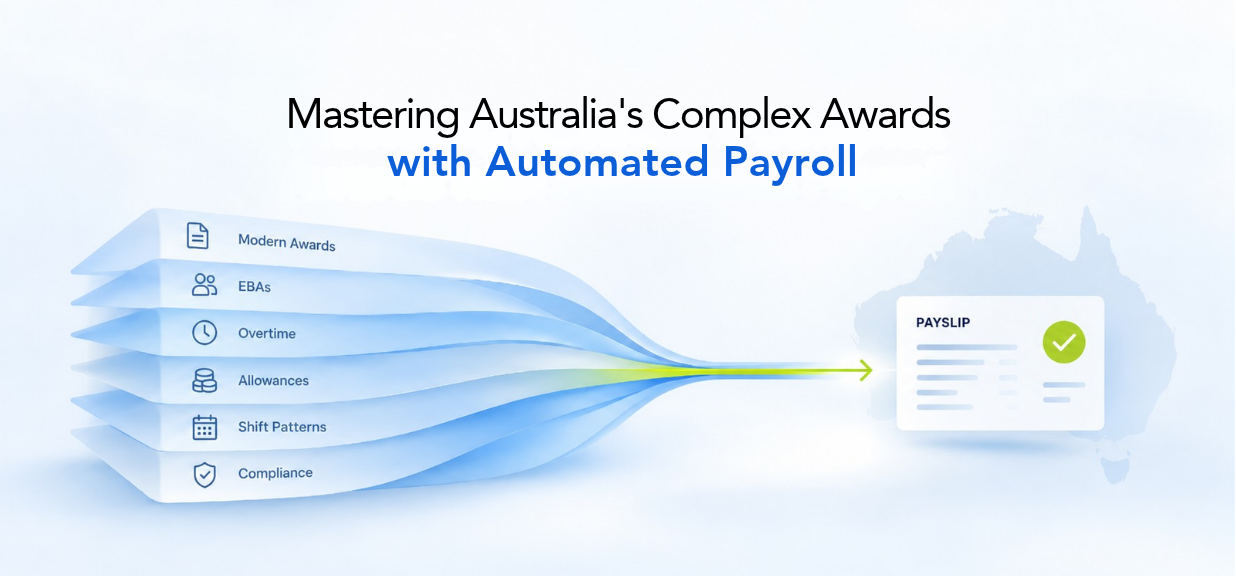
Ask any payroll leader in Australia what keeps them up at night, and the answer rarely changes: Award and EBA Management. With more than 120 Modern Awards in play and thousands of enterprise bargaining agreements (EBAs) negotiated across industries, paying people correctly in Australia is less like following a recipe and more like solving a puzzle that changes shape depending on the role, the day, the hour, and sometimes even the weather.
The stakes could not be higher. Underpayments, even unintentional ones, make headlines, invite scrutiny from the Fair Work Ombudsman, erode employee trust, and can take years and millions of dollars to remediate. With wage underpayment now a criminal offense for intentional breaches under the Closing Loopholes reforms, the margin for error has never been thinner.
Yet in many organizations, award interpretation still lives in spreadsheets, tribal knowledge, and the heads of a few overworked payroll specialists. It does not have to be this way. Organisations that stay ahead of Australian payroll compliance see risk early and act before it becomes a headline.
The Real Cost of Manual Award Interpretation
Every manual touchpoint in the award interpretation process is a door left open for error. When teams manually cross-check timesheets against penalty rates, manually apply allowances, and manually reconcile overtime thresholds, three things happen:
Time disappears. Repetitive checking, rechecking, and firefighting consume hours that could be spent on workforce insight and strategy.
Consistency suffers. Two people interpreting the same clause can arrive at two different outcomes. Multiply that across pay runs, sites, and years, and small variances compound into significant exposure.
Confidence erodes. When leadership cannot say with certainty that every payslip is right, every pay run becomes a leap of faith rather than a controlled, auditable process.
Manual interpretation is not just slow. It is a structural compliance risk that grows with every hire, every roster change, and every award variation the Fair Work Commission hands down.
Where the Complexity Bites: Award Compliance by Industry
This pressure is not theoretical. It shows up differently in every industry:
Healthcare and aged care. Rosters that run around the clock bring night shifts, weekend work, public holidays, on-call and standby arrangements, and classifications tied to qualifications, all colliding in a single fortnight. One carer's pay can be shaped by a dozen different conditions before it is ever calculated, and workforces run into the thousands.
Retail. A workforce full of casuals, juniors, and part-time staff trading seven days a week. Weekend penalties, evening rates, and age-based pay scales under the General Retail Industry Award are in constant motion, and a surge of seasonal hires over a busy holiday period multiplies the room for error just when there is the least time to check.
Hospitality. Split shifts, late-night trading, seasonal peaks, and high staff turnover make this one of the most demanding environments to pay correctly. The busier the venue, the more complex the pay run, precisely when accuracy matters most.
Mining and resources. Fly-in fly-out (FIFO) rosters that move crews in and out of remote sites, remote and district allowances, and heavily negotiated enterprise agreements mean the rules are as unique as the operation itself. With large crews and substantial pay packets, even a small interpretation slip scales into a very large problem.
Manufacturing and logistics. Rotating shifts, overtime thresholds, allowances for skills and tools, and drivers whose entitlements change with the kilometres travelled or the nights spent away from home. Every roster pattern is a fresh interpretation exercise, repeated week after week.
Construction. Site allowances, inclement weather provisions, rostered days off, and travel entitlements mean pay reflects the realities of the job site, and those realities change from project to project and agreement to agreement.
Different industries, same underlying truth: wherever people work irregular hours, in large numbers, under negotiated agreements, manual interpretation eventually cracks. The question is not whether it will crack, but when, and whether you will be ready.
Award and EBA Management: Made Easy Through Payroll Automation
This is where Neeyamo Payroll changes the conversation. Rather than treating award and EBA interpretation as a periodic scramble, Neeyamo Payroll is designed to embed it into the fabric of payroll itself: automated, kept current, and applied consistently every pay cycle.
The complexity does not go away. What changes is how much of it your team has to untangle by hand. Overtime, penalty conditions, allowances, and entitlements are interpreted automatically as part of the pay cycle, based on the rules configured for your organization. Intelligent validations and anomaly detection help flag anything unusual before it reaches an employee's bank account, giving your team the chance to review and confirm rather than discover issues after the fact.
Imagine your next pay run: less scrambling, fewer spreadsheets, less second-guessing. Payroll teams spend less time as data processors and more time as decision makers. Instead of only asking, "Did we get it right?" they have the headroom to ask, "What can we do better?"
Picture your team with those hours back. Request a walkthrough and watch a pay run interpret itself.
Payroll Governance You Can Actually Stand Behind
Automation alone is not the whole story. What organizations truly need, especially in a regulatory environment as vigilant as Australia's, is defensible governance. That means being able to show, at any moment, not just what an employee was paid, but why.
Neeyamo Payroll is built to support that standard of transparency. Every calculation is traceable, rules are applied uniformly, and award updates can flow through the system with minimal manual rework. A clear audit trail helps replace guesswork with evidence, so when regulators, auditors, or employees ask questions, your team has structured, consistent answers ready.
Employers remain responsible for their compliance obligations, and Neeyamo Payroll is designed to make meeting those obligations more reliable, more visible, and far less dependent on individual heroics. This is governance not as a compliance checkbox but as a genuine source of organizational confidence. Boards get clearer assurance. CFOs sign off faster. Employees trust their payslips. And the organizations that get there first turn compliance from a cost center into a competitive edge.
People First, Always
At its heart, this is not a technology story. It is a people story. Awards and EBAs exist to protect workers, and getting them right is a promise every employer makes to their workforce. When interpretation is supported by automation, governed by clear rules, and backed by an audit trail, that promise is far easier to keep on every payslip, in every cycle.
Employees notice. Accurate, timely, transparent pay is one of the most fundamental drivers of workplace trust, and one of the fastest ways to lose it when it goes wrong. The employers people want to work for are the ones who never make them wonder about their pay.
The Bottom Line
Awards and EBAs will never be simple. But managing them can be.
By supporting manual interpretation with intelligent automation and replacing hope with governance, Neeyamo Payroll helps turn one of Australian payroll's most persistent headaches into a quiet, dependable strength. Less manual effort. Fewer errors. Stronger compliance foundations. And a payroll function that finally has the time and the confidence to look forward instead of over its shoulder.
Forward-looking payroll teams are already making the shift. Every pay cycle spent on manual interpretation is another cycle of avoidable risk. Payroll should never be a leap of faith. With Neeyamo Payroll, it does not have to be.
Ready for your easiest pay run ever? Write to us at irene.jones@neeyamo.com or visit us here for more information.