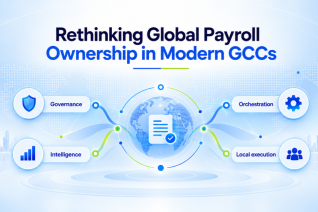
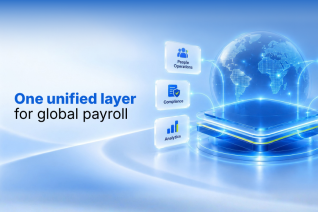
What happens when an organization has employees in 10, 30, or 100 countries, but payroll still has to work as though it were one operation?
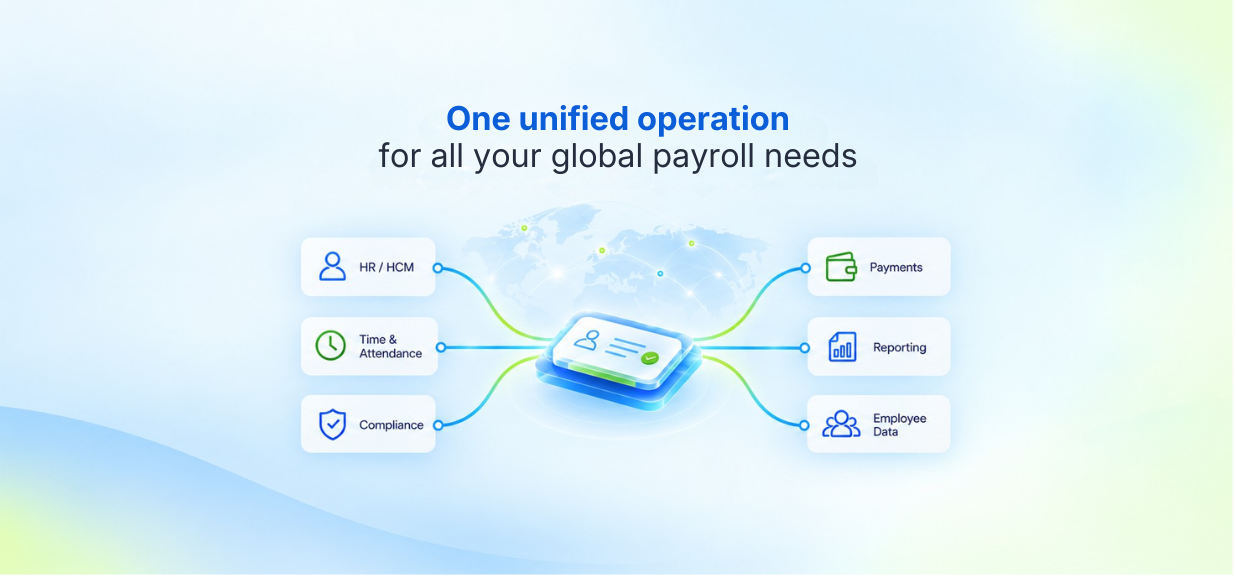
For many global organizations, the challenge is no longer simply paying employees accurately and on time. It is coordinating employee data, payroll calculations, country-specific compliance, approvals, payments, reporting, and multiple payroll stakeholders across jurisdictions.
And the complexity is increasing. PayrollOrg's 2026 survey highlights a landscape of increasing complexity and evolving expectations for global payroll teams, with organizations balancing in-house and outsourcing strategies. This is where global payroll services come into the picture.
What Are Global Payroll Services?
Global payroll services are solutions designed to help organizations manage payroll across multiple countries through a coordinated technology, process, and governance framework. They can encompass activities such as:
- Collecting and consolidating payroll inputs
- Validating employee and payroll data
- Calculating gross-to-net pay
- Applying country-specific tax and statutory rules
- Generating statutory outputs and reports
- Consolidating payroll reporting
- Managing payroll exceptions
- Providing global visibility and governance
Research into global payroll delivery models notes that large multinational organizations rarely standardize 100% of employees onto a single platform or provider. Instead, global models can combine in-house systems, outsourcing, hybrid approaches, regional operations, and country-specific solutions under global governance.
Why Does Global Payroll Become Complex?
Consider a company with employees across 40 countries. Employee information may originate in a central HCM system. Time and attendance may come from another platform. Benefits may be managed elsewhere. Payroll calculations may happen through different country systems or providers.
Finance may require another set of reports. Then come the local requirements. None of these differences necessarily creates a problem by itself. The problem emerges when an organization tries to manage all of them collectively. This is why global payroll is not simply a calculation exercise. It is a data, technology, compliance, process, and governance challenge.
How Do Global Payroll Services Work?
Global payroll services connect the different stages of payroll into one coordinated flow. Payroll begins with data, and in a global environment, this information can come from multiple sources and in different formats.
Data and Calculation
The challenge is not calculating payroll; it is getting the right data into the payroll process in the right format. Employee information can include:
- New hires
- Terminations
- Salary changes
- Working hours
- Overtime
- Bonuses
- Benefits
- Leave and absence
- Deductions
- Tax information
- Bank details
- Employment changes
Validation
Once payroll data has been collected, it needs to be validated. Once the data is validated, payroll calculations can begin. This is where the phrase "global payroll" can sometimes become misleading. Global payroll does not mean that every employee is processed using exactly the same rules. A worker in Germany does not have the same payroll requirements as a worker in India. An employee in Brazil does not necessarily follow the same statutory calculations as one in Singapore.
Compliance
The global layer provides consistency around how payroll is managed. The country layer applies the rules required to calculate payroll correctly. Neeyamo's NeeyamoPays approach reflects this distinction by combining localized payroll technology with country-level compliance and in-market expertise.
Payroll compliance is not a single activity performed at the end of the payroll cycle. It is embedded throughout the process. That means payroll operations need mechanisms for identifying and incorporating country-specific requirements. Payroll calculations should not simply move from processing to payment without appropriate review. Organizations may need approval workflows involving payroll, HR, finance, managers, or other designated stakeholders. This is particularly important when payroll is distributed across multiple countries and providers.
Consolidation & Reporting
Once payroll has been reviewed and approved, employees need to be paid. But even payment can involve country-specific requirements. A global payroll operating model therefore needs to coordinate payment execution without assuming that every country follows the same process. Once employees have been paid, payroll produces another important output: data.
The challenge is that global payroll data can arrive in different formats from different systems and providers. This is where consolidation becomes important. Instead of:
Country A report + Country B report + Country C report + spreadsheets → manual consolidation; the objective becomes multiple payroll outputs → harmonized data → consolidated reporting.
Global Payroll Services Do Not Mean One Payroll for Every Country
A common misconception is that global payroll requires every country to use exactly the same payroll engine, process, or configuration. That is rarely practical. Countries differ in their:
- Tax systems
- Statutory reporting
- Pay frequencies
- Banking requirements
- Currency
- Payroll calendars
A stronger approach is to standardize the elements that benefit from consistency while preserving the elements that must remain local. An organization may standardize payroll governance, data definitions, input formats, approval workflows, and reporting.
At the same time, country-specific payroll calculations and statutory requirements can remain localized. The question, therefore, changes from “How do we run the same payroll everywhere?” to “How do we manage different payroll requirements through one coordinated global operating model?”
Does Global Payroll Mean Using One Payroll System?
Not necessarily. This is one of the most important misconceptions about global payroll. The objective is not necessarily to eliminate every system. The objective is to determine the distinction between global and local. This is the difference between standardization and uniformity. Global payroll needs the first. It does not necessarily require the second.
What Are the Benefits of Global Payroll Services?
When the different stages of payroll are connected, organizations can gain benefits beyond payroll processing itself.
- Greater visibility: Instead of waiting for country-level reports to be manually consolidated, organizations can establish a more consistent view of payroll activity.
- Better data quality: Validating inputs before processing can help identify payroll issues earlier.
- Reduced fragmentation: A coordinated global model can reduce the operational burden created by disconnected systems, providers, formats, and workflows.
- Better scalability: As organizations enter new countries or add entities, a structured global payroll model can provide an established framework for expansion.
How Do You Choose a Global Payroll Services Provider?
Choosing a global payroll provider is not simply a question of how many countries the provider claims to cover. The more important question is how that coverage is delivered. Organizations should evaluate areas such as:
- Does the provider support the countries where the organization operates today and where it expects to expand?
- Does the provider have mechanisms and expertise for managing country-specific regulatory requirements?
- Can the payroll platform connect with the organization's HCM, HRIS, time, benefits, finance, and other systems?
- Can payroll leaders access consistent information across countries without relying on manual consolidation?
- Does the provider rely entirely on third-party local partners, operate its own country capabilities, or use a combination of models?
- Can the solution support the organization's growth, acquisitions, new entities, and expansion into additional jurisdictions?
- Can the organization establish consistent ownership, controls, service levels, escalation mechanisms, and accountability across countries?
How Is AI Changing Global Payroll Services?
As global payroll becomes more connected, AI is beginning to influence not only how payroll is processed but also how teams interact with payroll information. The opportunity is less about replacing payroll expertise and more about helping teams identify patterns, access information, and act on relevant changes faster.
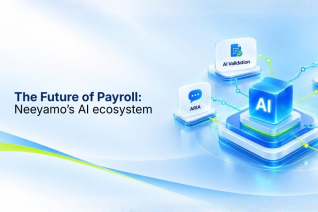
ARIA, Neeyamo’s Adaptive Real-time Intelligent Assistant, is designed to make payroll interactions more intuitive for employees, managers, and payroll professionals. Through conversational, guided, and voice-based interactions, ARIA helps users access payroll information and engage with payroll processes without relying solely on traditional navigation within the application.
Compass addresses another critical area of global payroll: regulatory change. Compass monitors regulatory developments, interprets their potential payroll implications, assesses affected areas, and supports the controlled implementation and validation of resulting changes.
Together, capabilities such as ARIA and Compass demonstrate how AI can support different dimensions of global payroll. The broader objective is to reduce the distance between information and action while keeping appropriate controls and human expertise within the process. AI can help process large volumes of information and surface relevant signals, while payroll professionals remain responsible for interpretation, validation, approval, and accountability. Neeyamo’s approach therefore positions AI as part of a broader payroll operating model rather than as a standalone automation layer.
Bringing Global Payroll Together
Global payroll is ultimately about more than processing pay across multiple countries. It is about coordinating data, local requirements, compliance, technology, people, and governance across an increasingly distributed workforce.
A strong global payroll model creates consistency where it makes sense while preserving the local expertise and country-specific requirements that cannot be standardized. As technology evolves, capabilities such as AI can further strengthen this model by helping teams interact with payroll more naturally, respond to regulatory change faster, and make better use of the information generated across payroll operations.
For organizations expanding across borders, the objective is therefore not simply to process payroll in more countries. It is to build a payroll operation that can scale with the business while maintaining accuracy, compliance, visibility, and control.
Whether you are expanding into new markets, managing multiple payroll providers, or trying to bring greater visibility to an existing global payroll setup, reach out to us at irene.jones@neeyamo.com to talk through your global payroll strategy.