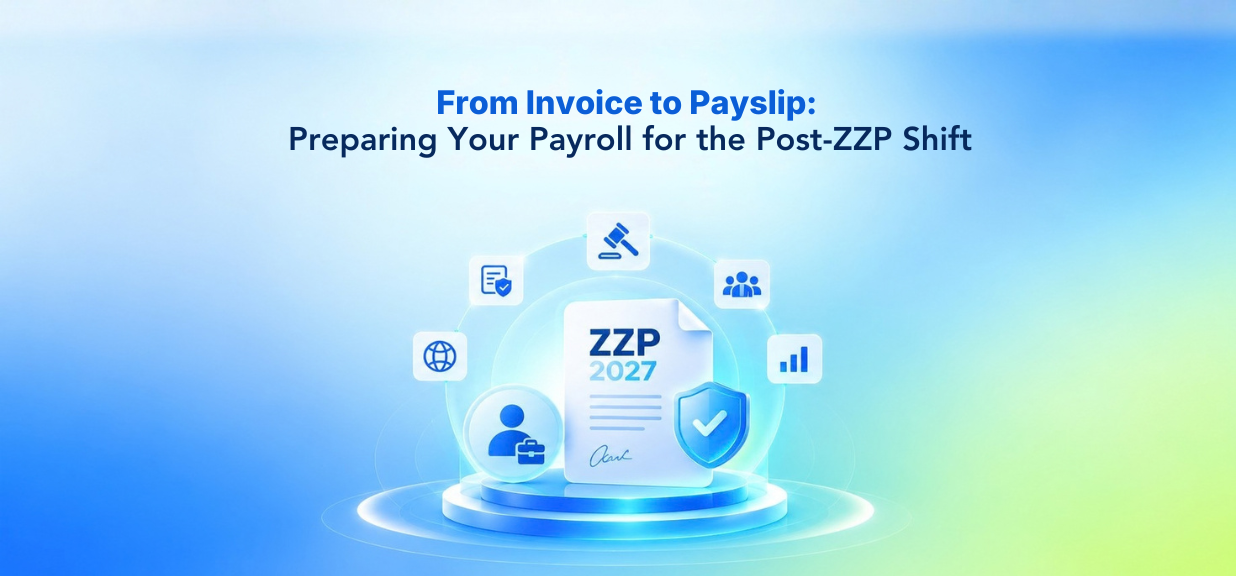
The zelfstandigenaftrek, the tax deduction that has long rewarded self-employed professionals in the Netherlands, stood at €7,030 in 2020. In 2026 it is €1,200. From 1 January 2027 it falls one last time, to €900, and current law expects it to stay there. The final step is worth about €300 in deductible profit, a small amount next to the attention it's about to get.
The euros aren't the story. The direction is. The tax advantage of working as a ZZP'er, the Dutch term for a self-employed professional with no staff of their own, is shrinking at the same time as legal scrutiny of independent work is growing and the rules around it are being rewritten. Each shift is manageable on its own. Together they change what it costs and how easy it is to defend and to build a team out of freelancers. Companies that use ZZP'ers, and the advisors who serve them, should be deciding this deliberately, not by habit.
* ZZP'er is a Dutch term for a self-employed person without staff.
What Is Settled, and What Isn’t
It helps to separate what is already law from what is still being debated, because the two get mixed up easily.
The phase-out of the deduction is settled. It has fallen every year since 2021, from €6,670 that year to €6,310 in 2022, €5,030 in 2023, €3,750 in 2024 and €2,470 in 2025, before the sharp cut to €1,200 in 2026. The move to €900 in 2027 is already written into existing legislation. It is the last scheduled step, not a fresh proposal waiting on a vote. The conditions for claiming the deduction are unchanged: the 1,225-hour urencriterium still applies, and the separate 12.7% mkb-winstvrijstelling is untouched.
What is not settled is the wider framework around it. The Belastingplan 2027 only becomes final once both chambers of parliament have voted, usually in December. The legislation meant to define who counts as genuinely self-employed has already changed shape once: the earlier VBAR proposal has largely been set aside, and the coalition is now working towards a separate Zelfstandigenwet, unlikely to arrive before 2027. Both remain proposals pending final parliamentary approval.
The Math: Why the Money Barely Moves
For an established ZZP'er with a healthy profit, the drop from €1,200 to €900 means somewhat more tax owed, since the deduction reduces taxable profit rather than the tax bill directly. Only a share of that €300 difference is ever actually felt, and the exact amount depends on individual income.
There's also a timing detail that trips people up every year. The €1,200 belongs to the 2026 tax year, so it's claimed in the return filed in 2027. The €900 belongs to the 2027 tax year, and shows up a year after that. It's a small thing, but it's exactly the kind of question accountants get asked more than once a season, and having a clear answer ready is worth something.
None of this is a shock to anyone's business. A ZZP'er will feel it about as much as a modest rise in an insurance premium. If it were only about the deduction, this wouldn't be worth writing about.
Five Shifts Pointing the Same Way
What makes 2027 interesting isn't the number. It's what's happening around it.
The shrinking deduction is one part of a bigger pattern. Alongside it sits the long-running discussion about making disability insurance compulsory for the self-employed, an idea that would turn a personal risk decision into a fixed cost. There's the return of active enforcement against false self-employment: since 1 January 2025, the Belastingdienst has been checking arrangements again after years of a moratorium, and back-payment assessments for wage tax can reach as far back as that date. There's the proposed rebuttable presumption of employment for anyone charging €36 an hour or less, an idea carried over from the earlier VBAR proposal into the coalition's current thinking. And there's the shift in the legislative vehicle itself, from VBAR to a Zelfstandigenwet, which stretches out the uncertainty even as the direction of travel stays the same.
Taken individually, none of these changes much. Taken together, they say something clear: being a ZZP'er in the Netherlands is becoming less fiscally rewarding, more closely examined, and more exposed to costs that used to be optional. Independence isn't cheap by default anymore. Increasingly, it has to be earned and demonstrated.
The Question Clients Are Starting to Ask Differently
For years, the question a company asked when filling a role was simple: what's the cheapest way to get this done? A ZZP'er was flexible, came with none of the obligations of employment, and often looked less expensive on paper. That question is quietly turning into a different one: what's the defensible way to get this done? The risk that actually matters here was never the freelancer's own tax position. It's whether the working relationship is genuinely independent in the first place.
The arrangements most exposed to that question are easy to spot: a freelancer working full days for a single client over a long stretch, following that client's schedule, using its systems, and reporting into its management structure. The invoice says freelancer. The working pattern says something else. It's exactly this kind of relationship that an inspector, or a court, would look at first, and the company is the one holding most of the risk if it doesn't hold up.
For arrangements like this, there are really only three honest paths. Keep it as genuine self-employment, which means the contract and the actual way of working both need to reflect real independence. End it. Or bring the person on as an employee. None of these is a crisis to manage. They're decisions, and the one outcome to avoid is leaving the question unanswered until an inspector answers it for you.
Where Payroll Comes In
This is where the topic becomes more than a tax story. The deduction itself never touches a payslip. But the shift around it does, because some engagements currently structured as freelance work are going to move into employment, and that's a payroll event, not just a contract change.
Bringing someone across properly means correct wage tax withholding from day one, the right social premiums, pension enrollment, holiday allowance, the applicable collective agreement, and processing that's accurate from the first payslip. A company converting several people in the same quarter can easily find its own payroll capacity or expertise stretched thinner than expected. The errors that happen under that kind of pressure, a wrong wage tax table, a missed pension enrolment, an incorrect holiday allowance, tend to take months to unwind and cost far more than the decision that caused them.
For employers reviewing ZZP’er engagements, this is where payroll readiness becomes critical. If a freelance relationship moves into employment, the change needs to be reflected correctly across onboarding, wage tax withholding, social premiums, pension enrolment, holiday allowance, collective agreement requirements, and the first payroll run. Neeyamo Payroll helps organizations manage country-specific payroll requirements with the visibility, compliance support, and operational control needed when workforce models change.
That's a real opening for the advisors sitting closest to these clients: accountancy firms, HR advisors and payroll bureaus. Their clients are going to need help on three fronts: looking honestly at how an engagement actually works day to day, deciding what to do about it, and then setting up the payroll side properly if the answer is employment.
A Review Before Year-End, Not a Scramble in January
The practical starting point is the small number of relationships that look most like employment: one client, long duration, fixed hours, and work carried out under direction. Look at how the work actually happens rather than what the contract says, because that's how the Belastingdienst and the courts look at it too. Then decide, case by case, whether to keep, adjust, or convert.
If the answer is conversion, the payroll set-up deserves the same care as the decision itself, including who will actually run it and whether the timeline before 1 January is realistic. The quiet weeks of Q4 are a far better time for this than the scramble that always shows up in January, and a short review now costs far less than a correction after an inspection.
Conclusion
The drop to €900 isn't a big deal by itself. It's a small tax change that most ZZP'ers will barely notice. But it's happening alongside bigger things: tighter checks on freelance arrangements, talk of mandatory insurance for the self-employed, and new rules still being worked out. Put together, these changes mean working with ZZP'ers is about to look different, and that affects payroll too.
If you're an accountant, HR advisor or payroll bureau, now's a good time to get ahead of this. The same clients asking about the €900 deduction today will likely be asking how to move a freelancer onto payroll a few months from now. Looking at your riskiest ZZP arrangements before year-end, rather than in the January rush, means you'll already have answers ready. Write to us at irene.jones@neeyamo.com to learn more or visit us here.