The 80-20 Challenge in Global Payroll
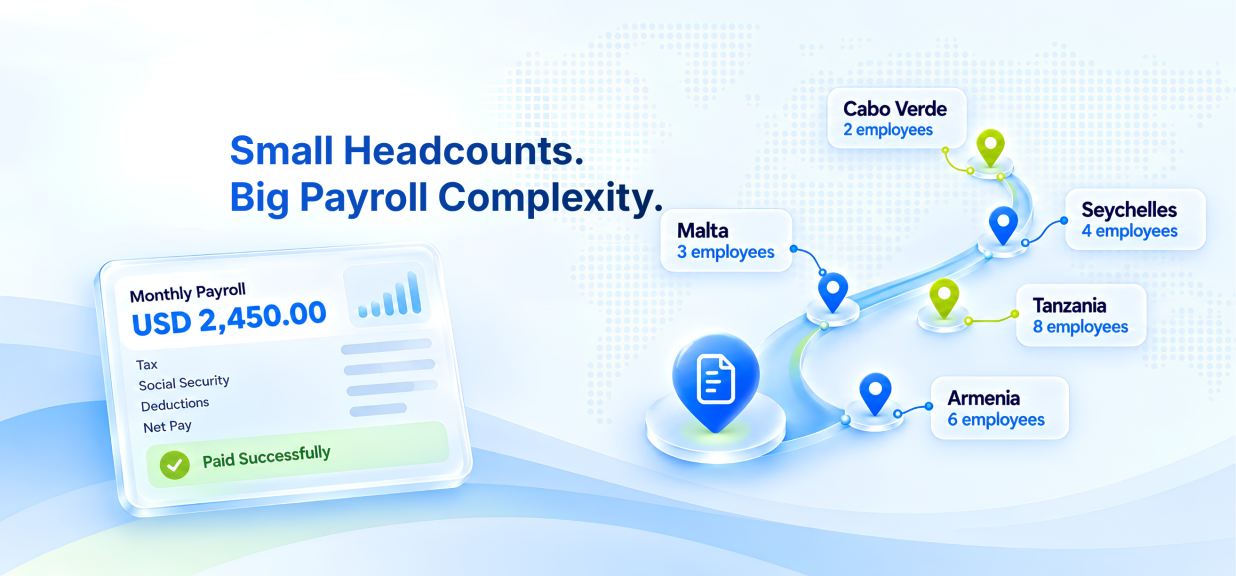
Imagine a company operating across 40 countries. While ten countries may have the highest employee headcount, the remaining, oftentimes a majority, have employees as few as ten, five, and even one.
This pattern is becoming more relevant as organizations look beyond traditional talent hubs. According to the World Economic Forum's Future of Jobs Report 2025, 47% of employers identify tapping into diverse talent pools as a promising strategy to increase talent availability, while 27% identify enabling remote work across national borders.
The employee headcount may be small, but the payroll responsibility remains. Tax and statutory requirements still apply. Payroll data needs to be collected, validated, and processed, even if the headcount is a single digit. This is the 80-20 challenge in global payroll: a large share of employees may be concentrated in a smaller number of countries, while the remaining workforce is spread across many smaller markets. That remaining group forms the long-tail of global payroll.
But first, what is Long-Tail Payroll?
Long-tail payroll refers to managing payroll in countries where an organization has a relatively small employee population while carrying the full local payroll, tax, statutory, compliance, and employee-service responsibilities. For businesses, this creates access to a much larger talent pool. For payroll teams, however, it creates another layer of operational complexity.
Why Long-Tail Payroll Is Becoming More Important
The long-tail has always existed in global payroll. What is changing is its scale.
The workforce itself is becoming more location-flexible. The World Economic Forum estimates that the number of global digital jobs that can be performed remotely from anywhere could increase by around 25% to 92 million by 2030. And the shift is already visible in hiring data.
For businesses, this opens access to talent in markets that may previously have been outside their hiring footprint. For payroll teams, however, every additional country brings a new set of operational responsibilities.
A software engineer in Taiwan, a marketing specialist in Cabo Verde, or a sales representative in Naples may represent only one or two employees in each location. But their payroll still needs to account for local tax rules, statutory requirements, reporting obligations, currencies, payment timelines, and compliance expectations.
That's where the long-tail begins to grow.
As organizations spread smaller employee populations across more countries, payroll models can become increasingly fragmented. Individually, each arrangement may appear manageable. Collectively, they can create a disproportionately complex payroll environment. The challenge, therefore, is not simply that organizations are hiring in more countries. It is that the geographic reach of the workforce can expand much faster than the payroll operating model designed to support it.
Also Read | Long-Tail HRIS: Streamlining HR for the Geographically Dispersed Workforce
The Traditional Payroll Model Wasn't Built for the Long-Tail Payroll
Traditional payroll models tend to work most efficiently where there is scale. When an organization has hundreds or thousands of employees in a country, dedicated payroll resources, established processes, and country-specific technology can be easier to justify.
The challenge looks very different when the workforce consists of, for example, just five employees.
Imagine an organization entering a new market with five employees. The payroll volume is small, but the operational requirements are not. Now consider what happens behind those five payslips.
A local payroll provider may need to be onboarded. Data may have to move manually from the organization's HR system into a provider-specific template. Payroll outputs may return in a different format and require another round of validation. Finance may need a separate process for funding and reconciliation. Compliance updates may sit with the local provider, while overall accountability remains with the organization.
For five employees, payroll can quickly involve multiple systems, manual handoffs, local vendors, approval steps, and country-specific processes. Nothing has necessarily failed. The model has simply become disproportionately complex for the number of employees it supports.
Multiply that scenario across ten, twenty, or thirty low-headcount countries, and the problem becomes clearer. Payroll teams are no longer managing a handful of employees. They are managing a growing collection of country-specific processes, providers, dependencies, and compliance responsibilities.
This is where the long-tail creates its real operational burden. Employee numbers may be small, but the infrastructure required to pay them correctly rarely shrinks at the same rate.
Neeyamo’s Framework for Long-Tail Payroll
Neeyamo’s long-tail payroll approach is built around bringing low-headcount countries into one broader global payroll operating model. Instead of treating each small country as a separate exception, the model combines global payroll technology, local payroll expertise, standardized workflows, compliance support, and centralized visibility.
The framework can be understood through five practical principles:
1. Greater visibility
Bring payroll information into a more centralized view across countries so leaders can see where employees are, how payroll is being managed, and where operational risk sits.
2. Consistent processes
Standardize data, workflows, controls, and governance wherever possible, while allowing for country-specific requirements.
3. Technology-enabled operations
Reduce dependence on spreadsheets, manual handoffs, and disconnected tools through technology that supports repeatable payroll operations.
4. Local expertise and compliance
Pair global consistency with country-specific payroll and compliance knowledge so local requirements are not lost inside a global model.
5. Scalability
Build an operating model that can absorb new countries and small employee populations without creating a new payroll challenge every time the workforce expands.
What Global Payroll Leaders Can Do
The first step is to stop looking at the long-tail purely through employee numbers. Instead, look at the operational effort behind each country.
Ask the following questions:
- How many payroll providers are involved?
- How many systems are being used?
- How much manual work is required?
- Where does compliance responsibility sit?
- How easily can payroll data be accessed?
- What happens if the person managing a country's payroll leaves?
These questions can reveal where the real long-tail burden exists. From here, the focus should be on three priorities:
- Map the long-tail: Identify the countries with smaller employee populations and understand how payroll is currently managed in each one. This includes reviewing current providers, payroll systems, manual dependencies, data flows, and compliance ownership.
- Reduce fragmentation: Look for areas where multiple vendors, spreadsheets, disconnected processes, or repeated manual handoffs are creating unnecessary complexity. The goal is not to remove every local variation, but to reduce avoidable operational friction.
- Build for expansion: Create a payroll model that can support new countries without creating a new operating challenge each time the workforce expands. As organizations continue to hire across borders, long-tail payroll should be designed for scalability, not managed as a series of one-off exceptions.
The long-tail payroll may represent a smaller share of the workforce, but it can create a disproportionate share of payroll complexity. As global hiring becomes more distributed, payroll leaders need operating models that do not only work for the largest markets, but also make smaller countries easier to manage with consistency, visibility, and control.
Download our guide to explore the operational challenges of long-tail payroll and the principles organizations can use to move from fragmented country-by-country management toward a more scalable model. Reach out to irene.jones@neeyamo.com for any queries.