How Neeyamo’s Pay Transparency Application Supports EU Pay Transparency Readiness
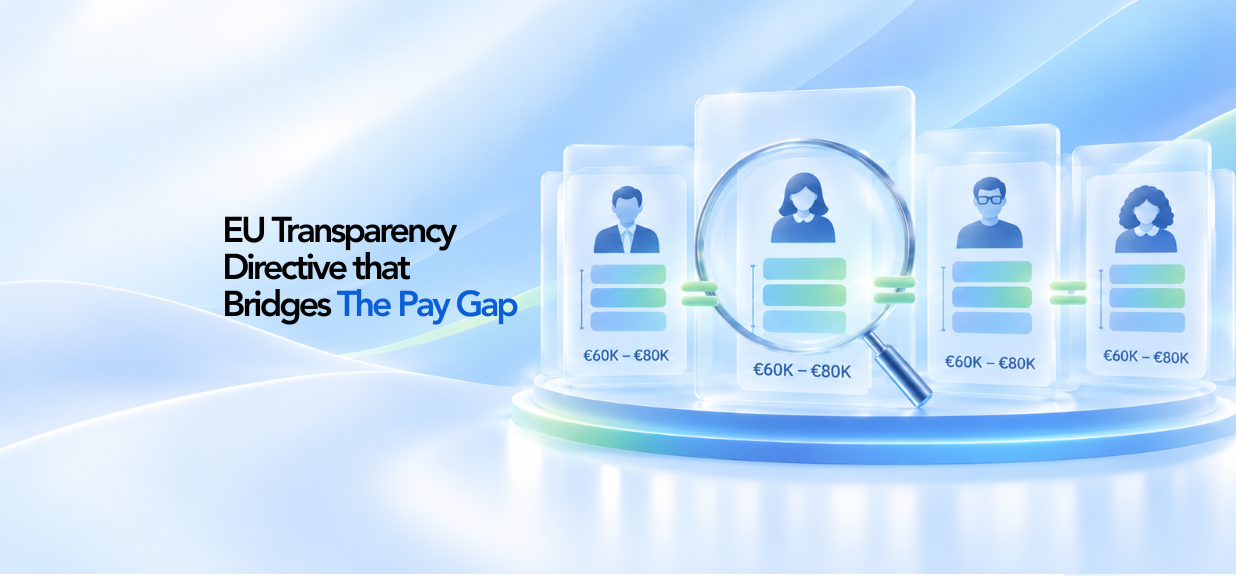
The gender pay gap stood at 10% in 2024, meaning that women earn 10% less, on average, per hour than men. Equal pay for equal work or work of equal value has long been a core EU principle under Article 157 of the Treaty on the Functioning of the European Union.
The Directive has far-reaching implications for HR, payroll, and employment law. Organizations that deal with fragmented data and the pertinent challenges require contextual reasons for compensation structures. The Directive gives employees the right to request information about their own pay level and average pay levels, broken down by sex, for categories of workers performing the same work or work of equal value. It also requires employers to report certain gender pay gap information where an unexplained pay gap of at least 5% is identified and take further corrective action.
The issue is no longer simply whether an organization has the data. The real question is whether that data is connected, contextualized, and governed well enough to make pay information meaningful.
Employers in the EU need to understand how pay is structured, identify meaningful comparisons between employees performing equal work or work of equal value, respond to employee information requests, and establish whether differences in pay can be explained by objective, gender-neutral factors.
The Infrastructure Challenge
Payroll systems already hold a significant amount of compensation information. Workforce systems hold employee, job, grade, department, location, and organizational data. But these data points often sit across different systems, structures, and teams. That becomes a challenge when an organization needs to move from a broad pay-gap number to a more meaningful question:
“Are employees performing the same work or work of equal value being compensated consistently?”
A company-wide average cannot always answer that. Comparing the average pay of all male employees with all female employees across an organization may indicate a difference, but it does not necessarily explain whether employees performing comparable work are being paid consistently. A workforce with more senior male employees, for example, could naturally produce a higher overall male pay average. Meaningful pay analysis requires context.
Organizations need to establish who should reasonably be compared, understand how compensation is distributed within that population, and give employees and internal teams the appropriate level of visibility without exposing individual compensation unnecessarily. Therefore, pay transparency readiness needs an infrastructure, not another reporting exercise.
Also Read | The EU Pay Transparency Deadline Has Passed. What happens next for payroll?
What does a Pay Transparency Ready Foundation Look Like?
A strong foundation brings together three capabilities.
1. Workforce and Payroll Data
The foundation is the underlying employee, payroll, compensation, and organizational data. Payroll systems already hold much of the information required for pay analysis, and the challenge is bringing these data points together in a way that supports consistent comparison.
A pay figure on its own provides limited context. Therefore, to determine whether two employees are meaningfully comparable, the system may need to consider attributes such as department, job family, grade, role, location, or other organizational dimensions. This makes data structure just as important as data availability.
2. Pay Analytics & Contextualized Insights
Once the comparison population has been established, the underlying compensation data can be transformed into analytical measures. Different metrics reveal different aspects of pay.
Average pay provides a view of the overall compensation level within a comparison population.
Median pay can provide additional context by reducing the influence of employees at the highest and lowest ends of the compensation range.
Gender pay-gap indicators can highlight differences between relevant male and female populations.
Salary distribution provides another layer of analysis by showing how compensation is distributed across the comparison group.
Together, these measures move the analysis beyond a single percentage.
3. Role-based visibility
Transparency does not mean making every employee's salary visible. Different audiences require different levels of access.
An employee may need visibility into their own compensation and relevant aggregated comparisons. HR may need a broader organizational view. Payroll and administrators may require deeper access to the underlying data and comparison criteria. The infrastructure supporting pay transparency therefore needs to provide useful visibility while maintaining appropriate privacy and access controls.
A distribution view could indicate whether the employee sits around the median, within a particular quartile, or toward the upper or lower end of the range. This can also make potential outliers visible. Importantly, the employee does not need to know what a specific colleague earns to understand their own position. The underlying individual records remain protected while aggregated information provides sufficient context to interpret the result.
This creates a different model of transparency: visibility into pay position, without visibility into individual pay.
How Neeyamo Pay Transparency Supports EU Pay Transparency Readiness
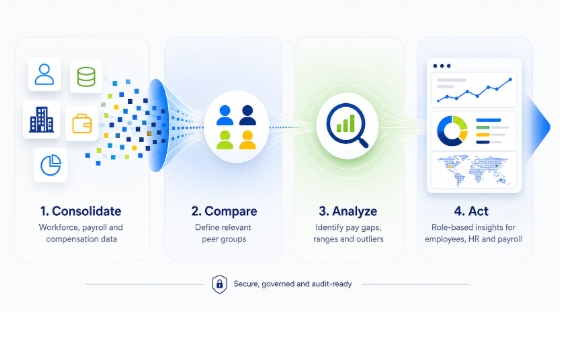
Establishing pay equity is ultimately a data and governance concern. Neeyamo Payroll helps organizations bring workforce context and payroll data together to support a more structured approach to pay transparency.
Rather than treating transparency as a separate reporting activity, the application creates a connected foundation for comparison, analysis, employee visibility, and investigation.
1. The Employee Experience
When an employee requests their pay-transparency information, the application uses relevant attributes such as department, location, grade, and job family to identify the appropriate population of employees performing the same work or work of equal value.
This contextual approach helps avoid misleading comparisons based solely on organization-wide averages. By applying defined comparison criteria, such as grade and job family, the application can narrow the analysis to a more relevant employee population. The resulting view provides employees with meaningful context around their own compensation while maintaining appropriate aggregation and privacy controls around the pay information of others.
2. Payroll Data into Insights
When these capabilities are connected to payroll and workforce systems, transparency does not have to exist as a separate reporting layer. It can become part of the broader employee and payroll experience.
Employee Self-Service: Personal pay position and relevant aggregated comparisons.
Organizational View: Broader compensation patterns for HR and people teams.
The interface may change by audience. The underlying principle does not. That is the technology foundation required to make pay transparency practical at scale.
3. From Aggregated Pay Data to DistributionAnalysis
Averages tell only part of the story. Two employees may sit within a group with a similar average salary while occupying very different positions within the overall pay distribution.
Using employee attributes including grade, department, gender, and payroll data—the application derives aggregate measures such as average pay, median pay, and quartile distribution. These measures provide additional context around where an employee's compensation sits within the relevant comparison population.
The distribution view can show whether an employee's pay falls within the first, second, third, or fourth quartile of the relevant pay range. This allows employees and HR teams to look beyond a single average and understand the broader distribution of compensation within a defined employee group.
By moving beyond a single pay-gap percentage and contextualizing compensation against the distribution of pay within the relevant comparison population, the application makes the underlying data easier to interpret and investigate.
4. Identifying Potentially Unusual Pay Positions
A distribution-based view can also help bring potentially unusual pay positions to attention. Where an employee's compensation sits materially outside the typical distribution for their relevant comparison group, the difference can be surfaced for further review.
Importantly, a position outside the expected range does not, by itself, indicate an error or discriminatory pay practice. Compensation differences may be influenced by legitimate, objective, and gender-neutral factors.
The purpose of the analysis is, therefore, not to automatically classify a pay difference but to provide HR and payroll teams with the context needed to determine which differences warrant further investigation.
5. Support HR and Payroll Investigation
For HR, payroll, and administrative teams, the value extends beyond employee visibility. The same underlying data can provide a broader view of compensation patterns across the organization.
Teams can move from identifying a pay difference to understanding the context around it.A potentially unusual pay position can be surfaced for further investigation, helping teams determine where additional review or documentation may be required. Importantly, an unusual position within a pay distribution does not automatically indicate discrimination, an error, or an inappropriate pay practice.
Compensation differences may be influenced by legitimate and objective factors.The role of the technology is to make the relevant patterns visible and give HR and payroll teams the context required to investigate them appropriately.
What Employers Should Prepare for Now
Pay transparency readiness starts with understanding the data and processes already in place. Organizations should consider three areas.
- Review the data available
- Identify the workforce, organizational, and payroll attributes currently available for pay comparison.
- Define meaningful comparison criteria
- Establish how relevant employee populations will be identified for the same work or work of equal value.
- Assess data gaps
The EU Pay Transparency Directive represents more than another reporting obligation. It is changing how organizations need to structure, understand, and communicate pay information.
For payroll teams, that means moving beyond simply processing compensation accurately. Payroll data must increasingly support the context employees, HR teams, and organizations need to understand how compensation is structured. That requires connected data, meaningful comparison groups, contextual analysis, and appropriate governance.
When these capabilities are built into the payroll experience, pay transparency becomes easier to understand, investigate, and manage at scale.
Pay Transparency Is Becoming a Payroll Experience
The evolution of pay transparency is bigger than a new reporting requirement. It changes how employees interact with compensation information and how organizations think about the data sitting behind their payroll processes.
As the EU moves further into implementation of its pay-transparency framework, organizations will need to think about more than producing the right report at the right time. They will need to consider how pay information is structured, interpreted, and communicated across the workforce. The next generation of payroll technology will increasingly need to support that shift.
Ready to make pay transparency more actionable? Explore how Neeyamo can help bring greater visibility and context to your global payroll. Drop your queries at irene.jones@neeyamo.com

Frequently Asked Questions
The Directive requires employers to provide greater visibility into pay, including information on employees’ own pay levels and average pay levels for workers performing the same work or work of equal value. It also introduces gender pay-gap reporting requirements and may require further action where unexplained gaps are identified.
Pay data alone does not provide enough context. Employers need to connect payroll information with attributes such as job family, grade, role, department, and location to identify meaningful comparison groups and understand whether pay differences can be objectively explained.
No. Pay transparency does not require individual salaries to be exposed. Employees can instead receive relevant aggregated information, such as their position within a pay range or comparison group, while individual compensation data remains protected through appropriate access and privacy controls.
Neeyamo Payroll brings workforce context and payroll data together to support comparison, analysis, employee visibility, and investigation. It can use attributes such as department, location, grade, and job family to establish more relevant comparison populations and provide contextual pay insights.
No. A pay position outside the typical range does not automatically indicate discrimination or an error. Differences may result from legitimate, objective, and gender-neutral factors. The purpose of the analysis is to help HR and payroll teams identify which cases may require further review.