An employee moves countries, but their compensation does not move on a single timeline. Salary continues through the home-country payroll, a bonus arrives for work completed before the assignment, and an equity award vests after service across multiple locations. By the time these details reach the host-country payroll, the reporting deadline may be approaching. The payroll team must then establish which amounts need to be included, how each should be treated, and which teams hold the records needed to make those decisions.
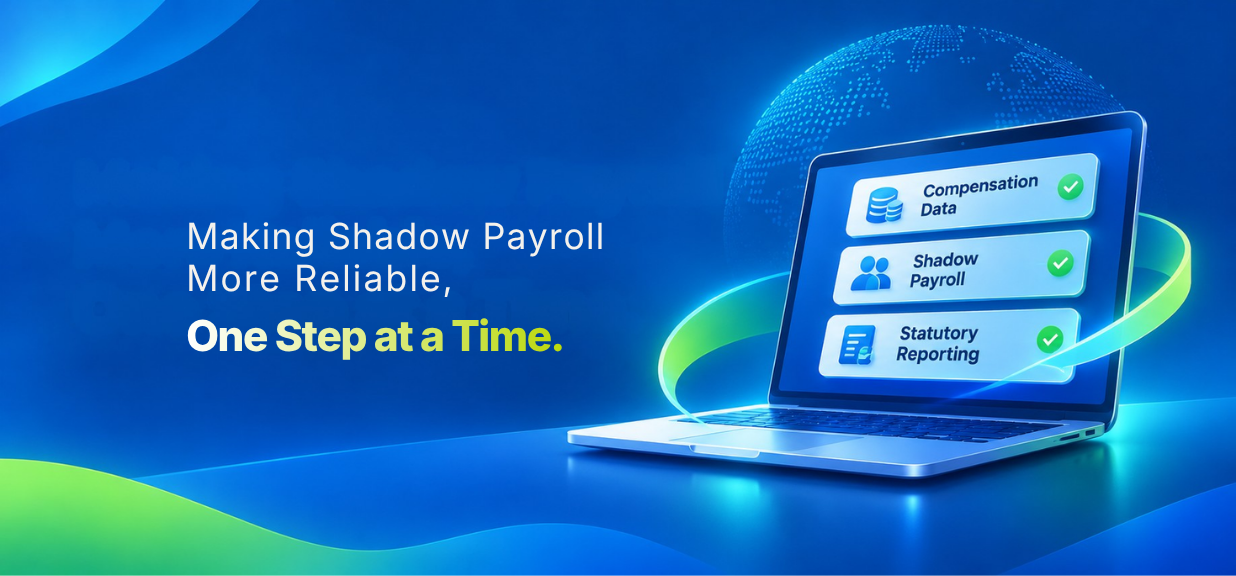
This is where shadow payroll becomes more than a calculation exercise. It helps employers meet local reporting, withholding, and remittance obligations, where applicable, on compensation paid through another country’s payroll, generally without making a second net salary payment. Reliability depends on connecting compensation data, income sourcing, local rules, reporting, and reconciliation into a controlled process.
Start with the Complete Compensation Picture
The home-country payslip may contain only part of the information needed for host-country reporting. Housing benefits, bonuses, equity awards, and work-location records can sit across different systems and providers. Each source may follow a different schedule, making information difficult to assemble before payroll deadlines.
The 2025 KPMG Global Mobility Benchmarking Report illustrates the broader challenge: 72% of surveyed organizations indicated that mobility reporting and analytics remained largely spreadsheet-driven. Data stored across different systems was another major hurdle: 55% ranked it among their top three barriers to using mobility analytics.
A compensation inventory should identify inputs, owners, and deadlines. Each transaction should preserve:
- Identity: Consistent employee identifiers and unique transaction references.
- Value: Original amount, currency, and compensation category.
- Timing: Payment date, relevant service period, and taxable-event date, where applicable.
- History: Source, receipt date, mapping changes, and approval status.
Establish Where Income Belongs
The country from which compensation is paid does not, by itself, determine where it is taxable. Bonuses and equity awards may relate to services performed across several countries. Payroll teams need to understand what the compensation relates to, alongside the employee’s residence, domestic legislation, applicable treaties, and employer obligations.
For some equity awards, sourcing involves allocating income according to the days worked in each country during a relevant service period, such as grant-to-vest. Neither the period nor the allocation method is universal. Supporting records should identify the award type, relevant dates, work locations, allocation method, and rationale for the treatment applied.
Reporting requirements need separate consideration from final tax liability. An amount may require reporting even where an exemption or relief subsequently applies. Treating reportability, taxability, and withholding as separate decisions helps teams address relevant local requirements.
Shadow Payroll: Documented Decisions
Each compensation element requires an assessment of local treatment. Housing, relocation benefits, bonuses, and equity awards can receive different treatment depending on the jurisdiction and employee circumstances. The review should address:
- Income tax: Applicable treatment, exemptions, reliefs, and required notifications or approvals.
- Social security: Coverage, contribution obligations, and relevant coordination agreements.
- Reporting: Required values, deadlines, and supporting documentation.
- Assignment policy: Employer-funded taxes and tax-equalization arrangements, where applicable.
Income tax and social security require separate assessments. Applicable coordination or totalization agreements can eliminate dual social security contributions for covered employment, subject to their conditions. Documentation, such as a certificate of coverage, may be necessary to establish an exemption. Rule versions, effective dates, testing, and approvals help explain historical calculations.
Make Calculations and Currency Conversion Traceable
Tax-equalized assignments and net-of-tax arrangements may require gross-up calculations. Where employer-paid tax is itself taxable, calculations must account for that additional liability under local rules. Teams should document their assumptions and establish how liabilities will be funded and remitted without duplicating net salary payments.
Compensation may be paid in one currency and reported in another, while accounting records follow a different policy. Retaining original values, converted amounts, rate sources, methods, and applicable dates helps explain differences. The conversion should follow the rate and method required or accepted for the relevant reporting purpose. A single exchange-rate approach should not be assumed across all countries, compensation types, or reporting periods.
Reconcile Through to Filing and Payment
A completed calculation does not establish that a submission was accepted or a liability paid. Deadlines and correction procedures vary by jurisdiction and arrangement. Late information may require an amended submission, subsequent adjustment, or another prescribed correction.
Regular reconciliation should connect:
- Source compensation with reported amounts, explaining sourcing, treatment, timing, and currency differences.
- Calculated liabilities with remittances and accounting records.
- Submissions with acceptance acknowledgements and completed corrections.
- Hypothetical tax deductions with settlement records, where tax equalization applies.
Building Confidence in Every Reported Amount
The real test of shadow payroll comes when someone asks how a reported amount was derived. Answering confidently requires a clear trail from the original compensation record through sourcing decisions, local treatment, calculation, and filing. These connections help payroll, mobility, and finance teams resolve discrepancies earlier and manage subsequent reporting cycles with fewer unanswered questions.
This is why shadow payroll needs to sit within the broader global payroll architecture. Connecting systems is part of the task; aligning data ownership, local expertise, and reconciliation makes those connections dependable. Neeyamo’s unified payroll approach brings payroll technology, enterprise integrations, and in-country execution together, supported by global payroll coverage across 160+ countries.
For organizations managing mobile workforces, the goal is to make compensation traceable from its entry into the process through to the fulfillment of reporting and payment obligations. To explore how a connected payroll approach can support your shadow payroll requirements, contact irene.jones@neeyamo.com.