What happens when the information businesses need is already available, but extracting it requires extensive manual effort? From identification records and onboarding documentation to supporting documents, these files contain data that differ in their structure, layout, and field patterns. These inconsistencies make extracting information more complex.
Traditional document processing approaches often rely on manual data entry or predefined extraction rules. However, variations in document structure can make fixed extraction methods difficult to maintain. This is where AI-powered document processing introduces a more adaptable approach.
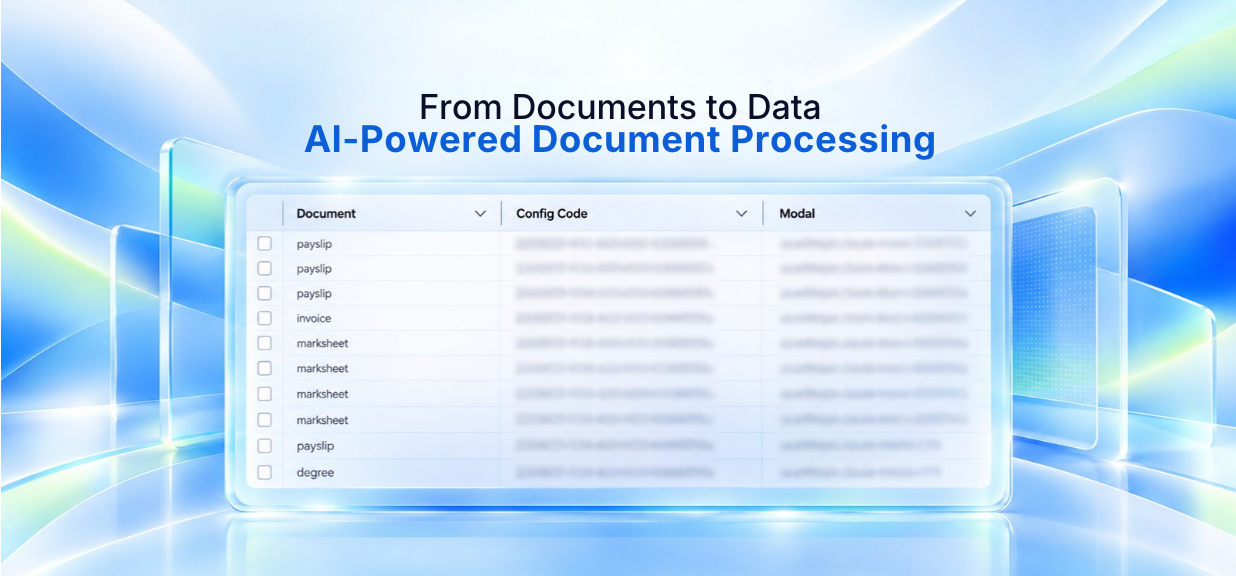
Rather than relying entirely on fixed document templates, AI-based extraction can identify relevant information and organize it into structured outputs. Neeyamo brings this approach into its AI ecosystem through its Document Scanning AI module, using configurable extraction instructions to transform document information into structured, usable data.
Why Traditional Document Processing Is Difficult to Scale
According to Everest’s study on RoI with relation to Intelligent Document Processing, the challenges of traditional document processing are high processing costs, lengthy processing times, manual data entry errors, and limited scalability among the challenges associated with traditional document processing. These challenges become more pronounced across four operational areas.
1. Variations in Document Structures
Documents containing similar information may follow different layouts and formatting conventions. Conventional document processing approaches work best with recognizable, consistent formats, while unfamiliar structures may require human intervention.
2. Dependence on Manual Data Extraction
Employees may need to review documents, identify relevant fields, and manually transfer information into business applications. These repetitive activities increase processing effort and introduce opportunities for transcription errors, especially when document volumes grow.
3. Limitations in Processing Unstructured Information
Traditional extraction methods often depend on predefined rules and predictable document structures. However, business documents frequently contain semi-structured or unstructured information that does not conform to a consistent format.
4. Challenges in Preparing Data for Downstream Systems
IDP emphasizes the growing need for reliable extraction and seamless integration with existing enterprise systems. Together, these limitations highlight the need for AI-powered document processing that goes beyond text recognition to support contextual interpretation, structured extraction, and more consistent handling of document information.
From Unstructured Documents to Actionable Data
Document processing begins with identifying the information contained within a file. Document extraction technologies can distinguish between raw text, key-value pairs, tables, and other structured elements. This helps preserve the relationship between information rather than treating the document as a collection of unrelated text.
Once document content is recognized, AI models can identify specific information based on defined extraction requirements. AI-powered document processing can also use contextual instructions to guide how information is interpreted and extracted. These instructions may define the fields to identify, expected data types, and how particular values should be represented. For example, a date appearing in a local format can be converted into a standardized representation when the system supports the required normalization.
The final stage involves organizing extracted information into a consistent, machine-readable format. Instead of producing an unstructured block of text, document processing systems can associate extracted values with predefined field names, creating structured records that applications can consume. Together, these capabilities allow organizations to move beyond basic text recognition toward more adaptable document extraction, creating a foundation for consistent information capture and downstream processing.
How Neeyamo Simplifies Document Processing with AI
Neeyamo approaches AI-powered document processing through its Document Scanning AI module, configured within AiCore in NeeyamoWorks. The capability focuses on defining how AI models interpret document information, identify specific fields, and generate structured outputs according to business requirements.
The process begins within AiCore, where users can establish the configuration associated with a document scanning use case. The configuration includes parameters such as the application, client, country, and document type.
Within this configuration, extraction instructions guide the model on what information to identify and how the response should be structured. This allows the extraction requirements to be expressed through defined instructions rather than relying entirely on positional rules that reference specific locations within a document.
The AI instructions specify the fields that must be identified within the document, including:
- Identification number
- Individual's name
- Issuing country
- Date of birth
- Document issue date
- Document expiry date
These fields establish the expected information that the AI model should return. The configuration demonstrates how individual data elements can be specified as part of the extraction instructions, allowing the output to focus on the information relevant to the use case.
Beyond identifying fields, the module's configuration includes instructions governing how extracted values should be represented. These rules help define the expected response format and establish a consistent structure for extracted information. For instance, where a particular field is unavailable, the extraction instructions can specify how that absence should be represented rather than leaving the output format undefined.
A central aspect of the capability is the use of JSON (JavaScript Object Notation) as the structured output format. By combining defined fields, formatting instructions, and JSON-based outputs, Neeyamo's Document Scanning AI module provides a configurable framework for transforming document information into structured records that can support subsequent business processes.
What AI-Powered Document Processing Means for Business Operations
For organizations managing employee records, identification documents, and other business documentation, the ability to capture and structure information consistently can improve how document-dependent processes are managed. A configurable approach to document extraction offers several operational advantages.
- Reduced dependence on manual data entry
- Greater consistency in data representation
- Adaptability to varying document formats
- Better preparation for downstream processing
Ultimately, effective document processing is not simply about reading information faster. It is about making information more accessible, consistently structured, and usable across business operations. By bringing configurable AI extraction into the process, organizations can reduce repetitive administrative effort while maintaining appropriate oversight of the information being captured.
Making Document Processing More Intelligent
Traditional approaches built around manual intervention and rigid document structures may struggle to accommodate varying formats and evolving information requirements. AI-powered document processing offers a more adaptable approach by combining document interpretation, configurable extraction instructions, and structured data outputs.
Through its Document Scanning AI capability within AiCore, Neeyamo demonstrates how organizations can define document-specific extraction requirements, configure AI models, and establish consistent output formats to support information processing.
Looking to simplify document information extraction with AI? Explore how Neeyamo's Payroll Product can help your organization move from manual document handling to configurable, structured data extraction. Reach out to irene.jones@neeyamo.com for more information.