Picture a finance team in Istanbul in November 2025. The Turkey workforce plan is done. The team has locked headcount, modelled the salary increase against expected inflation, and carried employer SGK at last year's rate.
Then the January 2026 payroll run lands. Gross pay matches the plan. Employer cost does not.
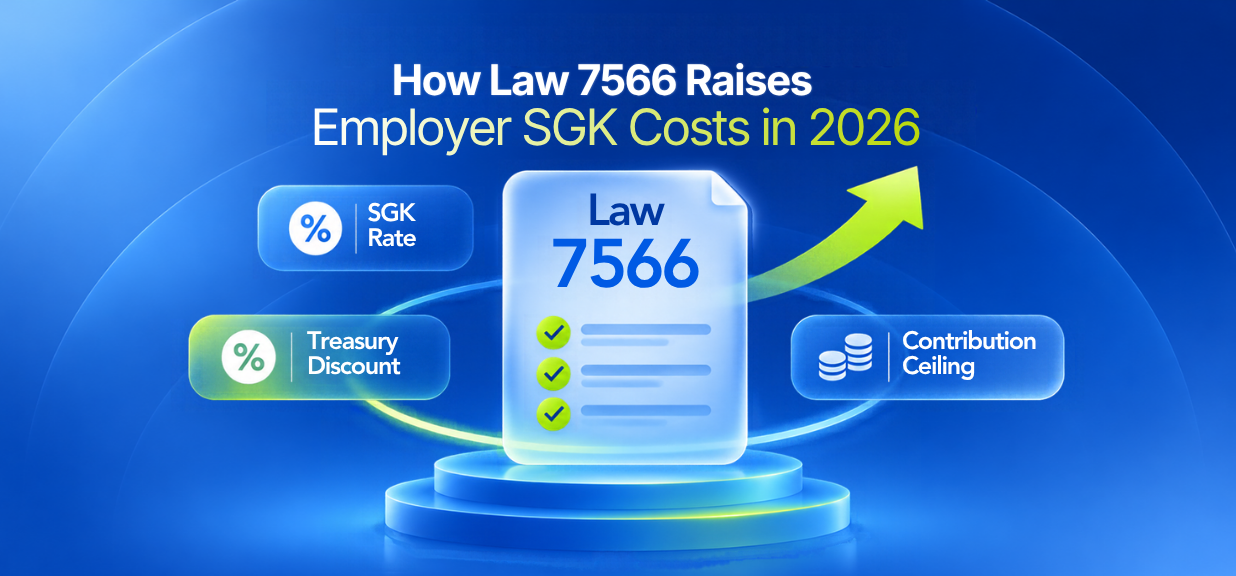
Nobody made a calculation error. The rules moved. Law 7566, published in Turkey's Official Gazette on 19 December 2025, made three changes to social security (SGK) contributions that reset employer cost from the first payroll of 2026.
What Does Law 7566 Change?
Law 7566 is an omnibus tax law, but several of its articles amend Law No. 5510, Turkey's social insurance law. The changes are final. Three of them matter for payroll budgets:
| Change |
2025 |
2026 |
| Employer pension share
MYÖ: disability, old age and death
|
11% |
12%
From January 2026 contribution period
|
| Treasury discount
Non-manufacturing employers
|
4 points |
2 points
From January 2026 contribution period
|
| Treasury discount
Manufacturing (NACE section C)
|
5 points |
5 points
Until 31 December 2026
|
| SGK contribution ceiling |
7.5 x minimum wage
TRY 195,041.40 / month
|
9 x minimum wage
TRY 297,270.00 / month
Effective 1 January 2026
|
KPMG Turkey's summary of the law confirms the rate and discount changes, and SGK Circular 2026/1 (6 January 2026) explains how the discount works. The employee's share does not change.
Why 2026 is different: the law arrived a week before a 27% minimum wage increase, from TRY 26,005.50 to TRY 33,030.00. The SGK floor and ceiling both follow the minimum wage, so the two effects compound.
Why Did Law 7566 Catch Budgets Off Guard?
Payroll asks whether this month is right. Budgeting asks what the year will cost. Law 7566 landed between the two.
- Timing. The law came out on 19 December 2025 and the new minimum wage a week later, after most finance teams had signed off their annual plans.
- Blended rates. Many models carry one "employer on-cost" percentage. A change to the rate, the discount and the ceiling stays hidden inside it until actuals arrive.
- Employee mix. A manufacturing plant sees +1 point, a services entity sees +3 points, and a senior-heavy head office also feels the ceiling. One group-wide assumption cannot fit all three.
- Currency. Many groups budget Turkey in EUR or USD, so exchange rates can hide or exaggerate a lira cost increase.
What Does This Mean for Employers?
The examples below hold salary flat to isolate the legal change. They assume short-term insurance at 2.25% and an employer that meets the discount conditions. 2025 rates are the starting point.
| Monthly, gross TRY 100,000 |
2025 |
2026 |
| Net employer SGK rate |
17.75% |
18.75% |
| Employer SGK cost |
TRY 17,750 |
TRY 18,750 |
| Total employer cost |
TRY 117,750 |
TRY 118,750 |
| Additional cost |
+TRY 1,000
Per month
+TRY 12,000 per year
|
One point looks small. But it applies to every employee, every month, and no salary decision created it.
| Monthly, gross TRY 100,000 |
2025 |
2026 |
| Standard employer rate |
22.75% |
23.75% |
| Treasury discount |
4 points |
2 points |
| Net employer SGK cost |
TRY 18,750 |
TRY 21,750 |
| Total employer cost |
TRY 118,750 |
TRY 121,750 |
| Additional cost |
+TRY 3,000
Per month
+TRY 36,000 per year
|
For a 250-person services team at this salary, that is TRY 9,000,000 a year before any pay rise. The discount also follows the workplace NACE code. SGK sets the rate automatically from that code, a code change applies from the following month, and SGK recovers any discount claimed under a wrong code with late payment penalties and interest.
Senior staff: the ceiling effect
This table compares 2026 under the old 7.5x rule with 2026 under Law 7566, for an employee on TRY 400,000 a month at a non-manufacturing employer. It shows only the effect of the new law.
| Monthly |
2026, old rules |
2026, Law 7566 |
| SGK base (capped) |
TRY 247,725.00 |
TRY 297,270.00 |
| Net employer rate |
18.75% |
21.75% |
| Employer SGK cost |
TRY 46,448.44 |
TRY 64,656.23 |
| Employee SGK deduction (15%) |
TRY 37,158.75 |
TRY 44,590.50 |
| Additional employer cost |
+TRY 18,207.79
Per month
+TRY 218,493.48 per year
|
Of the extra TRY 18,207.79 a month, TRY 10,776.04 comes from the higher ceiling and TRY 7,431.75 from the rate and discount changes. The employee also pays TRY 7,431.75 more SGK a month. Lower income tax offsets part of that, depending on the employee's cumulative tax bracket. Under a net-guaranteed contract, common for expatriates, the employer absorbs the difference, grossed up.
So, What Should Payroll Teams Do Now?
- Confirm the employer MYÖ rate at 12%, and the employee rate unchanged at 9%, from January 2026
- Check the Treasury discount for each workplace: 2 points, or 5 points for NACE section C
- Verify and document the NACE code of every SGK workplace registration
- Update the 2026 floor (TRY 33,030.00) and ceiling (TRY 297,270.00) in the payroll engine
- List employees above TRY 247,725 a month and recalculate their cost and net pay
- Recalculate stacked incentives, such as Law 6111 hiring support, after the 2 or 5 point discount
- Rebuild the 2026 budget with separate lines for rate, discount and ceiling, and explain the variance to date
- Tell affected employees before they notice a lower payslip
- Track whether the 5-point manufacturing discount continues after 2026
Practical Considerations for Multinationals
Turkey is rarely the only country that changed its rules this year, but it is often the one where rules change fastest. A few habits help:
- Keep rates, discounts, ceilings and incentive order as dated parameters, not hard-coded values.
- Give one person ownership of reading the Official Gazette and SGK circulars and deciding, within days, what changes in payroll.
- Test old and new parameters in parallel on a sample of employees before the first live run.
- Record which rule version produced each calculation, so you can show it when SGK or an auditor asks.
- Forecast with the same engine that runs payroll.
At Neeyamo, we run Turkey payroll this way. Statutory parameters sit as dated rules in our global payroll platform, and we validate each change before release, so a law like 7566 reaches payroll and forecasts at the same time.
Law 7566 did not change anyone's salary. It changed what each lira of salary costs. Neeyamo helps global enterprises simplify complex, multi-country payroll through a unified technology approach.
Looking to strengthen your payroll operations in Turkey? Talk to our Turkey payroll expert at irene.jones@neeyamo.com or visit us here.