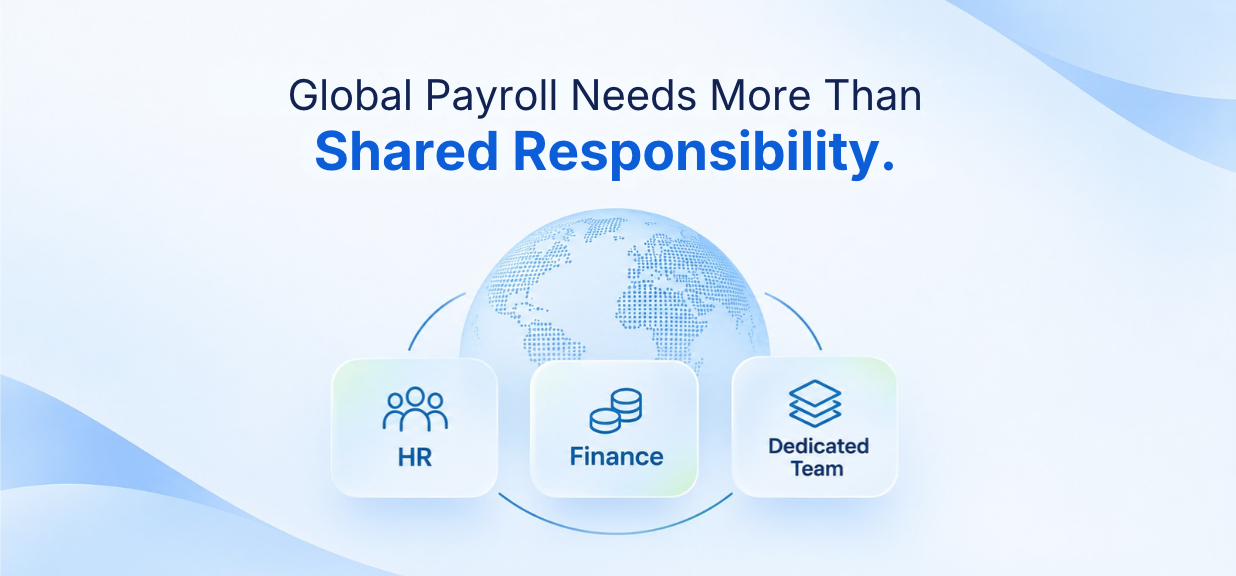
Global payroll in GCC rarely sits within the boundaries of a single department. Employee changes originate in HR, payroll calculations depend on accurate country-level inputs, financial controls fall under Finance, and statutory requirements vary across jurisdictions. When these activities span multiple countries, deciding who owns global payroll becomes more complicated than assigning it to a department.
For Global Capability Centers (GCCs), this creates an important organizational question: should HR oversee payroll because it is closely connected to the employee lifecycle? Should Finance take ownership because payroll directly affects financial accuracy and reporting? Or does the complexity of managing payroll across countries call for a dedicated global payroll team?
Each function has a legitimate role, but the real challenge is ensuring that these responsibilities operate as one coordinated process. Understanding where departmental ownership falls short is the first step towards establishing a more effective global payroll operating model.
Global Payroll in GCC: HR and Finance
HR has a direct connection to the employee lifecycle. Hiring, compensation changes, benefits, leave, terminations, and employee records all influence payroll calculations. Placing payroll under HR can strengthen coordination between employee data and payroll inputs, reducing inconsistencies before processing begins.
However, payroll does not end with calculating employee earnings. Salary disbursements, reconciliations, statutory liabilities, financial reporting, and general ledger integration bring Finance into the picture. Finance provides the controls necessary to ensure payroll costs are accurately recorded, approved, and reflected in organizational financials.
Both functions are indispensable, but their individual responsibilities create a challenge when payroll is managed within only one of them. HR-led payroll may lack sufficient financial oversight, while Finance-led payroll may have limited visibility into upstream employee changes and HR processes.
What Industry Data Reveals About Payroll Ownership
The challenge is reflected in PayrollOrg's 2025 Getting the World Paid survey, which gathered insights from more than 500 global payroll professionals.
The survey found that global payroll has no clear departmental home, with 35% of respondents placing it under HR and 33% reporting to Finance. This close distribution highlights how organizations continue to approach payroll ownership differently. However, the findings also reveal a gap in operational oversight: 38% of organizations do not measure global payroll performance against defined objectives, while only 25% use dashboards to track payroll metrics.
This suggests that the challenge extends beyond deciding which department should lead payroll. Without defined ownership, measurable performance indicators, and consistent visibility into operations, organizations risk managing payroll as a collection of disconnected activities rather than as a unified global function.
Why a Dedicated Global Payroll Team Makes More Sense
For managing global payroll across multiple countries, a dedicated global payroll team offers a more scalable operating structure.
Rather than assigning complete ownership to HR or Finance, this team becomes responsible for coordinating the end-to-end payroll process. Its responsibilities include managing payroll calendars, standardizing processes, monitoring country-level compliance, coordinating providers, validating data, and maintaining reporting consistency.
HR continues to own employee-related information and processes, while Finance oversees financial controls, accounting, and reconciliation. The dedicated payroll team connects these responsibilities and ensures that activities across both functions work together. This structure also creates a clear point of accountability for payroll performance, rather than distributing responsibility across departments without a central coordinating function.
Bringing It Together Through the GpCC Framework
A dedicated team, however, needs more than an organizational reporting line. It requires an operating framework that connects governance, technology, and execution across geographies.
This is where the Global Payroll Capability Center (GpCC) framework becomes relevant. It provides a structured approach to bringing global payroll operations under a unified capability, built around three interconnected layers:
- Orchestration: Connects HR, Finance, local payroll teams, and external providers through standardized workflows, coordinated responsibilities, and consistent processes.
- Governance: Establishes global payroll policies, ownership structures, compliance oversight, controls, and performance accountability across countries.
- Intelligence: Uses integrated data, analytics, and technology to improve payroll visibility, identify deviations, monitor performance, and support informed decisions.
Together, these layers move payroll beyond departmental ownership towards an integrated enterprise capability. The relevance of this approach becomes clearer as GCCs assume greater responsibility. EY's 2025 GCC Pulse Survey found that 87% of GCCs are taking ownership of end-to-end global processes, reflecting their growing role in enterprise-wide operations.
The Way Forward: Ownership Beyond Departmental Boundaries
Global payroll should not be viewed as an extension of HR or Finance alone. It needs dedicated operational ownership with both functions contributing their expertise and retaining accountability for their respective responsibilities.
For GCCs, establishing this structure is an opportunity to standardize global payroll operations, strengthen governance, and create greater visibility across countries. With the right operating model, payroll can evolve from a function managed across departmental boundaries into a coordinated global capability.
As GCCs continue to expand their global responsibilities, establishing the right payroll operating model will be essential to achieving greater consistency, control, and visibility. To understand how the Global Payroll Capability Center (GpCC) framework can support this transition, reach out to irene.jones@neeyamo.com for more information and to explore the possibilities for your organization.