India's Global Capability Centers (GCCs) are moving beyond traditional service delivery to take on greater responsibility for global business operations, technology, finance, analytics, and enterprise transformation. The next opportunity may lie in a function that remains fragmented across many multinational organizations: global payroll.
According to the NASSCOM–Zinnov GCC Value Orbit: From Delivery Engine to Enterprise Nerve Centre report, India had 2,117 GCCs across 3,728 units as of FY2026, employing approximately 2.36 million professionals and generating $98.4 billion in market revenue. The number of GCCs has grown 32% since FY2021.
These numbers reflect more than the expansion of India's GCC ecosystem. They represent an opportunity for multinational organizations to reconsider the capabilities their India-based centers can own, govern, and improve.
As GCCs assume broader enterprise responsibilities, the question is no longer simply what work can be moved to India. It is what global capabilities can be managed from India. Could global payroll be the next function to evolve from fragmented service delivery into a globally governed enterprise capability?
The Evolution of GCCs in India: From Delivery to Ownership
Global Capability Centers (GCCs) in India are increasingly moving beyond their traditional role as cost-efficient delivery hubs. Their mandate is expanding from executing tasks defined by global headquarters to owning capabilities that directly influence how the enterprise operates, innovates, and grows.
This shift is visible in how GCCs are being structured and managed. Technology teams that once supported global IT operations are now contributing to product engineering, AI adoption, and enterprise technology roadmaps. Finance teams are moving beyond transaction processing to own analytics, planning, and transformation initiatives. Similarly, HR and shared services teams are taking on broader responsibilities for process standardization, technology integration, governance, and service delivery across geographies.
The distinction is significant. Execution focuses on completing assigned activities; capability ownership involves taking responsibility for how an entire function performs, improves, and delivers business outcomes. It requires GCCs to work across markets, align processes with enterprise-wide objectives, establish common standards, and use data and technology to drive continuous improvement.
However, this evolution also exposes gaps in how some global functions are organized. Global payroll, for instance, often remains distributed across country-specific providers, local systems, regional teams, and disconnected workflows. Even when a GCC oversees HR technology or shared services, payroll operations may continue to follow separate processes, with limited standardization and visibility across countries.
For GCCs aspiring to take greater ownership of global operations, this represents an opportunity to extend their mandate into a function that is critical to employee experience, financial accuracy, compliance, and operational continuity.
The question is no longer simply whether a GCC can support global payroll. It is whether global payroll is structured to operate as an integrated enterprise capability, aligned with the GCC's expanding role in global governance, process ownership, and business performance
Why Global Payroll Remains a Challenge for GCCs
Global payroll is fundamentally different from many other enterprise processes. Every country has its own statutory requirements, payroll calendars, reporting obligations, employment regulations, and data considerations.
For multinational organizations operating across multiple countries, these differences can result in disconnected payroll systems, inconsistent reporting, limited global visibility, and complex vendor coordination.
Common challenges include:
- Fragmented payroll operations: Multiple country-level providers and platforms operate independently, making standardization difficult.
- Limited global visibility: Payroll leaders may struggle to consolidate payroll costs, exceptions, processing status, and operational performance across countries.
- Complex compliance requirements: Organizations must accommodate country-specific statutory obligations while maintaining consistent global oversight.
- Inconsistent processes: Different teams may follow different workflows, controls, and reporting standards.
- Restricted strategic oversight: When payroll ownership is distributed, GCC leadership may have limited control over the complete global payroll process.
The challenge is not simply processing salaries across countries. It is establishing a consistent, accountable operating model that combines global oversight with local execution.
Why GCCs Are Well Positioned to Take Ownership of Global Payroll
Global payroll is a natural extension of the capabilities many Global Capability Centers already support.
According to EY's Global Capability Center (GCC) Pulse Survey, November 2025, 65% of surveyed GCCs support human resources functions. The survey also found that 79% support finance and 78% support information technology. These findings illustrate the breadth of enterprise capabilities already operating within the GCC ecosystem.
For organizations whose GCCs already support HR operations, global payroll presents an opportunity to extend that capability into a more coordinated operating model. Payroll connects employee data, HR systems, finance, country-specific statutory requirements, and global reporting. Managing these dependencies requires more than processing salaries. It requires clear ownership, standardized processes, integrated technology, and local expertise.
A GCC-led global payroll model can support this transition in several ways.
1. Centralized Global Payroll Governance
A defined global owner can establish common standards, service-level expectations, escalation mechanisms, and performance measures across countries. This creates clearer accountability while maintaining the flexibility needed to accommodate local requirements.
2. Standardized Payroll Processes
Common workflows, controls, and reporting structures can improve consistency across regions. Rather than allowing each country's operation to function independently, organizations can define global standards while preserving country-specific processes where necessary.
3. Unified Technology and Data Visibility
A coordinated global payroll technology framework can improve access to payroll information, strengthen reporting, and support more informed decisions. It can also help organizations identify recurring exceptions and operational inefficiencies.
4. Local Execution With Global Oversight
Centralization does not mean eliminating local payroll expertise. Country-specific requirements still demand appropriate knowledge and execution. The objective is to connect these responsibilities to a consistent global operating model.
5. Continuous Improvement Through Data and Automation
With greater visibility into payroll operations, GCCs can identify recurring issues, improve processes, strengthen controls, and explore appropriate automation opportunities.
The objective is not to remove local expertise. It is to connect local payroll execution to a globally governed capability.
Introducing the Global Payroll Capability Center (GpCC)
The Global Payroll Capability Center (GpCC) provides an operating framework for GCCs seeking to take ownership of global payroll.
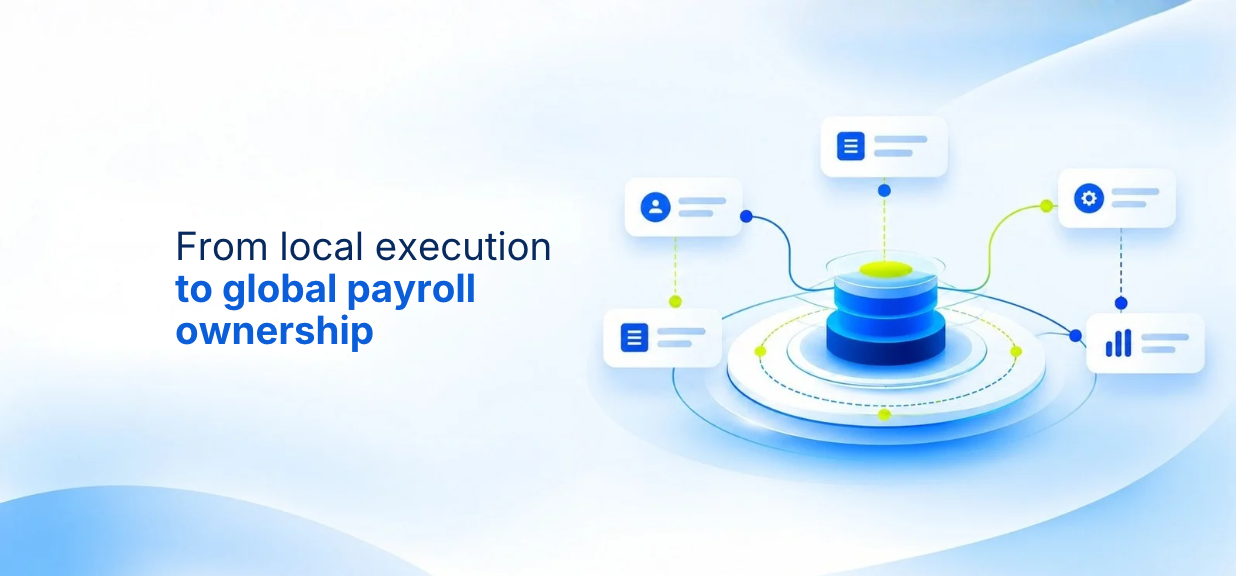
Conceptualized by Neeyamo, GpCC defines how a GCC can bring global payroll under a single accountable operating model, combining centralized governance, standardized processes, integrated technology, payroll expertise, and country-level execution. Rather than treating payroll as a collection of independent country operations, the GpCC framework positions it as a unified enterprise capability. Its operating model brings together three essential layers.
Orchestration
Orchestration connects payroll activities, stakeholders, systems, and country operations within a coordinated global framework. It helps ensure that different parts of the payroll process operate together rather than as disconnected activities.
Governance
Governance establishes ownership, accountability, common standards, controls, and performance oversight. It creates a consistent approach to managing global payroll while accommodating country-specific statutory requirements.
Intelligence
Intelligence uses payroll data, analytics, and technology to improve visibility, identify exceptions, and support continuous improvement. It helps transform payroll information into insights that can support operational and strategic decisions.
Together, these layers provide a structured approach for GCCs to extend their existing capabilities into global payroll.
What Should GCC Leaders Consider Before Centralizing Global Payroll?
Taking ownership of global payroll requires more than selecting a platform or consolidating vendors. GCC leaders must evaluate their existing payroll landscape, operating responsibilities, and readiness for global governance.
Key considerations include:
- Ownership: Is there a clearly accountable global payroll owner?
- Technology: Can the payroll technology landscape support the organization's country footprint and reporting requirements?
- Processes: Which activities can be standardized, and which must remain country-specific?
- Governance: Are service levels, controls, escalation paths, and performance measures consistently defined?
- Expertise: Is there sufficient global payroll knowledge and local statutory expertise to support the operating model?
- Transition: Can the organization move toward a unified model without disrupting payroll continuity or employee pay?
- Measurement: Are there clear metrics for accuracy, timeliness, compliance, exceptions, and service performance?
A phased approach can help organizations assess readiness, establish governance, prioritize countries, and progressively improve operational consistency.
For some organizations, the starting point may be consolidating payroll reporting. Others may begin with common processes, global oversight, or a review of their country-level provider landscape. The appropriate approach depends on the organization's existing technology, operating model, and level of maturity.
The next evolution of GCCs may not be about taking on more work. It may be about taking ownership of more critical global capabilities. Is global payroll next?
Explore the Global Payroll Capability Center (GpCC) framework by Neeyamo to understand how GCCs can structure and govern global payroll as an enterprise-wide capability. For more information, feel free to reach out to irene.jones@neeyamo.com.