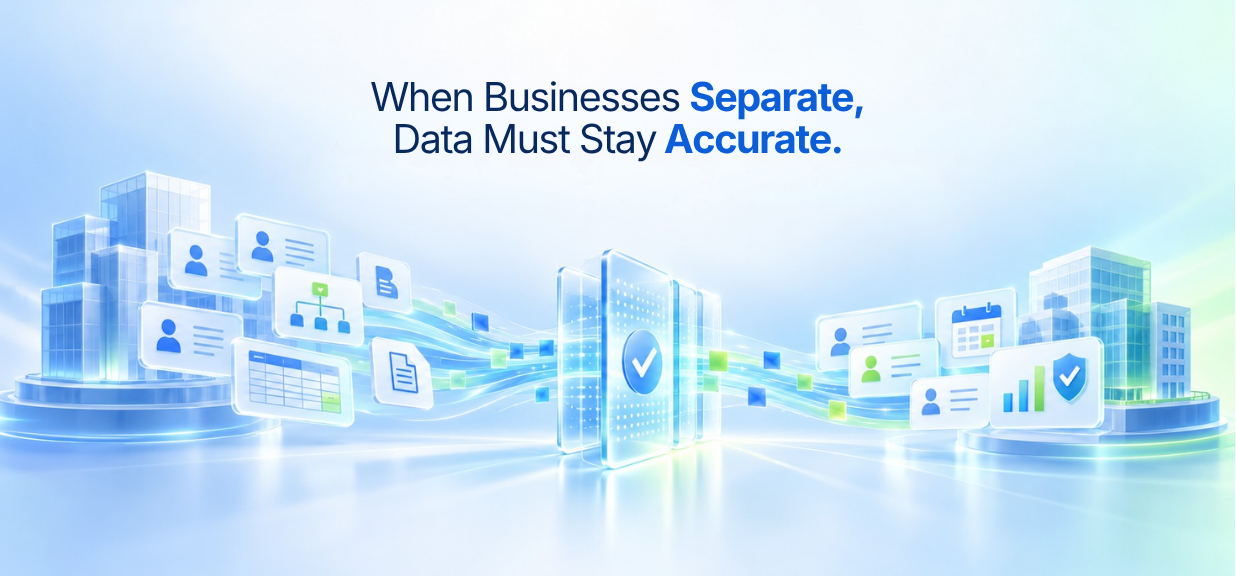
What happens when a business is ready to operate independently, but its employee data is still tied to the parent organization?
In a corporate carve-out, separating business operations is only one part of the challenge. Behind the transition lies a complex network of employee records, HR systems, payroll platforms, and shared processes that must be carefully disentangled before the new organization can function independently.
Without the preparation of transferring data, reconciling information and mapping records, inconsistencies in employee information can carry over into the new payroll environment. A successful payroll carve-out therefore depends on more than technology separation. It requires a clean, complete, and well-governed workforce data foundation that allows payroll to operate independently from day one.
The Problem of Fragmented Employee Data in a Carve-Out
One of the biggest challenges in a corporate carve-out is that employee data rarely exists within a single, unified system. Within the parent organization, these systems may operate through established integrations and shared processes. However, when a business separates, those dependencies become complicated. Fragmentation can introduce several challenges:
- Inconsistent employee records
- Incomplete payroll information
- Disconnected data ownership
- Shared system dependencies
Fragmented data can complicate employee identification, statutory reporting, compensation calculations, and the reconciliation of historical records. A successful payroll carve-out therefore requires organizations to identify where workforce information resides, understand how systems are connected, and establish a consistent employee data foundation before separation.
Defining the Workforce Population During a Carve-Out
Before employee data can be extracted or migrated, organizations must establish exactly which employees belong to the carved-out business. Defining the employee perimeter is a critical responsibility during divestiture planning. This involves defining the workforce population that will transfer, identifying employees who will remain with the parent organization, and determining how shared-service employees will be allocated.
For payroll readiness, defining this population involves several considerations:
- Employee identification: Establishing a validated list of transferring employees, including employment status, location, and employee identifiers.
- Legal entity alignment: Determining which employing entities will retain or assume responsibility for each employee.
- Payroll population mapping: Identifying existing payroll groups, countries, pay frequencies, and applicable employment arrangements.
- Shared workforce allocation: Resolving the treatment of employees supporting both the parent organization and the carved-out business.
- Workforce changes: Capturing new hires, terminations, transfers, and other employment changes occurring before separation.
Cleaning and Completing Payroll-Critical Data
Once the workforce population has been identified, the next step in a payroll carve-out is ensuring that employee records are accurate, complete, and consistent across systems. Inconsistencies can become significant when transferred into an independent payroll environment, where employee information must support accurate calculations, statutory deductions, and payment processing.
Data cleansing should therefore go beyond identifying errors. Organizations must establish consistent data standards, resolve discrepancies at their source, and ensure that only verified, relevant employee information enters the new payroll environment.
Mapping Employee Data to the New Operating Model
Once employee data has been cleansed and standardized, the next step in a corporate carve-out is aligning it with the new organization's operational and payroll structures. Existing records may reference legal entities, payroll groups, cost centers, and organizational structures that no longer apply after separation. These relationships must be reconfigured to reflect the new operating model.
A structured data mapping process typically involves:
- Legal entity and payroll mapping: Assigning employees to the appropriate employing entities, payroll groups, processing calendars, and statutory configurations.
- Organizational alignment: Updating departments, cost centres, reporting relationships, and compensation structures to reflect the new business.
- HRIS and payroll integration: Establishing connectivity between existing HRIS platforms and the new payroll environment through middleware to facilitate employee data exchange.
- Data extraction and transformation: Using ELT/ELT tools to extract and transfer workforce information, with a centralized master data management (MDM) layer supporting file processing, transformation, and standardization.
- Inbound and outbound data migration: Managing the movement of employee information between connected systems to maintain consistent payroll data flows.
For instance, Neeyamo Payroll incorporates an integration architecture designed to support these processes. Its middleware connects HRIS and payroll environments, while ELT/ELT tools facilitate data extraction and transfer. Information is routed through Tower MDM, where middleware processes and transforms incoming data based on file formats. DCOD supports inbound and outbound data migration, enabling information to move between connected systems.
Ultimately, effective data mapping helps ensure that employee information is not merely transferred but accurately structured for the new payroll environment, supporting operational continuity as the carved-out business transitions to independent processing.
Validating Employee Data Before Payroll Goes Live
Even after employee records have been cleaned and mapped, a payroll carve-out cannot be considered ready without comprehensive data validation. Before the first independent payroll cycle, organizations must confirm that transferred information accurately reflects the workforce and supports the expected payroll calculations.
Validation should extend beyond checking whether employee records have been successfully migrated. It should establish whether the new payroll environment can process those records correctly.
For a carve-out, validation activities should focus on headcount reconciliation, compensation verification, payroll balance reconciliation, statutory validation, and parallel payroll testing. Validation must also account for changes occurring between the initial data extraction and the separation date, including new hires, terminations, compensation adjustments, and employee transfers. Ultimately, Day 1 payroll readiness depends not only on successful data migration but also on demonstrating that the new environment can calculate and process employee payments accurately.
Establishing Data Ownership After the Carve-Out
Once employee data has been migrated and payroll operations become independent, organizations must establish clear ownership and governance structures to maintain data accuracy over time. Without defined responsibilities, employee information can become fragmented again as HR, payroll, finance, and regional teams begin managing workforce changes through separate processes.
For a successful payroll carve-out, organizations should establish several foundational practices:
- Identifying which systems maintain authoritative employee, compensation, and payroll records.
- Establishing accountability for employee changes, payroll inputs, approvals, and statutory information.
- Ensuring employee updates move accurately between HR, payroll, finance, and benefits systems.
- Establishing validation rules, access permissions, audit trails, and procedures for correcting discrepancies.
- Reviewing employee records, integration exceptions, and payroll-related changes after separation.
Building Payroll Independence on a Reliable Data Foundation
From defining the transferring workforce and resolving fragmented records to mapping employee information, validating payroll inputs, and establishing data ownership, each stage contributes to operational readiness. These activities are closely connected. Incomplete workforce identification can affect data migration, inaccurate records can disrupt payroll calculations, and unclear ownership can create inconsistencies long after separation.
Ultimately, payroll independence begins with data readiness. A clean, validated, and well-governed workforce data foundation not only reduces Day 1 risks but also supports accurate, compliant, and sustainable payroll operations as the newly independent organization moves forward.
Whether you're preparing for a corporate carve-out or navigating the complexities of employee data separation, reach out to us at irene.jones@neeyamo.com to discuss how you can build a reliable foundation for independent payroll operations.