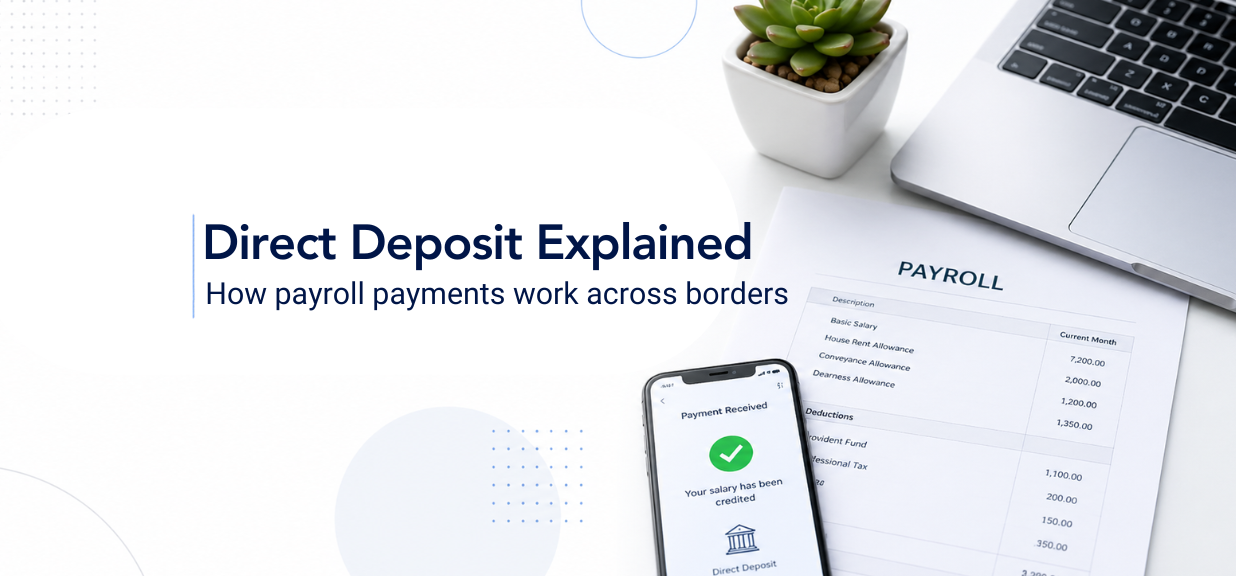
The global workforce is more decentralized than ever, yet the fundamental expectation of every employee remains the same: getting paid accurately and on time. At the heart of this reliability is direct deposit, a financial transaction that has evolved from a 1970s innovation into the backbone of modern payroll.
However, for multinational organizations, "direct deposit" is not a one-size-fits-all term. Navigating the compliance landscape across different borders requires an understanding of diverse banking systems, data privacy laws, and local labor regulations.
What is Direct Deposit?
Direct deposit is an electronic payment method in which employers transfer wages directly into an employee’s bank account via electronic funds transfer systems. According to the National Automated Clearing House Association, direct deposit is one of the most common uses of the Automated Clearing House network, which processes billions of transactions annually in the United States.
The American Payroll Association (Payroll Org) notes that direct deposit has become a cornerstone of payroll modernization due to its reliability and scalability across organizations of all sizes.
How Direct Deposit Works
The process behind direct deposit is standardized in principle, though infrastructure differs across regions.
- Employee authorization
Employees provide bank account details and consent to receive payments electronically.
- Payroll processing
Employers calculate net pay and generate a payment file formatted for the relevant banking network.
- Funds transfer
Payments are routed through clearing systems such as ACH and credited to employee accounts.
In the United States, the Automated Clearing House processes these transactions in batches. According to NACHA, the ACH network processed over 31 billion payments in 2023, highlighting the scale and reliability of electronic payroll systems.
Why Direct Deposit Matters
Speed and Efficiency
Direct deposit eliminates the delays associated with physical checks. Funds are typically available within one to two business days, with same-day ACH options increasingly available.
Cost Reduction
Organizations reduce administrative costs associated with printing, distributing, and reconciling paper checks.
Security and Transparency
Electronic payments create a clear audit trail and reduce risks associated with lost or stolen checks.
High Adoption Rates
According to NACHA, the vast majority of federal payments in the United States, including salaries and benefits, are made via direct deposit, demonstrating widespread trust in the system.
Compliance Considerations in Direct Deposit
While direct deposit simplifies payroll execution, it introduces important compliance requirements that vary across jurisdictions.
Employee Consent and Legal Rights
In many countries, employers must obtain explicit employee consent before initiating direct deposit. In the United States, regulations ensure that employees are not forced to use a specific financial institution, protecting individual choice.
The Electronic Fund Transfer Act establishes consumer protections, including error resolution procedures and liability limits for unauthorized transactions.
Banking Infrastructure and Regulatory Frameworks
Each country operates within its own payment ecosystem:
- United States: Governed by NACHA rules and ACH network standards
- European Union: Operates under SEPA, which standardizes euro-denominated bank transfers across member states
- India: Uses systems like NEFT, RTGS, and IMPS under the oversight of the Reserve Bank of India
- United Kingdom: Relies on BACS and Faster Payments for payroll processing
These systems define transaction timelines, file structures, and compliance requirements for employers.
Data Protection and Security
Payroll involves sensitive financial and personal data. Regulations such as the General Data Protection Regulation impose strict requirements on how employee data is collected, stored, and transmitted.
Organizations must implement encryption, secure file transfer protocols, and access controls to remain compliant.
Cross-Border Direct Deposit Compliance
For multinational organizations, direct deposit becomes more complex when payments cross borders. Compliance requirements may include:
- Anti-money laundering checks under global financial regulations
- Currency conversion reporting
- Adherence to local tax and wage laws
In the U.S., international ACH transactions must follow specific classification codes defined by NACHA to ensure proper reporting and compliance.
Payroll Timing and Settlement Rules
Different payment systems have defined processing windows and cut-off times. For example, ACH payments typically do not settle on weekends or public holidays, requiring payroll teams to plan ahead.
In India, NEFT operates in batches throughout the day, while real-time systems like IMPS enable instant transfers but may not always be used for payroll due to reconciliation and compliance considerations.
Challenges in Global Direct Deposit Compliance
Despite its benefits, managing direct deposit across multiple countries presents several operational challenges:
- Fragmented payment infrastructures across regions
- Varying compliance and reporting standards
- Currency exchange and foreign transaction complexities
- Integration between payroll systems and banking networks
These challenges make it difficult to create a standardized global payroll process.
The Future of Direct Deposit in Payroll
The future of direct deposit is being shaped by real-time payment systems and increasing regulatory alignment. Same-day and instant payment capabilities are becoming more common, improving employee experience and financial flexibility.
At the same time, regulatory bodies and payment networks continue to enhance transparency, security, and speed. NACHA’s ongoing updates to ACH rules reflect a broader global trend toward faster and more efficient payment systems.
Direct deposit is a foundational element of modern payroll, enabling organizations to pay employees efficiently and securely. However, its implementation across countries requires careful attention to compliance, banking infrastructure, and regulatory frameworks.
For global organizations, success with direct deposit depends not just on adopting digital payment systems, but on understanding and navigating the complex compliance landscape that governs them.
Managing direct deposit across countries is not just about moving money. It requires aligning payroll operations with diverse banking systems, regulatory frameworks, and compliance standards. This is where Neeyamo brings value.
Neeyamo enables organizations to streamline global payroll through a unified platform that integrates seamlessly with local banking infrastructures and payment networks. By combining automation with deep regulatory expertise, Neeyamo ensures that direct deposit processes are executed accurately, securely, and in full compliance with country-specific requirements.
For more information, feel free to reach out to irene.jones@neeyamo.com.