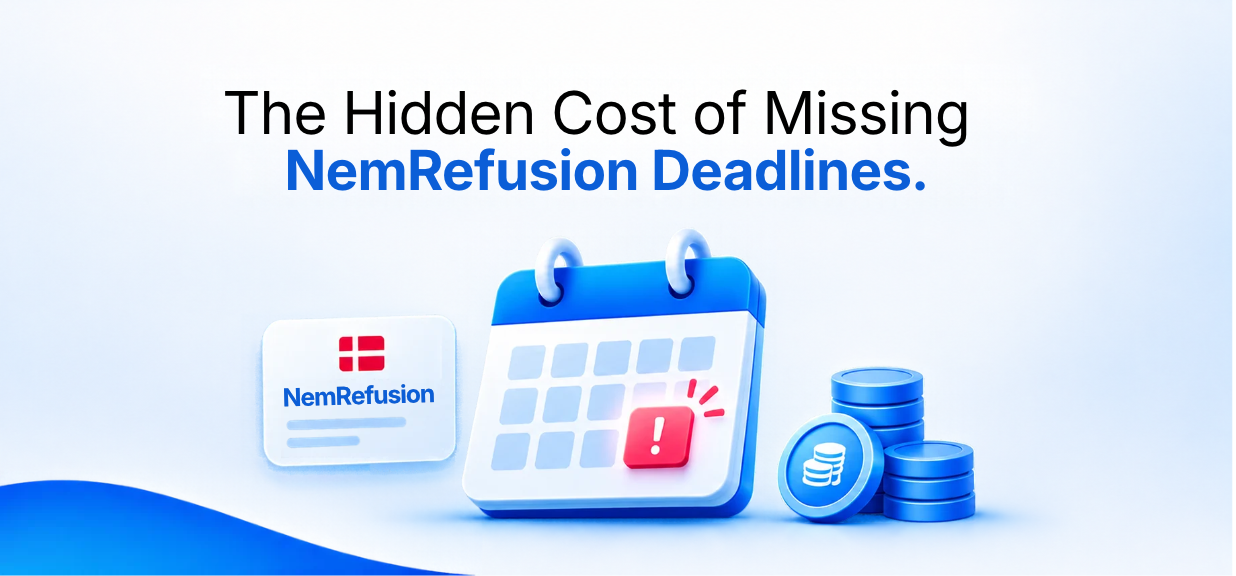
An employee calls in sick on a Monday. Payroll is not notified, and full salary continues as usual. Because the employer keeps paying wages, it has five weeks from the first absence day to report the absence in NemRefusion. If the report is filed later, the refund covers only the period from the date of reporting, so the earlier days can be lost. With the 2026 maximum sickness benefit at DKK 5,085 per week, each week of refund lost this way is a cost the employer absorbs.
In Denmark, that deadline lives inside NemRefusion, the government portal where employers report sick leave and parental leave and claim the refunds that follow. For a global payroll leader, it is one of the most deadline-sensitive local processes to get right.
Why Does NemRefusion Matter in Denmark?
Danish employers have had to use NemRefusion for digital absence reports and refund requests since 2011, and the municipal IT agency KOMBIT runs it. Employers use it free of charge, and it is available around the clock through Virk.dk, the national business portal. Two payers sit behind it: municipalities handle sickness benefit, and Udbetaling Danmark, the public benefits authority, handles parental leave.
Because sick leave is widespread in Denmark, NemRefusion reporting becomes a regular payroll task rather than an occasional one. In 2024, 448,000 people received sickness benefit, and own-illness absence reached 4.1% across sectors. In a 500-person workforce, that equals roughly 20 full-time equivalents absent on an average day.
What Does This Mean for Payroll?
Employers normally pay wages or sickness benefit for the first 30 calendar days of sick leave. If they keep paying wages afterwards, they can claim a refund, provided the employee meets the municipality's conditions. Smaller private employers can also buy sickness insurance that brings refunds forward to the second day.
Because the refund is capped, part of the salary cost stays with the employer. In 2026, the highest sickness benefit is DKK 5,085 per week, or DKK 137.43 per hour. As an illustration, an employee paid DKK 250 per hour on a 37-hour week costs DKK 9,250 weekly. The refund tops out at DKK 5,085, leaving DKK 4,165 per week with the employer.
Data quality matters as much as dates. Salary goes into NemRefusion as one amount of base pay plus regular supplements. Holiday allowance, public holiday pay, employer-administered pension, and ATP contributions stay out. The authority always receives pay excluding the labor market contribution (AM-bidrag). For shift workers, payroll reports day-work hours as fixed hours.
Status: final and in force as of 26 October 2026.
Because the refund runs only from the date a report is filed, reporting late can mean losing the refund for the days before it. Dispensation is possible when a NemRefusion outage caused the delay.
How Does the NemRefusion Process Work?
- Payroll or HR records the first day of absence, working hours, and pay.
- An authorized user logs in on Virk.dk with MitID Erhverv, the business digital ID, and holds refund rights.
- The employer creates the case and signs it. Reports filed too early wait in a holding status. Sickness reports wait up to 23 days unless the employer has early refund rights.
- The municipality or Udbetaling Danmark receives the report. The employee gets a notification letter that the employer cannot see.
- The employer requests refunds, tracks case status, reports changes and recovery, and reconciles payments.
What Else Should Payroll Teams Know About NemRefusion?
- Every transaction is logged with full traceability, and the system links to Denmark's population register, business register, eIndkomst income register, and Digital Post.
- Udbetaling Danmark can offset an overpayment against refunds due for other employees.
- Interface specification v3.1.5 took effect on 20 May 2026, and new schemas (3.0.2) followed on 19 October 2026.
What Are the Integration Options?
Employers can connect in four ways:
- Manual portal entry. A user keys each case into NemRefusion on Virk.dk. It suits low volumes, but it re-keys data that already sits in payroll.
- Direct system-to-system reporting (Virksomhedsservice). Payroll, HR and absence systems can report directly and automatically through interfaces built on open OIOXML standards and published XSD schemas.
- Lightweight web service (Virksomhedsservice Light). A lighter connection route with its own integration guide.
- Supplier-managed connection. Your payroll or HR provider connects once and sends absence data automatically. NemRefusion publishes a list of connected suppliers, so check yours. A specialist refund service such as MinRefusion is another route (see below).
Suppliers sign a data exchange agreement, build to the interface specification, and test. KOMBIT may charge a test fee, but it cannot charge for the first 10 test hours.
What Is MinRefusion, and How Does It Work?
MinRefusion is not the government portal. It is a private Danish service that, according to its own website, automates refund claims by exchanging data with NemRefusion. Its integration list covers workforce management, time registration, payroll, HR, and ERP systems, including SAP SuccessFactors, Microsoft Dynamics 365, and Zenegy.
How it works:
- Connect your payroll, HR, or time system through a ready-made integration, an API, or a custom data endpoint.
- Register absence once in your own system, at time registration, payroll run, or shift planning.
- Absence data transfers to MinRefusion automatically.
- MinRefusion reports the absence and files the refund request in NemRefusion for you, and its control panel tracks expected payments.
So, What Should Payroll Teams Do Now?
- Name a deadline owner. Set alerts well ahead of the five-week sickness window and the eight-week parental leave window.
- Capture absence data once. Align the first absence day, hours, and pay elements in payroll with NemRefusion definitions before connecting anything.
- Reconcile refunds monthly. Compare expected refunds with payments received, and watch for offsets.
- Report parental leave even when you pay no wages. Employees cannot claim benefit until the employer reports.
- Track reform news. From 1 July 2026, municipalities follow up less with employees expected back within 26 weeks. The change is final and does not alter reporting or refund rules.
For multi-country employers, the harder problem is rarely the portal. It is keeping absence, pay, and deadline data consistent across countries and systems. A unified payroll approach with local expertise helps teams capture data once and apply local rules consistently.
Missed deadlines and re-keyed data turn a routine refund into lost cash. As payroll regulations continue to evolve, organizations need the flexibility to adapt without compromising accuracy or compliance. Neeyamo helps global enterprises simplify complex, multi-country payroll operations through a unified technology approach.
Looking to strengthen your global payroll operations in Denmark? Reach out to irene.jones@neeyamo.com for more information.