The Changing Reality of Global Payroll
The global workforce is no longer defined by geography. Organizations today hire talent across borders, hiring billions of workers building teams that span time zones, regulatory environments, and cultural contexts. Hiring has never been more flexible, but payroll has not kept pace.
Every new country as business enters brings with it a distinct set of tax laws, statutory obligations, reporting frameworks, and compliance requirements. What looks like a straightforward process on paper becomes exponentially more complex when multiplied across markets. Exchange rates fluctuate. Regulations change without warning. Government systems differ not just in structure but in logic.
This is why payroll has evolved beyond a back-office function. It is now a strategic lever that can either accelerate global growth or quietly hold it back.
Why Paying Employees Globally Is Still a Challenge
Payroll appears deceptively simple. Salaries are calculated, deductions are applied, and payments go out. But beneath that surface, global payroll is one of the most fragmented operational challenges a multinational organization faces.
Every country operates differently. Tax structures vary. Social security systems are built on entirely different principles. Reporting formats, pay frequencies, and statutory contribution rules differ from one jurisdiction to the next. In some markets, payroll must interface directly with government-mandated wage protection systems. In others, industry-specific entitlements add layers of complexity that no generic system was ever designed to handle.
Organizations navigating this reality often end up depending on a patchwork of local vendors, disconnected platforms, and manual workarounds, and each one introduces its own risk. Visibility suffers. Errors multiply. Compliance becomes reactive rather than proactive. And when something goes wrong, the consequences are not just operational. Incorrect or late payroll payments carry real financial penalties, damage employee trust, and in some markets, can restrict a company's ability to operate.
The absence of locally embedded compliance is not a minor gap. It is a structural vulnerability.
Rethinking Payroll as a Strategic Function
As organizations expand, payroll starts to influence far more than just finance. It shapes the employee experience, determines how quickly a business can enter a new market, and defines how confidently an organization can manage regulatory risk at scale.
Employees expect to be paid accurately and on time, regardless of where they are located. Businesses need to ensure compliance without sacrificing the speed of growth. When payroll works seamlessly, it becomes invisible in the best possible way. When it doesn't, it becomes the most visible problem in the organization.
This is the shift that reframes payroll from a transactional necessity into a foundation for business agility.
What Is NeeyamoPays™?
NeeyamoPays™ is a country-specific payroll solution built within a unified global framework. Rather than applying a single standardized approach across all markets, it is designed around a fundamental principle: payroll must adapt to each country’s regulatory and operational environment to be truly effective.
Each NeeyamoPays™ implementation is pre-configured with country-specific statutory rules, designed to align with local compliance requirements from day one.
Automated validations and intelligent processing are embedded directly into the payroll engine and not added on afterward. The result is a system where local accuracy and global manageability are not competing priorities. They coexist by design.
This is not a generic global solution with localization applied as an afterthought. It is a payroll engine where compliance is the starting point.
How NeeyamoPays™ Enables Businesses in the Real World
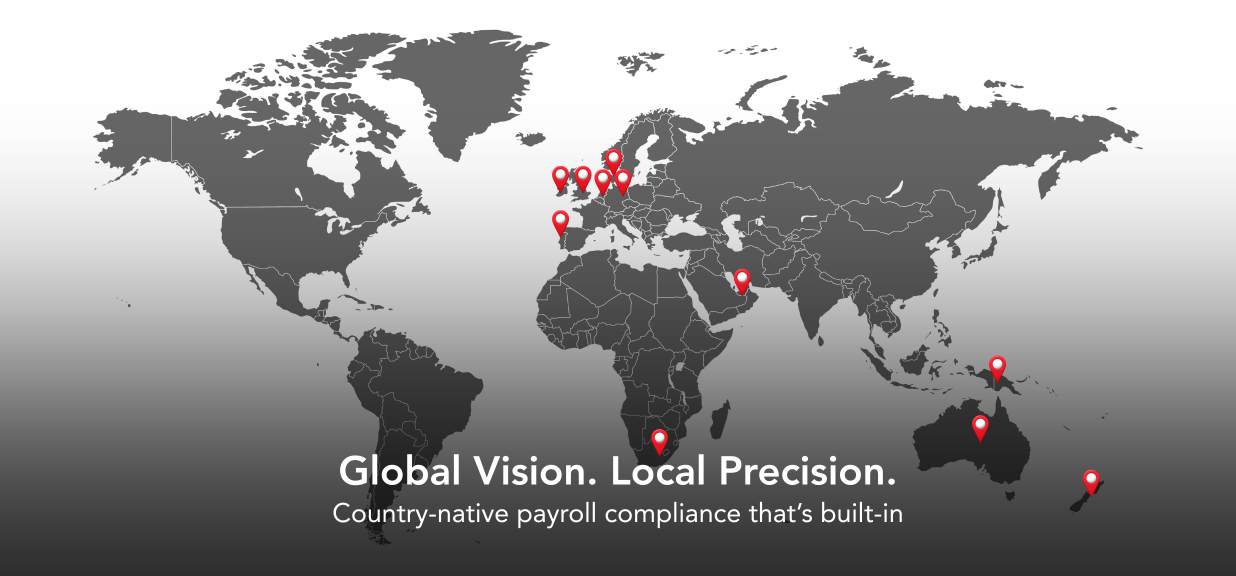
NeeyamoPays™ is currently live across 10+ countries across key global markets, enabling organizations to run payroll in diverse regulatory environments through one consistent framework. Rather than treating each country as a separate problem to be solved independently, NeeyamoPays™ brings a model that adapts to local requirements while maintaining global alignment.
As business expansion continues to accelerate, this footprint is growing, supporting more markets and enabling organizations to scale payroll operations with the same confidence they bring to their core business decisions.
In practice, NeeyamoPays™ helps organizations consolidate multi-country payroll processes into a single framework, significantly reducing dependence on fragmented vendors and disconnected systems. It simplifies market entry by bringing predefined statutory structures that remove the guesswork from payroll setup in new regions. Automation reduces manual inputs, standardizes workflows, and improves consistency across the board. And with better data visibility, payroll teams and finance leaders gain the oversight they need to make informed decisions and not just process transactions.
The USPs of NeeyamoPays™
Built-In, Country-Native Compliance:
Statutory rules, contribution frameworks, tax tables, and reporting requirements are embedded directly into each country's payroll engine, not retrofitted later. Compliance is the foundation, not a feature.
Pre-Configured from Day One:
Every NeeyamoPays™ implementation arrives ready to run, with country-specific configurations already in place. This means faster deployment, fewer surprises, and a significantly shorter path from setup to first payroll.
300+ Automated Validations:
Built-in validation logic catches errors before payroll is finalized, not after. This dramatically reduces the risk of incorrect payments and the operational burden of corrections.
Unlimited Draft Runs:
Teams can test, review, and refine payroll as many times as needed before committing to the final run, giving payroll managers control and confidence at every stage.
AI-Powered Intelligence with ARIA:
NeeyamoPays™ doesn't wait for compliance changes to become problems. Powering this intelligence is ARIA, Neeyamo's Adaptive Real-time Intelligent Assistant. ARIA is an always-on AI agent that monitors regulatory updates, responds instantly to payroll queries, and ensures every interaction is accurate, contextual, and compliant. Whether employees are checking payslip details, managers are reviewing payroll data, or administrators are navigating compliance requirements, ARIA transforms those interactions into immediate, intelligent action.
Certified Integrations with Leading HRIS Platforms:
Seamless, certified connectors with Workday, Oracle, SAP SuccessFactors, and virtually any HR, finance, or accounting system ensure that payroll data flows cleanly without manual intervention or reconciliation headaches.
Backed by a 160+ Country Global Platform:
The local precision of NeeyamoPays™ is supported by the infrastructure, expertise, and scale of Neeyamo's global payroll platform, giving organizations the best of both worlds.
Scales Across Organizations of Every Size:
Whether a business is a growing mid-market organization or a large multinational, NeeyamoPays™ adapts to its needs without adding operational complexity.
Fast Time-to-Value:
Deployment is designed to be rapid, with organizations able to go live and realize the benefits of compliant, automated payroll in a matter of days rather than months.
From Compliance to Confidence
When payroll is accurate, timely, and compliant, the impact reaches well beyond the payroll team. It builds employee trust. It reduces the organization's risk exposure. It gives finance and HR leadership the financial visibility they need to make strategic decisions. And it frees up operational capacity that was previously consumed by manual processes and vendor management.
Payroll stops being a risk area and becomes a reliable foundation for growth.
Enabling the Future of Global Work
The nature of work continues to evolve rapidly. Organizations are no longer restricted by borders, and talent is no longer tied to a single location. In this environment, the ability to pay employees accurately and compliantly across countries is not just an operational capability; it is a competitive advantage.
NeeyamoPays™ is built for this reality. By combining country-specific payroll intelligence, automation, and a unified global structure, it enables organizations to operate with both precision and consistency, no matter where their people are.
The question is no longer whether businesses can hire globally. The real question is whether they can pay globally, with the accuracy, compliance, and confidence that their workforce deserves.
To know more, book a demo with us today or drop your queries to our expert at irene.jones@neeyamo.com.