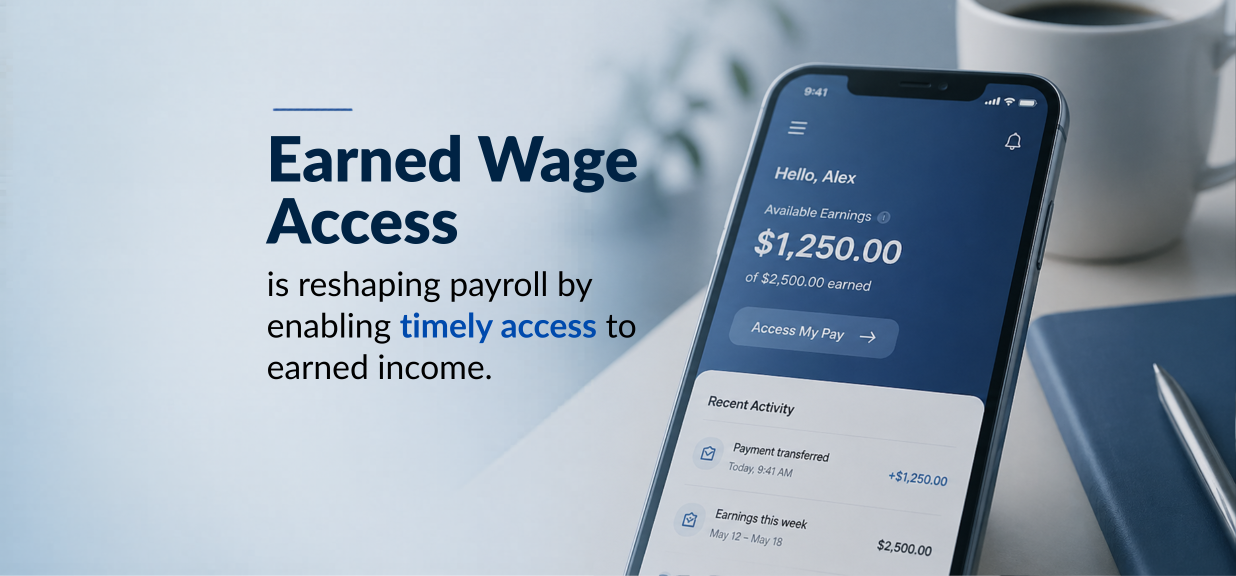
80% of employees say they would move to an employer that offers earned wage access.
Read that again. Not “would consider it.” Not “would prefer it.” Would move.
In a hiring environment where organizations are investing heavily in employer branding, retention programs, and benefits packages, a single payroll capability is quietly rising above the rest. And many organizations still have not addressed it.
On the latest episode of the Payroll Powerlist by Neeyamo, host Nancy spoke with Sharon Kirby, Global Partnerships Director at VEEP Software, to explore what this shift means for business leaders, payroll professionals, and employees.
One thing became clear early in the conversation. This is not a feature discussion. It is a fundamental shift in how pay is experienced.
What is earned wage access, and why does it matter for employers today
Earned wage access, also known as on-demand pay or early wage access, enables employees to access a portion of their earned pay as they earn it, rather than waiting for a fixed employer-determined payroll schedule. No loans. No credit checks. No reliance on high-cost borrowing.
That distinction matters.
Traditional payday loans can carry annual percentage rates of up to 400%, according to the Consumer Financial Protection Bureau. Earned wage access does not create new obligations. It simply provides earlier access to earned income.
Two forces are driving urgency.
The first is the cost of living. A Federal Reserve survey found that 37% of Americans cannot cover a 400 dollar emergency expense without borrowing or selling something. In the UK, most workers have under 500 pounds in savings. Financial buffers are limited across income groups.
The second is behavioral and generational. Younger workers are not just rethinking how they work, but how they get paid. They evaluate employers differently, placing greater importance on how they are treated financially. Access to earned wages is no longer seen as a perk. It is increasingly part of the baseline expectation.
For a workforce that lives on demand, waiting weeks for access to earned income feels increasingly out of place.
Earned wage access as a duty of care for employers
Payroll and HR have always carried a strong responsibility. Paying employees accurately and on time is non-negotiable.
Earned wage access extends that responsibility further.
If employees have already earned their wages, restricting access becomes less about process and more about people. The conversation shifts toward financial well-being and employee support.
For many organizations, earned wage access also reveals something that was previously invisible. How employees are actually navigating the gap between pay cycles.
For many organizations, this is where earned wage access moves from a benefit to a responsibility.
Earned wage access for payroll professionals
For payroll teams, real-time pay access often raises immediate concerns. More complexity. More reconciliation. More risk.
The reassurance is clear. When implemented correctly, earned wage access adds no additional workload.
Any earned wage access model that increases payroll workload is fundamentally flawed. The expectation is simple. Payroll should not do more work.
The foundation is integration. EWA platforms connect directly with payroll and time systems through APIs. What employees access reflects what they have earned. When payroll closes, reconciliation happens automatically.
The EWA layer operates alongside payroll without changing core processes. Accuracy remains intact.
Another key point is funding. Providers fund early access, not employers. There is no impact on cash flow.
Earned wage access compliance in the US and global markets
In the United States, earned wage access is also a compliance decision.
Regulations are evolving across states, with varying requirements. Some mandate free access options. Others define how access can be structured.
This is not a reason to delay adoption. It is a reason to choose the right partner.
Leading providers monitor regulations, maintain compliance frameworks, and guide employers through changes. In the UK, responsible providers align with Financial Conduct Authority expectations and industry codes.
One principle is consistent. Employees must have a way to access earned wages without fees.
Clearing up misconceptions about earned wage access
Several misconceptions slow adoption.
The first is behavioral. Will employees misuse access? Data suggests otherwise. Weekly workers in the US access, earned wage between 2.6 and 2.9 times per week on average. This reflects structured usage rather than impulsive behavior.
In practice, employees tend to access only what they need. The behavior is measured, not excessive.
Employees are not changing how they manage money. They are gaining flexibility.
The second misconception is cost. Retail turnover ranges between 45 and 55 percent annually, according to the US Bureau of Labor Statistics. Earned wage access can reduce churn by around 20 percent. With hiring costs near 4,000 dollars per employee, the financial impact is significant.
The third misconception is relevance. While adoption is higher among hourly workers, salaried employees also use earned wage access to manage timing and liquidity.
The real impact of earned wage access on employees
Beyond the data, the conversation highlighted everyday realities.
Employees are missing work because they cannot afford transport. Workers finishing shifts without enough cash to get home safely. Parents are taking on extra work to bridge gaps between pay cycles.
These are not isolated cases.
Earned wage access does not eliminate financial stress entirely. But it removes a recurring friction point. The gap between earning and access.
For many employees, that gap is where stress begins.
Listen to the full episode to explore deeper insights on compliance, financial wellness, and the future of payroll.
Industries adopting earned wage access
Retail, healthcare, hospitality, logistics, and manufacturing are leading the adoption. These sectors often include shift-based workforces and variable income patterns.
Healthcare is a strong example. In the UK, adoption of earned wage access among healthcare workers has been significant. This highlights that the need is driven by timing and access, not just income level.
The gig economy is accelerating adoption further, with workers managing multiple income streams and irregular schedules.
The future of earned wage access and payroll
Earned wage access has been active in the United States for over a decade and in the UK for several years. Adoption is around 20 percent in the US and 10 percent in the UK, with rapid growth in both.
Adoption patterns show a clear trajectory. The United States continues to lead, with the UK following, while other regions are beginning to explore similar models.
What was once considered a progressive benefit is quickly becoming a baseline expectation.
Industry sentiment is clear. This is not optional evolution. It is a structural shift in payroll.
There is a growing consensus among payroll leaders that this is the direction payroll is moving toward. In many ways, earned wage access is not just part of the future. It is the future of pay.
There is also a secondary impact. Organizations with weekly payroll cycles can move to less frequent cycles while maintaining flexibility through EWA. This creates operational efficiency without affecting employee experience.
The question for CHROs and global payroll leaders is no longer whether to explore earned wage access. It is how quickly it can be implemented.
Increasingly, the greater risk lies in not offering it.
What to look for in an earned wage access provider
When evaluating solutions, focus on a few critical areas.
Compliance depth
Providers should demonstrate strong regional compliance capabilities, especially in markets like the US, where regulations vary by state. Look for partners that actively monitor and manage these changes.
Integration capability
Direct integration with payroll and time systems is essential. The solution should ensure real-time accuracy and seamless reconciliation without manual effort from payroll teams.
Fee structure
Employees must have access to a no-cost option. Providers should also be transparent about any optional fees for faster access.
Funding model
Providers should fund early access without impacting employer cash flow. This ensures no disruption to financial operations.
Financial wellness tools
Solutions should include employee-facing education and support to help users make informed financial decisions.
The next evolution of earned wage access is already emerging. Providers are moving beyond fixed access limits toward personalized thresholds based on individual financial patterns and wellness insights.
Earned wage access reflects a broader shift in how organizations support their workforce.
When employees can access what they have already earned, everyday decisions become easier. Showing up to work, managing expenses, and maintaining stability become less stressful.
This is where payroll moves beyond process.
It becomes a driver of trust and employee confidence.
For a deeper discussion on earned wage access, global payroll strategies, or how these capabilities can be integrated effectively, connect with Irene Jones at irene.jones@neeyamo.com.