When payroll works, nobody notices. When it fails, the impact is immediate.
An employee misses a salary payment in Singapore. A statutory filing in the UAE gets delayed. A payroll discrepancy in Saudi Arabia triggers compliance scrutiny. In that moment, payroll ceases to be a back-office function and becomes a business risk.
For multinational organizations, these issues rarely stem from a lack of effort. They stem from fragmentation.
Over time, global payroll environments become increasingly complex, with multiple vendors across regions, disconnected systems, varying compliance processes, and inconsistent operational standards. What begins as localized optimization eventually creates a payroll ecosystem that is difficult to govern, scale, or monitor centrally.
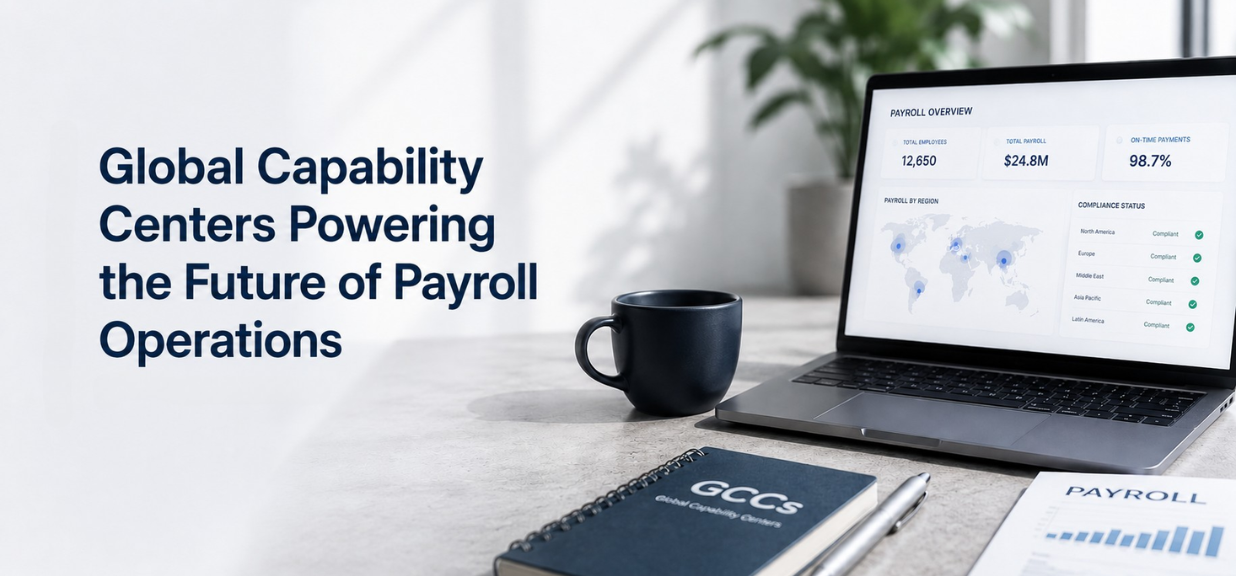
This is where Global Capability Centers (GCCs), and more specifically Global Payroll Capability Centers (GpCCs), are reshaping payroll delivery.
A GpCC is not simply a centralized payroll processing unit. It is an orchestration and governance model that enables enterprises to manage payroll as a unified global capability.
The numbers tell the story: Global payroll strategies often struggle to translate into consistent execution because of fragmented vendor ecosystems and operational complexity. Industry survey data shows that 74% of organizations work with more than two payroll vendors, yet only 25% believe their vendor management framework is truly effective. The result is a disconnected payroll environment marked by fragmented processes, limited visibility, inconsistent controls, and growing compliance risk. For multinational organizations, these gaps can lead to regulatory scrutiny, payroll inaccuracies, delayed reporting, and operational inefficiencies that directly impact workforce confidence and business expansion. This is where Global Capability Centers (GCCs) come into play, bringing centralized governance, operational consistency, and strategic oversight to transform payroll from a fragmented administrative function into a scalable global capability.
Payroll Has Become a Strategic Function
Payroll today sits at the intersection of compliance, employee experience, finance, and workforce strategy.
As organizations expand globally, payroll complexity increases exponentially. Every country has its own tax regulations, labor laws, reporting obligations, benefits structures, and statutory requirements. Managing payroll country by country creates operational silos that reduce visibility and increase risk.
This shift has fundamentally changed what organizations expect from payroll.
The goal is no longer limited to accurate salary processing. Enterprises now require centralized visibility, stronger governance, audit readiness, and operational consistency across all geographies.
That requires more than local execution. It requires a globally coordinated operating model.
What a Global Payroll Capability Center Actually Does
A GpCC creates a centralized operating layer above fragmented payroll ecosystems.
Instead of treating each country's payroll as an isolated process, the GpCC introduces standardization, governance, and orchestration across regions. It establishes a consistent framework for how payroll is managed, monitored, and controlled globally while still allowing local compliance execution where necessary.
Importantly, this does not mean organizations must move to a single payroll vendor worldwide.
Most multinational enterprises operate complex payroll ecosystems that have evolved over the years through acquisitions, regional expansion, and local compliance requirements. A GpCC brings structure to that complexity without forcing immediate platform consolidation.
The focus shifts from fragmented execution to centralized control.
Also read | An Executive Handbook for GCCs
How does a GCC Optimize Payroll Delivery: Five Key Transformations
1. Unified Operating Rhythm → Operational Predictability
One of the biggest challenges in multinational payroll is inconsistency. Different regions often follow different approval cycles, reporting structures, escalation paths, and validation methods. Over time, this creates inefficiencies and operational ambiguity.
A GpCC introduces a unified operating rhythm:
- Payroll processes become standardized
- Controls become measurable
- Reporting becomes consistent across geographies
- Organizations gain clearer accountability and greater operational predictability
2. Centralized Governance → Proactive Compliance
In fragmented payroll environments, compliance oversight is often reactive. Risks only become visible after an issue occurs.
A GpCC changes this by creating centralized visibility:
- Payroll operations monitoring
- Vendor performance tracking
- Compliance tracking
- Exception management
Instead of relying on manual follow-ups and disconnected reporting, enterprises gain real-time oversight into payroll health across all regions.
3. Unified Data Visibility → Better Strategic Decisions
For many global organizations, payroll data exists across multiple providers and disconnected systems. Finance leaders struggle to obtain consolidated workforce cost insights, while HR teams lack centralized visibility into payroll performance.
A GpCC serves as the consolidation layer:
- Brings fragmented data streams together
- Enables organizations to monitor payroll globally
- Improves reporting accuracy
- Supports better strategic decision-making
4. Orchestrated Vendor Management → Seamless Integration
Most multinational enterprises rely on multiple payroll providers across different countries. Without centralized coordination, this often creates:
- Integration gaps
- Duplicated effort
- Inconsistent service delivery
The GpCC acts as the orchestration layer between vendors, HR systems, finance platforms, and compliance workflows. Instead of managing payroll through disconnected regional relationships, organizations begin operating payroll as a single, coordinated ecosystem.
5. Intelligent Automation → Predictive Control
Traditional payroll models rely heavily on spreadsheets, manual validations, and reactive compliance management.
Modern GpCCs replace this with:
- Integrated workflows
- Automated controls
- Real-time dashboards
- Embedded audit trails
Modern payroll platforms such as Neeyamo Payroll help organizations standardize payroll operations across vendors and geographies while maintaining centralized governance.
At the same time, payroll AI agents like ARIA are introducing a new layer of intelligence to payroll:
- Proactively detect anomalies
- Monitor regulatory updates
- Validate calculations
- Flag compliance risks in real time
This shifts payroll operations from reactive management toward predictive control..
The Business Impact of a Mature GpCC
The value of a GpCC extends far beyond operational efficiency.
Organizations with mature payroll capability centers can reduce payroll errors, improve compliance readiness, accelerate audit response times, and increase employee trust by delivering more reliable payroll.
More importantly, they gain scalability.
As enterprises expand into new markets, the GpCC provides a repeatable framework for onboarding countries, integrating vendors, and managing compliance consistently. Payroll transformation becomes faster, more controlled, and less disruptive.
Ultimately, the greatest advantage is confidence.
Confidence that payroll is accurate. Confidence that controls are working. Confidence that compliance obligations are being met across every geography.
Conclusion
Global payroll can no longer operate effectively as a fragmented regional function.
As multinational organizations scale, payroll requires centralized governance, intelligent orchestration, and real-time visibility. That is precisely where GCCs and GpCCs create value.
They transform payroll from a collection of disconnected country operations into a coordinated global capability, one that supports compliance, scalability, operational control, and enterprise growth.
The future of payroll is not simply centralized processing.
It is a unified global performance.
For more information, visit us here or drop your questions to our payroll expert, irene.jones@neeyamo.com