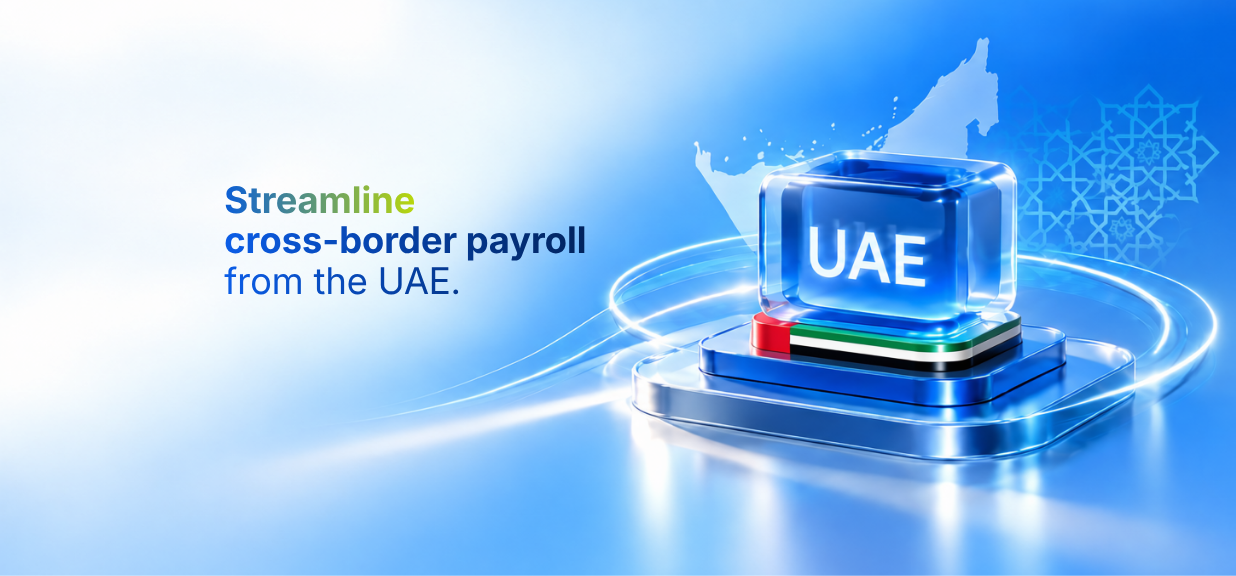
The UAE has become a strategic hub for businesses managing operations across the Middle East, Africa, Asia, and beyond. As companies establish regional headquarters in Dubai and Abu Dhabi, payroll teams are increasingly responsible for employees working across multiple countries.
Managing payroll from the UAE can create significant efficiencies, but it also introduces complexity. Every country has its own employment laws, payroll calendars, statutory requirements, currencies, reporting obligations, and employee benefits. A process that works well in the UAE cannot simply be replicated across Saudi Arabia, India, the UK, Egypt, or other markets.
The key to successful multi-country payroll is finding the right balance between centralized control and local compliance.
Why Multi-Country Payroll is Becoming More Complex
At first glance, payroll appears straightforward: calculate salaries, deduct applicable amounts, and pay employees. In reality, payroll is closely connected to employment legislation, taxation, social security, banking, and regulatory reporting.
For a UAE-based organization managing employees across several countries, the differences can be substantial. For example, UAE private-sector employers covered by the Wage Protection System (WPS) need to process salary payments through the approved WPS framework. The UAE government states that establishments registered with the Ministry of Human Resources and Emiratisation (MoHRE) must pay wages through WPS, subject to applicable exclusions.
MoHRE introduced the Wage Protection System (WPS) in cooperation with the Central Bank of the UAE to electronically monitor the payment of workers’ wages. The system was introduced to strengthen wage protection by ensuring that employees receive their contractual wages accurately and on time, while enabling the Ministry to monitor wage payments and identify non-compliance.
Saudi Arabia, meanwhile, has its own wage protection and social insurance requirements, while countries such as India, the UK, and Egypt operate under completely different tax and statutory frameworks.
This means that multi-country payroll is not simply one payroll process replicated across different countries. It is a collection of local payroll processes that need to operate within a common global framework.
The Biggest Challenges for UAE-Based Payroll Teams
1. Keeping up with local compliance
Regulations can change frequently, and monitoring those changes across multiple jurisdictions is difficult. A payroll team based in the UAE may be familiar with requirements such as WPS, gratuity, and Emiratisation but may not have the same level of expertise in social security in India, PAYE in the UK, or local employment regulations in other markets.
This creates a risk of relying on outdated rules or applying one country's approach to another. A strong multi-country payroll model therefore requires local regulatory expertise combined with central governance.
2. Managing different payroll calendars
Each country can have different payroll cut-off dates, salary payment deadlines, statutory filing dates and public holidays. These differences become particularly challenging when payroll is managed centrally from the UAE. A delay in receiving payroll inputs from one country can affect the entire payroll calendar.
A central payroll calendar should therefore capture:
- Payroll input deadlines
- Payroll processing dates
- Approval deadlines
- Salary payment dates
- Statutory filing deadlines
- Bank holidays and public holidays
- Cut-off dates for new joiners and leavers
The objective is to make deadlines visible before they become issues.
3. Managing multiple currencies
Currency management is another major challenge. A UAE-headquartered organization may have employees paid in AED, SAR, INR, GBP, EUR, USD, and several other currencies. Payroll teams need to manage exchange rates, funding requirements, bank charges, and reconciliation while ensuring that employees receive the correct amount in their local currency.
This becomes particularly important for finance teams that need a consolidated view of global payroll costs. A good payroll solution should therefore support local payroll calculations and payments while providing consolidated reporting in a common currency.
4. Integrating HR, payroll and finance
Multi-country payroll becomes significantly more difficult when employee information is maintained across multiple systems. For example, an organisation may use Workday or SAP SuccessFactors as its global HR system, local payroll providers in different countries and separate banking platforms for salary payments. Without effective integration, payroll teams can end up moving employee data manually between systems.
This increases the risk of:
- Incorrect employee information
- Duplicate records
- Missing payroll inputs
- Incorrect salary calculations
- Manual reconciliation
- Delayed payroll processing
The ideal architecture should allow the HR system to act as the primary source of employee information, while payroll systems apply the relevant country-specific rules.
Centralization Does Not Mean Standardization of Everything
One of the most important principles of multi-country payroll is that centralization and standardization are not the same thing.
Organizations should standardize what can be standardized:
- Governance
- Approval workflows
- Data structures
- Payroll controls
- Reporting
- Security
- Service-level agreements
- Escalation processes
At the same time, they need to preserve local requirements for:
- Tax
- Social security
- Wage protection
- Statutory benefits
- Leave
- End-of-service benefits
- Payroll reporting
- Salary payments
In other words, the objective should be one global payroll framework with local compliance embedded within it.
Technology as the Foundation
Technology plays a critical role in making this model scalable.
A modern multi-country payroll platform should provide a single view of payroll while maintaining country-specific rules and workflows. This can help organisations move away from multiple spreadsheets, disconnected providers and manual consolidation.
Key capabilities to look for include:
Country-specific compliance: Payroll calculations and statutory requirements should reflect local legislation.
Multiple currencies: The platform should support payroll calculations and reporting across currencies.
HRIS integration: Integration with platforms such as Workday, SAP SuccessFactors or Oracle can reduce manual data entry.
Automated workflows: Payroll inputs, validations, approvals and sign-offs should follow a controlled workflow.
Consolidated reporting: Finance and HR leaders should be able to view payroll costs, headcount and liabilities across countries from a single dashboard.
Audit trails: Every payroll change and approval should be traceable.
Security: Payroll contains highly sensitive employee information, making access controls, encryption, and secure data transfer essential.
Building the Right Operating Model
Technology alone will not solve multi-country payroll challenges. Organizations also need a clearly defined operating model.
A successful model typically establishes:
- Global ownership – A central payroll or HR operations team owns the overall process.
- Local expertise – Country specialists or payroll partners manage local statutory requirements.
- Clear responsibilities – Every party understands who provides inputs, validates payroll, approves results and executes payments.
- Standard controls – Payroll reconciliation, variance analysis and approval processes are consistent across countries.
- Central visibility – Management can see the status and cost of payroll across all markets.
This approach allows the UAE team to maintain control without attempting to become experts in every country's payroll legislation.
The Role of a Managed Payroll Partner
For organizations operating across several countries, outsourcing can simplify the operating model.
Instead of managing multiple local payroll vendors independently, businesses can work with a global payroll partner that coordinates payroll across jurisdictions.
The right partner can provide:
- Local payroll expertise
- Country-specific compliance
- Payroll processing
- Statutory reporting
- Salary payment support
- Payroll reconciliation
- Consolidated reporting
- A single point of contact
This can be particularly valuable for UAE-based regional headquarters where the HR or finance team needs central visibility without having to build payroll expertise in every market.
Moving Towards a Single View of Global Payroll
The future of multi-country payroll is moving towards greater consolidation. Businesses increasingly want to answer simple questions without manually combining information from multiple countries:
- How many employees do we have globally?
- What is our total monthly payroll cost?
- Which countries have payroll pending approval?
- Are there any compliance risks?
- What statutory payments are due?
A single payroll framework can make these questions easier to answer by bringing country-specific payroll processing into a common governance and reporting environment.
For UAE-based organizations, this is particularly relevant as the country continues to serve as a regional hub. The UAE's WPS framework itself continues to evolve, with MoHRE launching an upgraded WPS in 2025 that introduced greater digital integration between MoHRE systems, financial institutions and salary-payment processes.
Conclusion
Managing multi-country payroll from the UAE is not about trying to make every country's payroll identical. It is about creating one controlled operating model that respects the differences between countries. The organizations that succeed will combine centralized governance, local compliance expertise, and technology that provides a single source of truth.
For HR and finance leaders, the goal should be simple: one view of payroll, one governance framework, and one reliable process—while allowing every country to remain compliant with its own local requirements. That is what turns multi-country payroll from a complex administrative function into a scalable global business capability.
Explore how a unified global payroll approach can help you simplify operations, strengthen compliance, and gain a single view of payroll across markets. For more information, contact us at irene.jones@neeyamo.com.