Artificial intelligence is changing what payroll technology can do.
For years, the conversation around payroll automation focused primarily on processing faster, reducing repetitive work, and improving operational efficiency. But as global payroll becomes increasingly complex, organizations need more than automation. They need technology that can identify anomalies, respond to changing regulations, surface insights, and make payroll easier to interact with.
This is where AI-powered payroll begins to take shape.
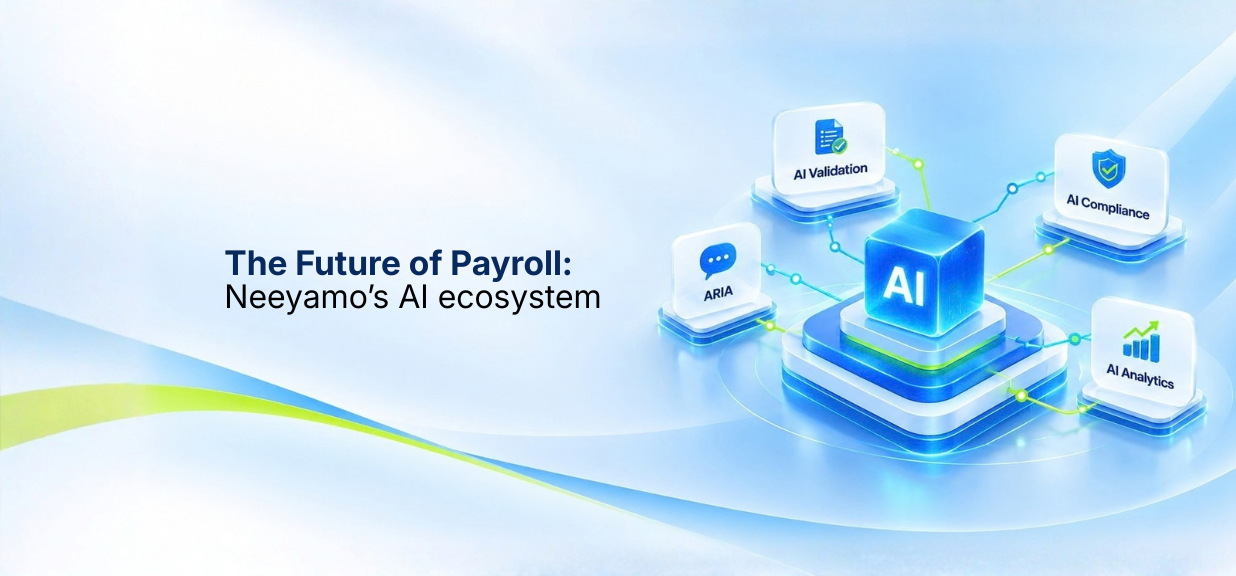
Rather than a single AI capability performing one task, an AI-powered payroll ecosystem brings together different forms of intelligence across the payroll lifecycle. At Neeyamo, this includes AI/ML-powered validation, AI-driven compliance monitoring, intelligent assistance through ARIA, and analytics that can help organizations derive more value from payroll data.
The result is an ecosystem where AI can help validate, monitor, assist, and inform across payroll operations.
AI that validates: strengthening payroll accuracy
Payroll depends on data. Employee information, time, earnings, deductions, benefits, and other inputs all need to come together accurately before payroll can be processed.
In a multi-country environment, the challenge becomes even greater. Different systems, processes, and country-specific requirements can create additional complexity, making data validation an important control point in the payroll lifecycle.
Neeyamo’s AI/ML-powered validation capabilities add intelligence to this stage. The validation engine can evaluate payroll inputs against patterns established from historical payroll cycles and identify anomalies before calculations take place. This allows potential issues to be surfaced earlier in the process rather than discovered after payroll has already been processed.
The role of AI here is not simply to automate a check. It is to add another layer of intelligence to the validation process, helping payroll teams identify data that may require attention before it moves further through the payroll cycle.
AI that monitors: keeping pace with compliance
Payroll compliance is another area where the environment is constantly changing.
Organizations operating across multiple jurisdictions need to keep track of evolving tax requirements, employment regulations, statutory obligations, and other country-specific changes. Keeping up with these developments is not simply about knowing that a regulation has changed. Payroll teams also need to understand what those changes mean for payroll operations.
Neeyamo’s compliance capabilities use AI-powered monitoring to consolidate regulatory updates from multiple regional compliance sources into a unified view. The platform can provide alerts, track regulatory changes, and flag critical updates in real time.
This represents another layer of the AI-powered payroll ecosystem: intelligence that continuously monitors the environment around payroll.
For global payroll teams, the value is in connecting regulatory change with the operational processes that need to respond to it.
AI that assists: bringing intelligence into the payroll experience
AI does not only belong behind the scenes. It can also change how people interact with payroll.
This is where ARIA, Neeyamo’s Adaptive Real-time Intelligent Assistant, comes in.
ARIA is embedded within Neeyamo’s payroll ecosystem and is designed to support employees, managers, payroll professionals, and other users through contextual, intelligent interactions. Users can engage with ARIA through conversational chat, guided interactions, or voice.
That can change the nature of the payroll experience. Instead of navigating through multiple screens to find information or complete a task, users can interact with payroll more naturally.
ARIA is also designed around the needs of different users and their context within the payroll application. Its role is therefore broader than simply answering questions. It brings intelligence into the point where people interact with payroll.
And because payroll requires accuracy and trust, ARIA is designed around deterministic responses and guardrails rather than treating payroll as an open-ended generative AI environment.
AI that informs: turning payroll data into insight
Payroll generates an enormous amount of data. But having data is different from being able to use it effectively.
Analytics can help organizations move from simply understanding what happened to identifying patterns and potential future outcomes. Neeyamo's current thinking around payroll analytics describes a progression from descriptive and diagnostic analytics toward predictive and prescriptive approaches, where AI can help organizations identify patterns, anomalies, and potential risks.
This creates another role for AI within payroll: turning payroll data into intelligence that can support better-informed decisions.
Rather than viewing payroll data solely as a record of completed transactions, organizations can begin to use it as a source of workforce and operational insight.
The opportunity is significant because payroll sits at the intersection of people, money, time, and compliance. When that data can be analyzed intelligently, it can provide a broader view of what is happening across the workforce.
One ecosystem. Different roles for AI.
These capabilities may perform different functions, but they contribute to the same larger shift.
- AI/ML validation helps validate payroll inputs.
- AI-powered compliance monitoring helps monitor regulatory change.
- ARIA helps employees and payroll stakeholders interact with payroll.
- Analytics helps turn payroll data into actionable intelligence.
Together, these capabilities demonstrate why the future of AI-powered payroll is not about a single AI feature. It is about where intelligence can be embedded across the payroll lifecycle.
AI can help identify something that needs attention before processing. It can monitor an evolving regulatory environment. It can help a person find information or complete a payroll-related task. And it can help organizations understand patterns within their payroll data.
The result is a payroll ecosystem that can become more responsive, contextual, and intelligent without losing sight of what payroll ultimately requires: accuracy, compliance, control, and trust.
The next evolution of payroll
The evolution of AI in payroll is not simply about putting more AI into existing systems. It is about giving intelligence the right role at the right point in the payroll lifecycle. Some work can be validated by AI. Some changes can be monitored by AI. Some interactions can be handled through AI. And some insights can be surfaced through AI.
But payroll will continue to require people, expertise, context, and accountability. The goal, therefore, is not AI or humans. It is knowing where the handoff happens.
At Neeyamo, we are exploring what this balance looks like across the payroll lifecycle, bringing together AI-powered validation, compliance monitoring, intelligent assistance, and analytics within a connected payroll ecosystem. The focus is not simply on adding AI to payroll, but on applying it where it can create meaningful value while keeping people close to the moments that require expertise, context, and responsibility.
That is what an AI-powered payroll ecosystem can ultimately enable: technology handling the work it is designed to handle, while people remain close to the moments that require expertise, context, and accountability.
Interested in exploring an AI-powered payroll ecosystem? Contact irene.jones@neeyamo.com to learn more about Neeyamo’s approach.