Payroll must be right. Every time. Across every geography your enterprise operates in.
That is not a vision statement. It is the baseline expectation from regulators, from employees, from the board, and from every audit that lands on your desk.
And yet, for most global enterprises, the reality of payroll looks nothing like that expectation.
The Gap Between Expectation and Reality
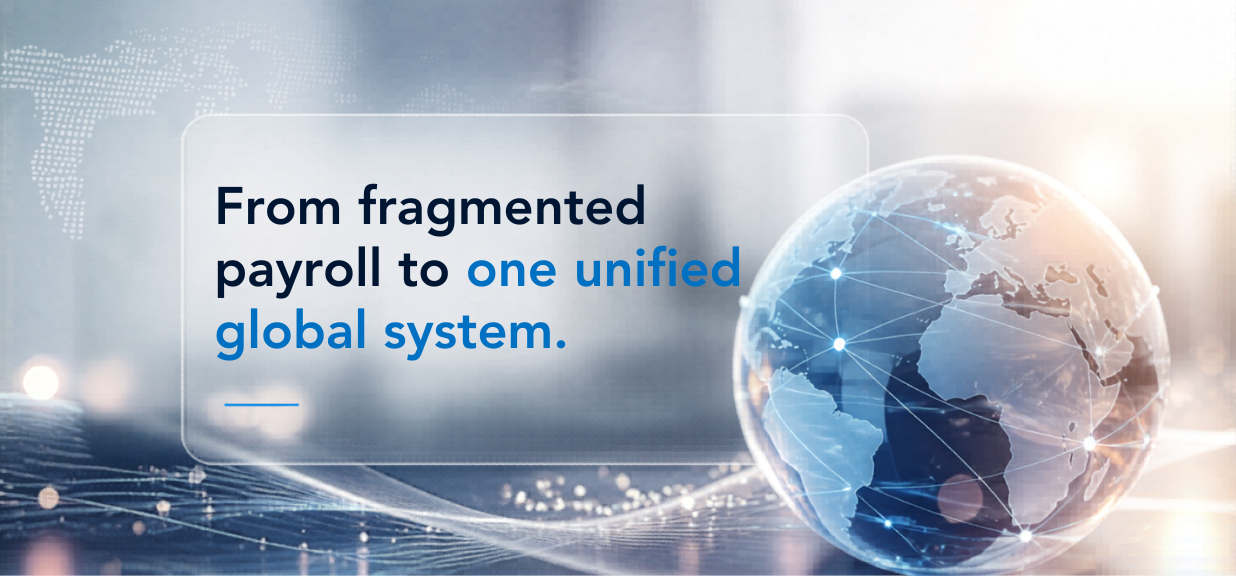
Global payroll today is rarely one thing. There are many things running in parallel: multiple vendors, multiple platforms, uneven controls, and fragmented visibility. Each country run makes sense locally. But across the enterprise, the picture is something different: an uncoordinated patchwork where accountability gets diluted, exceptions multiply quietly, and exposure only becomes visible after something breaks.
This fragmentation was rarely designed. It accumulated.
Organic growth added vendors. Acquisitions inherited systems. Regional autonomy created inconsistency. And through it all, the long tail the smaller, harder-to-reach markets where most compliance risk quietly concentrates was managed through local heroics rather than governed through a system.
The result: global payroll that works country by country, but doesn't behave like an enterprise capability.
That is the gap the Global Payroll Capability Center is built to close.
What a GPCC Actually Is
GPCC is a governance and intelligence layer designed to sit above the complexity that already exists in your payroll ecosystem, and make it operate like one coherent, governed, enterprise-grade capability.
The organizing principle is simple:
Standardize where possible. Orchestrate where necessary. Control by design.
Standardize where regulations allow it, common process definitions, control frameworks, exception taxonomies, reporting packs, and data standards. The more your enterprise can run on a shared operating model, the less space there is for inconsistency to take root.
Orchestrate where local variation is unavoidable because it always is, somewhere. Different regulatory calendars. Different statutory requirements. Different vendor contracts that can't be unwound overnight. Orchestration means those differences are managed, not ignored, connected through one operating rhythm instead of isolated in separate country silos.
Control by design, not as an afterthought. In most payroll environments, evidence is assembled manually when an audit arrives. Controls are checked retrospectively. Exceptions surface at month-end. A GPCC embeds governance directly into the workflow: audit-ready evidence produced through the process itself, controls that are owned by roles not individuals, and exceptions that are seen and triaged before they become escalations.
This is precisely the model Neeyamo pioneered.
Also read | An Executive Handbook for GCC leaders.
Why This Is Achievable Now
For years, global payroll stayed fragmented because enterprises lacked a practical operating layer to connect country execution into a governed system. The idea of unified governance was appealing but the infrastructure to deliver it didn't exist.
That has changed.
Modern payroll platforms such as Neeyamo Payroll are designed specifically to provide that operating layer: sitting above multi-country, multi-vendor reality to enable orchestrated execution, unified visibility, and evidence-by-design controls. Not by replacing every local tool or forcing a single-platform world, but by creating the connective tissue that was always missing.
And intelligence is accelerating what's possible further. AI capabilities such as ARIA Adaptive Real-time Intelligent Assistant is Neeyamo's AI agent built to make global payroll intuitive, proactive, and autonomous. Whether through chat, voice, or guided workflows, ARIA turns every query into action delivering outcomes that are accurate, contextual, and human-like. More than an assistant, ARIA is the AI foundation for a future where payroll runs seamlessly, intelligently, and without friction.
The path is from fragmented execution to unified governance to scalable autonomy. The operating layer that enables that path now exists.
Where a GPCC Sits in Your Operating Model
A GPCC is not a function that takes over payroll. It is a function that governs it and governance is only effective when accountability is clear.
The design principle: keep governance and standards centralized, keep execution scalable, keep proximity activities local, and concentrate specialist capability in Centers of Excellence.
In practical terms, this means:
Corporate and functional leadership owns policy, enterprise standards, and control objectives. Strategic decisions about vendor selection, risk appetite, and cross-country standard-setting belong here.
GCC / GPCC operations owns scaled execution and performance management payroll run coordination, master data administration, exception triage, vendor operations governance, cut-off management, and the reporting packs that give leadership a single view of performance and risk.
Payroll CoEs own the capability that improves the system over time process design and standardization, controls library, compliance change impact assessment, analytics, automation pipelines, and the knowledge base that prevents expertise from sitting in individuals instead of systems.
Country and BU teams own proximity time capture, local approvals, statutory interactions where in-country context is genuinely required, and local issue resolution that can't be handled centrally.
A useful test for any decision: If it sets standards, it belongs at the center. If it scales execution, it belongs in the GCC. If it requires local context, it belongs in-country. If it improves the system repeatedly, it belongs in the CoE.
The GPCC Is Not One Size
How far a GPCC can extend into your organization and how fast depends on your enterprise's operating DNA. How decisions get made. Who owns standards. How much local variation your business is designed to tolerate.
A centralized, function-led enterprise is a strong candidate for a global GPCC with unified standards and rapid rollout. A decentralized, BU-led enterprise requires a different starting point: begin with visibility and compliance intelligence, establish minimum control standards, and phase consolidation as trust is built.
The goal is not to force a structure the enterprise will resist. The goal is to design the GPCC to fit how the enterprise naturally operates while still moving toward unified governance.
In every archetype, the destination is the same: centralize what must be consistent, federate what requires proximity, and orchestrate what cannot be consolidated yet.
What "Unified" Actually Means
Unified global payroll does not require a single vendor everywhere. It requires a single operating model above the ecosystem.
Unified = common process + common data + orchestrated execution + one view of performance and risk.
When that model is in place, payroll stops being a collection of country runs and starts behaving like an enterprise capability. Finance leadership uses payroll data as a strategic input, not a source of operational anxiety. Compliance teams govern proactively, not reactively. And across the enterprise from the GCC hub to the employee in Lagos or Kuala Lumpur there is a consistency of execution that fragmentation is never allowed.
That consistency is what trust is built on.
Neeyamo: Pioneering the Global Payroll Capability Center
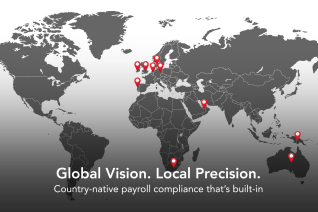
GPCC emerged from over a decade of Neeyamo working at the front lines of global payroll complexity inside the messy, fragmented, high-stakes reality of running payroll for enterprises operating across 160+ countries.
We have processed payroll in the markets others call the "long tail" the smaller, harder-to-reach geographies where most providers stop and most compliance risk accumulates. We have seen, firsthand, what fragmentation costs organizations: in money, in compliance exposure, in employee trust, and in leadership bandwidth.
The Global Payroll Capability Center is our answer built not from theory, but from practice.
As the originator of the GPCC concept, Neeyamo brings three things no one else can:
Category depth. We didn't adopt the GPCC concept, we created it. Our thinking, our architecture, and our delivery model are built around this approach from the ground up, not retrofitted onto an existing product.
Global reach without compromise. Our infrastructure covers 160+ countries with genuine in-country compliance expertise. The GPCC isn't a governance layer over a thin network, it's intelligence built on real, deep, local payroll capability.
AI-first architecture. Our GPCC is powered by Neeyamo's proprietary intelligence layer enabling the kind of real-time anomaly detection, predictive compliance, and autonomous exception management that transforms payroll from a cost centre into a strategic asset.
The Direction of Travel
The next benchmark of payroll leadership will not be "how many countries are we live in?" It will be a simpler, harder question:
How confidently can your enterprise run payroll everywhere, every cycle, without drama?
The enterprises building toward autonomous payroll where global execution is orchestrated, continuously visible, and increasingly self-correcting are not waiting for a perfect system before they start. They are building the governance layer first: the standards, controls, orchestration, and single view of risk that make the rest possible.
That is what a GPCC is for.
Neeyamo has been at the forefront of developing this model not from a whitepaper, but from a decade of working at the front lines of global payroll complexity, across 160+ countries, and through the messy, high-stakes reality of enterprises that needed payroll to behave like one system before they had the tools to make it so.
The tools now exist. The operating model is proven. The next step belongs to the leaders shaping what their enterprise looks like on the other side of fragmentation.
We are ready to build it with you.
To explore how a GPCC can bring unified governance to your global payroll operations, visit us here or connect with our expert at irene.jones@neeyamo.com.