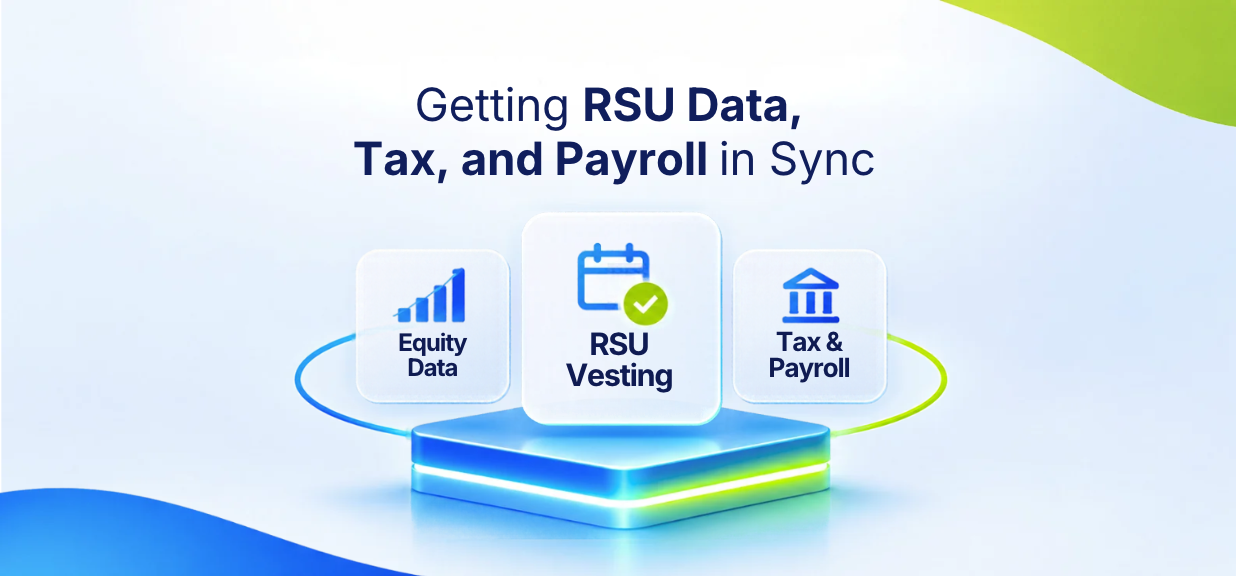
An employee's restricted stock units (RSUs) vest today. The equity platform confirms the transaction, shares are released, and the employee receives a notification. From their perspective, the process is complete. But behind that notification, payroll may be dealing with an entirely different set of questions. What is the taxable value? Which country has the right to tax the income? Has withholding already been funded? And who is responsible for validating each answer?
These questions are becoming increasingly relevant as equity compensation gains prominence. According to 2026 executive compensation research published by Harvard Law School, the use of time-based restricted stock and RSU awards among Russell 3000 companies increased from 71% in 2019 to 84% in 2026. While these figures concern executive incentive plans, they illustrate the growing importance of equity awards.
For multinational organizations, every RSU vesting event can create payroll obligations. Meeting those obligations depends on much more than the number of shares vested.
Where RSU Vesting Meets Payroll
RSUs are equity awards that generally entitle employees to receive company shares after specified vesting conditions are satisfied. Although the equity administration platform manages the award lifecycle, the resulting compensation may need to be processed through payroll for tax withholding and statutory reporting.
The complication lies in timing and jurisdiction. In the United States, RSU income is generally subject to federal income tax when shares are transferred, although certain employment tax rules can produce different timing. In the United Kingdom, the treatment depends on employment-related securities legislation and applicable PAYE and National Insurance requirements. This means the vesting date, taxable event, and payroll reporting deadline may not always coincide. For employees who have worked across borders, another question arises: where was the income earned?
A vesting transaction that looks straightforward in an equity platform can therefore require several validations before payroll can process it correctly.
Five Checks That Determine Payroll Accuracy
Before an RSU transaction enters payroll, organizations need to establish whether the underlying information is complete, accurate, and approved. Five areas deserve particular attention:
- Employee and employment details: The equity record must match the correct employee, employing entity, and payroll country. International transfers, changes in employment status, and departures can affect which payroll is responsible for reporting the transaction.
- Award and vesting information: Payroll requires the grant identifier, relevant dates, units vested, shares delivered, and any forfeitures or adjustments. Missing or inconsistent transaction details can lead to incorrect compensation reporting.
- Share valuation and currency: The applicable share value, valuation date, transaction currency, and exchange rate must be validated. Differences between equity and payroll valuation records can directly affect taxable income and withholding calculations.
- Tax jurisdiction and mobility history: Consider an employee granted RSUs in the UK who subsequently relocates to Germany before settlement. Depending on domestic legislation and applicable tax treaties, the income may need to be allocated between jurisdictions. Determining the correct treatment requires employment-location history, relevant service periods, and an approved income-sourcing methodology.
- Withholding and settlement arrangements: Taxes may be funded through share withholding, sell-to-cover transactions, or cash deductions. Payroll must verify whether the amount collected matches the applicable withholding obligation and reconcile any differences.
These checks are interconnected. An accurate share valuation is of limited use if the income is allocated to the wrong jurisdiction or reported through the wrong employing entity.
The Ownership Gap Between Equity and Payroll
The biggest operational risk often arises when information moves between teams. Each team handles a different part of the process. Equity administration tracks vested shares, HR maintains employment records, Tax determines the applicable tax treatment, Payroll manages income reporting and withholding, and Finance reconciles the financial impact. However, without clear ownership, it can be difficult to ensure that all this information is accurate and consistent.
The Global Equity Insights 2025 study, covering 177 companies across 20 countries and 11 industries, highlights this challenge. It shows that managing long-term incentive plans requires significant resources, with many organizations relying on external advisers to handle global equity compliance.
For employers, the lesson is that ownership must be defined at every stage. Equity administration should validate award and settlement data, while HR and mobility teams confirm employment history. Tax specialists should approve jurisdictional treatment and income allocation. Payroll should apply those instructions and manage reporting, with finance reconciling the resulting transactions.
The objective is not to make payroll responsible for every decision. It is to ensure payroll receives validated information from the teams accountable for those decisions.
Reconciliation Is the Final Control
Even after processing, RSU transactions must be reconciled across equity administration, broker records, payroll, and finance. Organizations should compare vested units, taxable values, withholding amounts, and settlement details. Missing employee mappings, inconsistent exchange rates, and unmatched transactions should be investigated before applicable reporting deadlines.
Late-arriving data also needs a defined escalation process, particularly when off-cycle payroll, additional withholding, or statutory corrections are required. Without these controls, a single discrepancy can travel through multiple systems before anyone identifies its source.
Making Equity Compensation Part of a Reliable Global Payroll Process
RSU vesting illustrates a wider reality of global payroll: not every payroll obligation begins inside the payroll system. As compensation structures become more complex and employees move across jurisdictions, organizations need stronger coordination between the systems that generate compensation data and the teams responsible for its payroll treatment.
Managing these complexities requires more than isolated payroll processes. Organizations need a connected payroll technology stack that supports consistent data flows, standardized workflows, country-specific compliance, and visibility across global operations. A unified payroll approach helps bring these elements together, reducing fragmentation between systems and enabling greater control over complex compensation events.
This is where Neeyamo's unified global payroll approach and payroll technology stack become relevant. By combining global payroll technology, local compliance expertise, and standardized processes, Neeyamo helps multinational organizations manage payroll complexities across countries while improving operational consistency and visibility. This connected foundation is particularly valuable when equity compensation, international mobility, and other non-standard earnings introduce additional payroll requirements.
An RSU vesting event should not become a last-minute exercise in identifying missing information or unclear responsibilities. With the right technology, expertise, and accountability, organizations can build a more reliable process from equity administration through payroll reporting.
Facing challenges with RSU-related payroll processing or managing complex compensation across countries? Reach out to irene.jones@neeyamo.com to explore how Neeyamo can help simplify your global payroll operations.