Think about the last time an employee in your organization needed to update their bank details, check their leave balance, or pull up a payslip. What did that look like?
In most organizations, it meant an email to HR. A follow-up. A wait. A response that arrived two days later, if it arrived at all.
That experience is no longer acceptable. And employees know it.
The modern workforce has grown up booking flights, managing finances, and ordering groceries through apps that respond in seconds. They bring those expectations into the workplace. When HR can't match that standard, the friction isn't just inconvenient; it's a signal. It tells employees that the organization hasn't invested in their experience. And in a talent market where retention is hard-won, that signal matters more than you realize.
Once a modest digital filing cabinet, it has quietly grown into the primary interface between employees and everything HR. It is no longer a feature. It is the front door.
The Old Model Was Breaking Under Its Own Weight
For years, HR operated as the central intermediary within organizations.
Nearly every employee request, document, approval, and query had to pass through HR before reaching its destination. That model made sense when companies were smaller, workforces were localized, and administrative processes were largely manual. But as organizations expanded across geographies and adopted digital ways of working, the limitations of this approach became increasingly apparent.
Today, HR teams overwhelmed by repetitive, transactional tasks have little time to focus on the areas where their expertise creates the greatest value. Strategic priorities such as workforce planning, talent development, employee experience, organizational culture, and regulatory compliance often compete with day-to-day administrative demands. Instead of enabling these higher-value activities, the traditional operating model consumes the very capacity that HR needs to drive meaningful business outcomes.
From Filing Cabinet to Command Center
The evolution of the employee portal has been significant.
In the beginning, employee portals were basic internal websites used mainly to store and share HR policy documents in PDF format. Today, they are integrated platforms that sit at the intersection of HR, payroll, compliance, and employee lifecycle management.
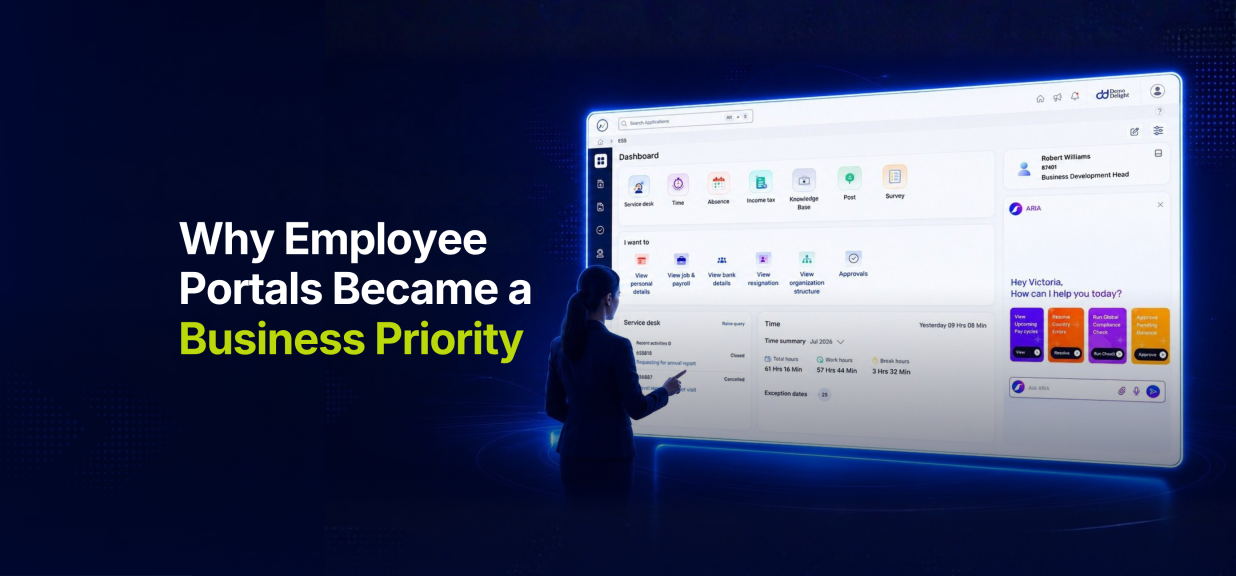
A well-designed employee portal in 2026 enables an employee to:
- Access and download payslips without contacting anyone
- Submit and track leave requests with real-time visibility
- Update personal and banking details independently
- Complete onboarding tasks and digital documentation
- Access benefits information, policies, and compliance documents
- Raise service desk queries and track resolution
For HR teams, a single platform creates a single source of truth, one place where employee data is accurate, auditable, and current. And this has compliance implications that are increasingly material, particularly for organizations managing workforces across multiple geographies.
The Global Dimension Changes the Stakes
For organizations operating across borders, the employee portal takes on additional significance.
A workforce distributed across ten, twenty, or fifty countries cannot rely on centralized HR teams for day-to-day employee interactions. Time zones, language differences, and country-specific compliance requirements make that model impractical. What is needed is a platform that can serve an employee in Singapore with the same consistency it serves one in Mexico or Germany, with local compliance built in, not bolted on.
This is where the design of the portal matters as much as its existence. A portal that handles global pay visibility, country-specific leave policies, multi-currency payslips, and localized onboarding documentation is fundamentally different from one built for a single-country workforce.
Deloitte's 2026 Global Human Capital Trends report, based on research in 89 countries, finds that organizations that take a purely tech-focused approach to AI are 1.6x more likely to fall short of expected returns than those that take a human-centric approach.
The implication for employee portals is direct. A portal built around technology for its own sake, without designing for how employees actually want to interact with it, will underdeliver regardless of how sophisticated its backend is.
Where Neeyamo’s ARIA Changes the Conversation
Most employee portals, even well-designed ones, still require employees to know where to click, what form to fill out, and which system holds the information they need. That friction, however small, is enough to push people back to email or a colleague.
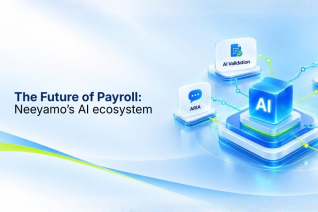
ARIA, Neeyamo's Adaptive Real-time Intelligent Assistant, removes that friction entirely. It is not a portal overlay, but an AI-powered agent embedded within the payroll and HR environment, allowing employees, managers, and administrators to interact in ways that suit them, not as the system demands.
It operates across three modes:
Contextual Cards guide employees through predefined workflows, like applying for leave or viewing payslips, through a structured, click-based experience.
Conversational Chat lets employees type naturally and get instant, accurate answers pulled directly from payroll data, not a generic response or a ticket that waits 48 hours.
Talk Sessions take it further, letting employees simply speak to ARIA, with voice commands interpreted in real time and mapped to the right workflow, adapting to different accents and phrasing.
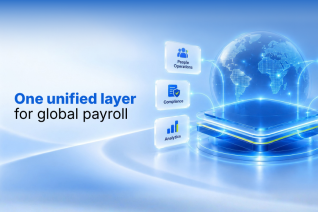
Beyond individual queries, ARIA consolidates payroll policies, compliance rules, and case histories into a unified knowledge base, helping HR and payroll teams spot patterns and anomalies and ground decisions in data, not intuition. Built on Neeyamo's unified global payroll architecture, it harmonizes inputs, validates data before processing, and embeds compliance checks across jurisdictions. It is not a standalone chatbot. It is the intelligent layer of a globally integrated payroll system.
Employee Portals are a Strategic Asset, Not a System of Record
One framing error organizations repeatedly make is treating the employee portal as infrastructure necessary, but not strategic. That framing is outdated.
The portal generates behavioral data: what employees look for, where they get stuck, which queries recur, which documents are never accessed. That data is a window into the employee experience. Organizations that analyze it can identify friction points before they become frustrating. They can surface unmet needs before they become attrition.
With ARIA in the picture, this intelligence becomes active. Rather than waiting for data to be analyzed and acted upon, ARIA's adaptive learning continuously improves the quality and relevance of interactions, delivering outcomes that are accurate, contextual, and human-like, at scale.
What This Means for HR Leadership
The practical question for HR leaders is not whether to invest in a unified employee portal; the case for that is settled. The question is what kind of portal, and whether it is genuinely fit for the workforce it is meant to serve.
The checklist is straightforward:
- Does it function across all the countries where your workforce operates?
- Is it genuinely self-service, or does it still route employees back to HR for common tasks?
- Is it integrated with payroll, time, compliance, and benefits, or is it another silo?
- Can it support employees in multiple languages and time zones?
- Does it allow employees to interact naturally, not just navigate?
- Does it provide HR with visibility into how it is being used?
If the answers reveal gaps, those gaps are not just operational. They are experience gaps, and experience gaps, at scale, become engagement gaps.
The Front Door Is Already Open
The organizations that have invested in robust employee portals are not ahead of a trend. They are ahead of a standard that is rapidly becoming table stakes.
This is where Neeyamo's Employee Hub comes in. It is a central repository of employee master data that integrates self-service capabilities, manager workflows, service desk functionality, and knowledge management into a single platform. For organizations managing workforces across long-tail countries, where local regulatory requirements can vary significantly, Hub delivers the governance and consistency that fragmented systems just cannot.
ARIA is what brings that foundation to life. It transforms the portal from a place employees visit into an assistant they can speak to, type to, or click through; one that learns, responds, and acts with the kind of precision and immediacy the modern workforce expects.
The employee portal is no longer a convenience. It is the architecture of the employee-organization relationship. Organizations that recognize this are building a more responsive, more accurate, and more trusted HR function.
The front door is already open. The question is what employees find when they walk through it.
Explore how Neeyamo Hub and ARIA can transform your HR and payroll operations. Write to us at irene.jones@neeyamo.com to know more!