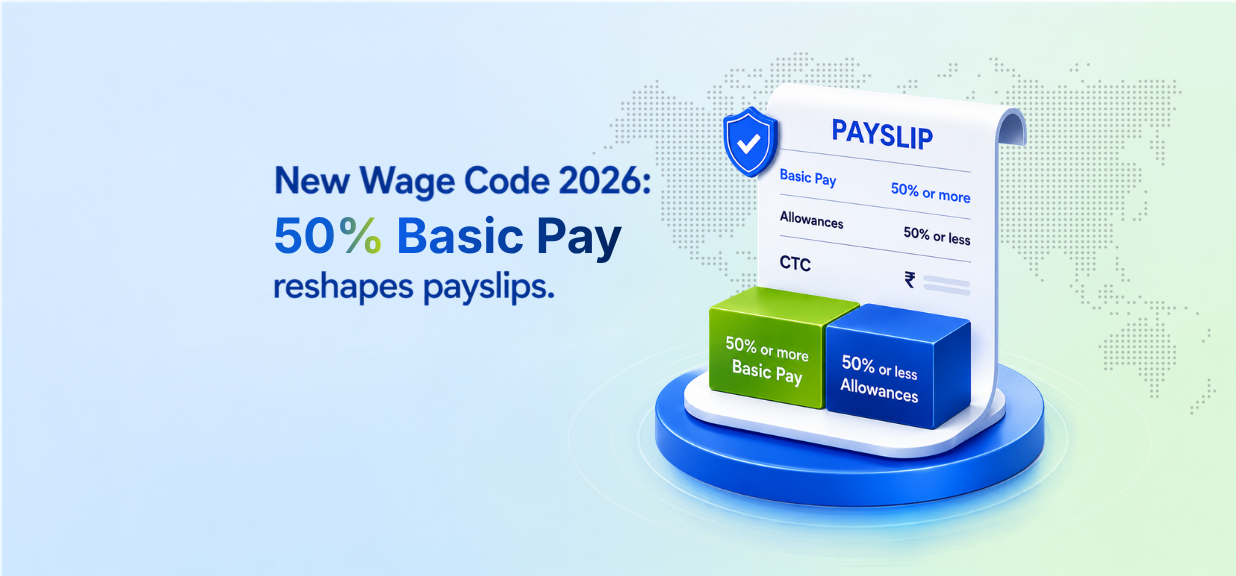
July 2026 marked the salary restructuring of the payslip in accordance with the New Wage Code under the Code of Wages, 2019. The 50% basic pay rule impacts take-home pay, PF savings, and gratuity. Of the four comprehensive labor codes, the Code on Wages, 2019, has garnered significant interest from organizations and employees alike because it directly affects the way compensation is defined, structured, and administered.
Delineating the Code
While the Code on Wages received Presidential assent in August 2019, implementation was delayed because of complex state-wise formulation of the policies. The legal effective date came into force on 21 November 2025. However, many employers chose July as their salary restructuring cycle, as it marks the beginning of payroll revision.
Instead of introducing a new concept of wages, the term's definition has been changed to simplify compliance, improve transparency, and strengthen employee security across sectors. Historically, employers had flexibility in designing salary structures, and a common approach was to keep the basic pay relatively low and the allowances such as House Rent Allowance (HRA), conveyance allowance, and other reimbursements high. The New Wage Code introduces a provision requiring basic pay to be at least 50% of the CTC. The new wage definition now includes,
- Basic Pay
- Dearness Allowance
- Retaining Allowance
If the total of specified allowances, such as gratuity and retrenchment, exceeds 50% of the total employee remuneration, that portion is deemed "wages" and used to calculate PF, gratuity, and ESI. The Code on Wages, 2019 also introduced a new exit settlement rule. The employer must ensure a complete and final settlement (F&F) within 48 hours for the exiting employee.
Statutory Contributions and Their Implications
The employee and employer contributions, now based on the higher wage, improve long-term retirement benefits better than the previous regime. The government aims to create greater consistency in salary structures and to prevent excessive reliance on allowances, thereby strengthening employees' long-term social security.
The previous gratuity law required five years of continuous service before an employee became eligible for gratuity. While this applies to permanent employees, contract workers or fixed-term employees (FTEs) are eligible for pro-rata gratuity after just one year of service under the new rule. Additionally, even long-serving employees will receive a higher gratuity payout since the new definition refers to the broader wage base.
Implications for Payroll Post the New Rule (2026)
Though this appears to be a straightforward adjustment, it has significant downstream implications for payroll. Many employees expect their monthly salary to remain unchanged. While the annual CTC may remain the same, several salary components are likely to shift. The component changes are as follows:
Organizations with relatively low base salaries and higher allowances would adjust to rebalance their components. Employees may notice increased basic pay and reduced allowances; from a bird's-eye view, the salary structure would be structured differently, while the CTC remains the same.
- Increased Provident Fund (PF) Contribution:
A higher basic salary would lead to higher PF contributions, increasing employee and employer PF deductions and resulting in greater retirement savings over time. Some employers adopt statutory PF wage caps when applicable, while employees can contribute through Voluntary Provident Fund (VPF) options.
- Significant Gratuity Benefits
All gratuity calculations are based on wages, and with higher basic pay, employees accumulate larger gratuity benefits, ensuring long-term financial security for long-term employees. While gratuity is only realized upon termination and under specified circumstances, the long-term value can increase significantly under the revised salary structure.
One of the commonly discussed outcomes of the wage code is the impact on take-home pay. This is a result of higher basic wages, and this reduction is offset by increased retirement savings and enhanced statutory benefits.
Why the New Wage Code Matters
For payroll and HR leaders, the reform marks a move from highly flexible compensation structures to a more standardized approach. While organizations can still retain flexibility, they have to abide by the prescribed wage definition and statutory thresholds. This has implications across the organizational structure.
The revised definition of wages under the Code on Wages applies across India. While individual states may prescribe procedural rules for implementation, employers in every state must align their salary structures and statutory wage calculations with the Code's provisions to ensure compliance.
For employers, the new structure calls for a review of compensation strategies, payroll processes, and compliance frameworks to ensure alignment. Salary restructuring is the primary consideration, and while this does not necessarily mean a higher CTC, it alters the composition of compensation and statutory contributions. Employers must assess the long-term cost implications of the revised salary structures, and beyond this, payroll systems have to accurately classify wage components and calculate statutory deductions.
Alongside this, employees must be informed about the revised structures, with an emphasis on take-home pay, deductions, and long-term benefits. Employers who communicate such changes proactively build employee trust and confidence.
For employees, the visible impact is on their monthly payslip. While the overall CTC remains unchanged, the composition shifts towards wages, with higher PF contributions and a small deduction in monthly take-home pay. This also promotes greater transparency in compensation and gives employees a clearer picture of statutory benefits. In the long run, this will enable employees with stronger social security and an equitable compensation framework.
The Impact on Payroll and Compliance
The most prominent change in payroll processes is to reflect the revised legal framework and to ensure ongoing compliance requirements that impact every stage of the payroll lifecycle. When reconfiguring payroll systems, organizations that were reliant on customized compensation structures must assess whether the relevant components align with the revised statutory requirements. Payroll engines need to update wage and non-wage elements and calculate contributions. For organizations that operate as GCCs, maintaining consistency is equally important; even minor discrepancies can lead to inaccurate deductions, payroll errors, or compliance gaps.
Also read: How GCCs Optimize Payroll Delivery for Multinationals
As part of the new reform, organizations must demonstrate that the compensation structure complies with the legal definition. This leads to greater emphasis on governance, documentation, and readiness. Regular internal audits can help identify potential issues before they lead to statutory penalties. Changes to salary structures require coordination between HR, finance, legal, tax, and payroll to ensure consistency and that local regulatory changes are reflected within global HRIS platforms, payroll engines, finance systems, and reporting frameworks. Automated payroll platforms equipped with built-in capabilities help organizations implement such legislative and regulatory updates accurately and consistently.
Example:
| Component |
Old Wage Structure |
New Wage Code (50% Rule) |
| Total Monthly Remuneration |
₹76,000 |
₹76,000 |
| Basic Pay + Dearness Allowance (DA) |
₹20,000 |
₹38,000 |
| Allowances |
₹56,000 |
₹38,000 |
| Wages Considered for Statutory Compliance |
₹20,000 |
₹38,000 |
| PF, Gratuity & Other Statutory Benefits Calculated On |
₹20,000 |
₹38,000 |
| Compliance with 50% Wage Rule |
❌ Not Required |
✅ Compliant |
The Lasting Impact
The New Wage Code is something beyond a legislative update; it is a catalyst for payroll transformation. This marks a significant step in creating a transparent, standardized, and equitable compensation system. The broader significance of the 50% wage rule reshapes payroll and statutory compliance.
Organizations that invest in robust payroll technology and proactive compliance practices are better equipped to navigate evolving reforms. Therefore, the New Wage Code is more than a salary restructuring reform; it is a shift in modernizing payroll.
Reach out to us at irene.jones@neeyamo.com to know more!