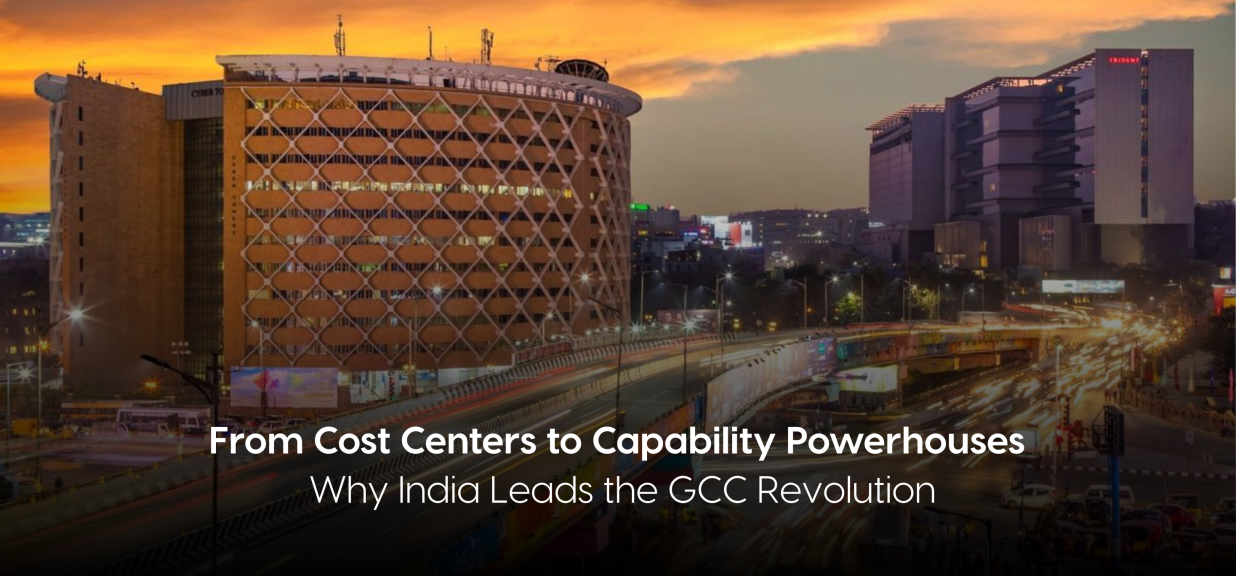
India is home to more than 1,800 Global Capability Centers employing over 2.16 million professionals, making it the largest GCC ecosystem in the world.
Over the past three decades, Global Capability Centers (GCCs) have evolved from cost-driven offshore units into strategic engines of enterprise transformation. Today, multinational organizations rely on GCCs not only for operational support but also for innovation, digital product development, and enterprise-wide decision-making.
As companies rethink global operating models in the era of AI, automation, and digital transformation, GCCs have become a critical component of long-term growth strategies. Organizations increasingly seek locations that combine talent, scalability, and innovation ecosystems to support these evolving capabilities.
India has consistently emerged as the preferred destination for this new generation of GCCs. With a deep pool of deep-technology talent, a mature ecosystem built over decades, and an expanding innovation landscape, the country continues to attract global enterprises seeking to scale their capabilities.
From Support Centers to Strategic Capability Hubs
The GCC model has undergone a significant transformation over the years. In the early days, multinational companies established offshore centers primarily to handle IT services and back-office operations. The focus was largely on cost optimization and operational efficiency.
As these centers matured, their responsibilities expanded. GCCs began supporting a wider range of functions such as finance, human resources, analytics, and procurement. Organizations gradually realized that these centers could contribute far beyond operational tasks. They could also support strategic decision-making and enterprise growth.
Today, GCCs play a far more sophisticated role. Many of them lead initiatives in artificial intelligence, product engineering, cybersecurity, and digital transformation. In several organizations, GCC leaders now participate directly in global strategy discussions and help shape innovation roadmaps and business priorities.
India has played a central role in enabling this shift by providing companies with the scale and expertise required to support advanced capabilities.
Also Read | How GCCs Are Shaping the Future of Global Enterprises
Talent: India’s Enduring Advantage
One of the strongest drivers behind GCC expansion in India is the country’s vast talent pool. India produces millions of graduates in science, technology, engineering, and mathematics each year. In fact, around 31% of global STEM graduates come from India, making it one of the largest sources of technical talent worldwide.
For global enterprises, this scale of talent offers a significant advantage. Companies can build large teams of engineers, data scientists, cloud specialists, and cybersecurity experts within a single ecosystem.
Beyond technical expertise, Indian professionals bring strong communication skills, global exposure, and experience working in distributed teams. These qualities make it easier for multinational companies to integrate Indian GCCs into their global operating models.
The ability to access and scale talent quickly continues to make India one of the most attractive locations for capability centers.
A Mature and Resilient GCC Ecosystem
Another key factor behind India’s GCC leadership is the maturity of its ecosystem. Over the past three decades, the country has built a robust network of technology partners, consulting firms, startup communities, and academic institutions that support enterprise innovation.
As a result, India now hosts nearly half of all GCCs worldwide, reinforcing its position as the global epicenter of capability centers. This number is expected to grow significantly, with over 25 new GCCs likely in the next two to three years.
For companies establishing new GCCs, this mature ecosystem offers several benefits. Organizations can tap into experienced leadership talent, well-established delivery frameworks, and a supportive environment that understands the needs of multinational enterprises.
Leading companies across industries, including banking, technology, healthcare, manufacturing, and consumer goods, have already built large capability centers in India. Their continued investments further strengthen the ecosystem and attract new global entrants.
Beyond Cost: A Hub for Innovation
While cost efficiency originally fueled the GCC movement, the value proposition has evolved significantly. Today, India is increasingly viewed as a hub for innovation and digital capability building.
Modern GCCs in India lead initiatives in areas such as artificial intelligence, digital product development, engineering research, and advanced analytics. These centers are no longer limited to supporting global operations. They are actively shaping the future of enterprise technology.
India’s vibrant startup ecosystem also contributes to this innovation environment. Thousands of technology startups operate across sectors such as fintech, health tech, and deep tech. This creates opportunities for GCCs to collaborate with emerging innovators and accelerate product development.
This culture of experimentation and collaboration allows enterprises to build innovation pipelines directly from their capability centers.
Register Now | Neeyamo N’gene - Hyderabad
The GCC Landscape Is Expanding Across India
For many years, GCC growth in India was concentrated in major metropolitan cities such as Bengaluru, Hyderabad, Pune, Chennai, Mumbai, and Delhi NCR. These cities continue to serve as the primary hubs because of their strong infrastructure and talent availability.
However, the next phase of GCC expansion is increasingly moving beyond these metro locations.
Emerging cities such as Coimbatore, Kochi, Ahmedabad, Indore, and Bhubaneswar are gaining attention from global enterprises. These locations offer access to new talent pools while maintaining lower operational costs and improving infrastructure.
For many organizations, building a distributed GCC model across multiple Indian cities has become an effective strategy for achieving both resilience and scalability.
Know More | How India Became the Backbone of Global Capability Centres
The Future of GCCs in India
India’s GCC ecosystem is entering a new phase of growth. As enterprises adopt AI-driven operating models and accelerate digital transformation, capability centers will play an even more strategic role in global business operations.
India’s ability to combine large-scale talent availability with a thriving innovation ecosystem positions it well for this next phase.
The economic potential of the sector is significant. By 2030, GCCs could contribute between $154 billion and $199 billion in direct economic value to India’s economy, reflecting the sector’s continued expansion.
As these centers grow in complexity and scale, organizations will increasingly focus on building resilient workforce strategies, managing distributed teams, and ensuring compliance across multiple markets.
Conclusion
Global Capability Centers have become a cornerstone of modern enterprise strategy. They enable organizations to accelerate innovation, scale digital capabilities, and build resilient global operations.
India’s combination of deep talent pools, ecosystem maturity, and innovation capacity has positioned it as the natural home for these centers. What began as a cost-driven model has evolved into a powerful engine for enterprise transformation.
For global companies looking to build future-ready capabilities, India continues to offer an unmatched advantage and remains the epicenter of GCC expansion.
Explore more insights on the global workforce and the capability center transformation here, or simply talk to our expert at irene.jones@neeyamo.com