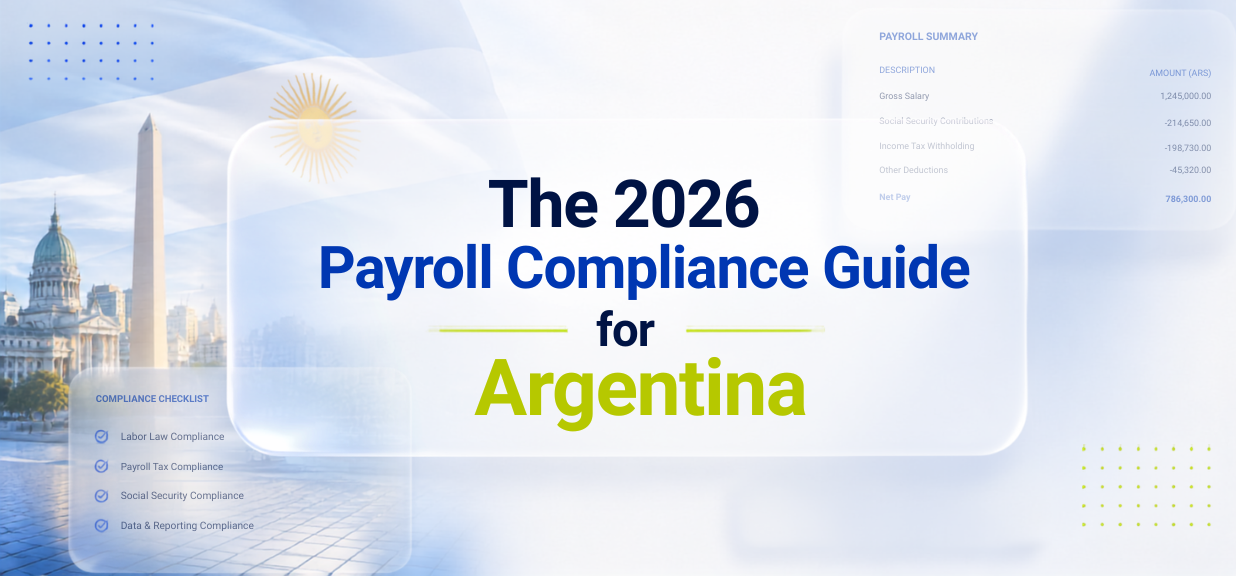
On 6 March 2026, Argentina made history. President Javier Milei signed Law 27.802, the Ley de Modernización Laboral, into the Official Gazette via Decree 137/2026, marking the most sweeping overhaul of Argentine labor law in decades. Spanning 196 articles, the reform touches everything from how employment relationships are defined to how severance is calculated, to an entirely new employer-funded contribution mechanism that comes into effect on 1 November 2026.
For multinationals and global employers managing payroll across Latin America, this law is not a background update; it demands immediate attention. At Neeyamo, we help organizations stay ahead of exactly these kinds of tectonic shifts in global payroll compliance. For a broader view of Argentina's employment landscape, from statutory benefits to payroll cycles, visit our Argentina Global Employment Guide.
But what is this reform all about?
The 2026 Labor Modernization Law (Law No. 27,802), enacted by President Javier Milei through Decree 137/2026, marks Argentina’s most significant labor reform in more than five decades. The legislation aims to reduce employment litigation, lower labor costs, and promote formal hiring through greater workforce flexibility.
Key changes include stricter distinctions between employees and independent contractors, the introduction of a new worker-collaborator category for gig and platform workers, revised severance calculations that exclude aguinaldo, vacation pay, and one-time bonuses, and the launch of the Fondo de Asistencia Laboral (FAL) in November 2026, a pre-funded severance system financed through employer contributions. The reform also expands probation periods, allows hour-bank arrangements for overtime compensation, and limits union protections by ending automatic extensions of expired collective agreements and imposing tighter restrictions on strikes in essential services.
Why Argentina Needed This Reform
Argentina's previous labour framework, built around the Ley de Contrato de Trabajo (LCT), was widely seen as rigid and litigation-heavy. Employers faced unpredictable severance costs, aggressive court interpretations of employment relationships, and onerous registration penalties for unregistered workers. Between November 2023 and September 2025, more than 20,000 businesses with registered employees shut down, a pace of roughly 30 per day.
Law 27.802 is designed to reverse this trajectory by:
- Reducing legal uncertainty around employment classification
- Introducing more predictable dismissal cost mechanisms
- Expanding non-remunerative benefits (with direct payroll implications)
- Creating incentives for formalizing informal workers
- Regulating the gig economy with a clear legal framework
The result is a law that simultaneously lowers employer costs and attempts to bring hundreds of thousands of informal workers into the formal economy.
Key Changes Under Argentina Law 27.802:
1. The Labor Assistance Fund (FAL)
The Fondo de Asistencia Laboral (FAL) is the centerpiece of the reform and the change with the most direct impact on Argentina's payroll compliance in 2026.
Effective 1 November 2026, all employers must make monthly contributions to the FAL, calculated on the basis of wages registered in Argentina's Integrated Pension System (SIPA):
| Employer Type |
Monthly FAL Contribution |
| Large Companies |
1% of the SIPA wage base per worker |
| Micro, Small & Medium Enterprises (MipYMEs) |
2.5% of the SIPA wage base per worker |
How the FAL works:
- The fund is held and managed by entities authorized by Argentina's National Securities Commission (CNV)
- Accumulated contributions can be drawn to cover statutory severance obligations partially or fully
- Critically, the FAL does not replace severance law; it acts as a structured financial buffer
- Employers participating in the FAL receive an equivalent reduction in their employer contributions to the social security system, making the mechanism broadly cost-neutral
The practical implication for payroll teams: you now have a new monthly line item in Argentina payroll runs, active from 1 November 2026. Payroll systems must be configured to calculate, withhold, and remit FAL contributions correctly. The national executive may extend the effective date by up to six additional months, but prudent compliance means preparing now.
Neeyamo Compliance Note: The Argentina FAL contribution 2026 requires updates to payroll calculation engines, worker classification tagging (large vs. SME), and reporting configurations. Employers should confirm with their local payroll provider that these changes are live before the November deadline.
2. Severance Calculation
Under the old framework, disputes over severance calculations were common and costly. Argentina Law 27.802 payroll compliance becomes more predictable with the following changes:
What's excluded from the severance base:
- The Sueldo Anual Complementario (SAC / 13th salary)
- Vacation pay
- Any bonuses not paid on a monthly basis
What's included:
- For variable items (bonuses, commissions, overtime): the average of the last 6 months, or the last full year, whichever is more beneficial to the employee
- Only payments accrued for at least 6 months during the last calendar year qualify as "customary"
Severance cap: Capped at three times the average salary defined in the relevant collective bargaining agreement codifying the principle from the Argentine Supreme Court's Vizzoti ruling into statute.
Installment payment of court judgments:
- Large companies: up to 6 monthly installments
- Micro, small, and medium enterprises: up to 12 monthly installments
- All adjusted using the Consumer Price Index (CPI) plus an annual interest rate of 3%
This unified CPI + 3% formula replaces a patchwork of inconsistent court-applied interest rates, bringing much-needed predictability to employment law compliance in Argentina.
3. Extended Probation Periods
The Argentina Labor Modernization Law payroll 2026 changes extend the standard probation period significantly:
| Company Size |
New Probation Period |
| All employers (default) |
6 months (up from 3) |
| Companies with 6-100 employees (via collective bargaining) |
Up to 8 months |
| Companies with up to 5 employees |
Up to 12 months |
During the probationary period, either party can terminate the relationship without severance obligation, and no prior notice (preaviso) is required. For payroll teams, this means a longer window during which termination does not trigger the standard severance calculation, simplifying offboarding processes for new hires who do not work out.
4. Non-Remunerative Benefits
One of the most significant payroll-level changes in Argentina Law 27.802 is the formal codification of non-remunerative social benefits. The following items are now explicitly excluded from the salary base and therefore not subject to:
- Social security contributions
- Severance calculations
- Annual bonus (aguinaldo) base
- Vacation pay base
Items now classified as non-remunerative:
- Employer-provided meal and food services/allowances
- Comprehensive medical plan benefits (or employer-paid premium portion)
- Mobile phone and internet expenses used exclusively for work
- Automobile expenses (supported by receipts)
- Childcare, nursery services, and education/training expenses
Why this matters for Argentina payroll compliance 2026: Previously, many of these items sat in a legal grey zone, and courts had sometimes reclassified them as hidden salary, triggering back-payments of social security and inflating severance. The law resolves this ambiguity. Payroll teams can now structure compensation packages with greater certainty, and benefit programs should be reviewed and remapped accordingly.
Additionally, Article 104 bis introduces "dynamic" compensation components, fixed or variable pay elements tied to individual merit or organizational factors that employers can introduce, modify, or discontinue unilaterally or by mutual agreement. This expands flexibility in Argentina's historically rigid salary structures.
5. Platform and Gig Workers
Law 27.802 formally establishes a legal regime for platform-based workers (ride-hailing, food delivery, etc.), classifying them as independent contractors rather than employees, provided they maintain genuine autonomy over when and how they work.
Key features of the platform worker regime:
- Workers retain freedom to connect/disconnect and refuse orders
- Platforms must provide personal accident insurance covering death or disability
- Data portability rights are guaranteed
- Unregistered platform arrangements can be regularised within 180 days of enactment under the new Registered Employment Promotion Program (PER)
For companies operating marketplace or platform models in Argentina, this classification certainty removes a significant legal exposure that previously resulted in costly employment reclassification claims.
6. Labor Formalization Incentives
Two new programs support the transition from informal to formal employment:
RIFL (Labor Formalization Incentive Regime): Employers gain social security contribution benefits for each new formal hire added during the program's one-year validity window.
PER (Registered Employment Promotion Program): Allows regularisation of unregistered or improperly registered employment relationships that existed prior to the law's enactment, within a 180-day window.
For global companies with entities in Argentina, now is the time to audit workforce classification and ensure all workers are correctly registered, both to avoid penalties and to take advantage of formalization incentives.
7. Employment Certificate Timelines & Digital Recordkeeping
The deadline for delivering employment certificates following termination has been extended to 45 business days. Importantly, employers can now satisfy this requirement by making certificates available electronically through the ARCA digital system, significantly reducing administrative risk and the potential for fines.
This shift toward digital compliance infrastructure aligns with the broader direction of Argentine labor administration and is a practical improvement for HR and payroll operations teams.
8. Special Labor Statutes
From 1 January 2027, several sector-specific labor statutes will be repealed, and those workers will be absorbed into the general labor regime under the LCT. Affected statutes include those covering:
- Traveling sales representatives (Law 14,546)
- Journalists (Law 12,908)
- Glass industry workers
Employers in these sectors should begin transition planning now, as the applicable employment terms, benefits, and payroll calculations will shift materially.
What Remains Under Legal Scrutiny
It is important to note that Argentina Law 27.802 has not gone unchallenged. On 30 March 2026, Argentina's National Labor Justice system suspended certain articles of the law following concerns raised by the General Confederation of Labor (CGT) regarding constitutionality. Approximately 40% of the bill's articles, including those related to extended working hours, strike restrictions, and union assembly regulation, are subject to precautionary suspension pending further review.
For payroll compliance purposes, the provisions most directly affecting payroll, the FAL contribution, severance calculation rules, non-remunerative benefits, and probation period changes are largely intact and should be treated as operative.
Neeyamo strongly recommends that employers monitor judicial developments and consult legal counsel before applying suspended provisions. This is a fast-moving legal landscape.
The Compliance Checklist for Global Payroll Teams
With the Argentina Labor Modernization Law payroll 2026 now in effect, here is what your payroll and HR operations teams should be actioning:
Immediate (Before 1 November 2026):
- Configure payroll systems to calculate and remit the FAL contribution (1% large / 2.5% SMEs)
- Confirm your local payroll provider or Employer of Record has FAL contribution logic live
- Review and reclassify benefits packages against the new non-remunerative benefit definitions
- Update severance calculation templates to exclude SAC and non-monthly bonuses
- Audit platform/gig worker arrangements for correct classification under the new regime
Short-Term (Within 90 Days):
- Review probation period policies and update employment contract templates
- Assess the informal or misclassified workforce for PER regularisation eligibility
- Update employment certificate issuance workflows to leverage ARCA digital system
- Register for RIFL if planning new hires in Argentina
Strategic (Before January 2027):
- Review the workforce in sectors affected by the sunsetting of special statutes (journalists, sales representatives, and the glass industry)
- Model the financial impact of FAL contributions on the total cost of employment
- Incorporate the new CPI + 3% adjustment formula into multi-year labor cost projections
How Neeyamo Can Help
Managing Argentina Law 27.802 payroll compliance is complex, especially for multinational organizations running payroll across dozens of countries simultaneously. At Neeyamo, our global payroll platform and in-country compliance expertise are built precisely for this.
We help global employers:
- Adapt payroll engines to reflect new FAL contribution calculations
- Maintain compliance with Argentina's ARCA digital recordkeeping requirements
- Navigate worker classification decisions from full-time hires to platform contractors
- Stay ahead of evolving judicial interpretations as Law 27.802 is tested in courts
Argentina's reforms represent an opportunity: the country is positioning itself as a more investible, predictable destination for global workforce expansion. Getting your Argentina payroll compliance 2026 right from the outset is the foundation for capturing that opportunity. For more information, contact us at irene.jones@neeyamo.com.