Payroll has always been one of the most data-rich functions in any organization. And yet, for decades, it remained one of the least intelligent.
The numbers existed. The patterns were there. But the ability to read them, act on them, and turn them into decisions that moved the business forward? That was largely absent.
That is no longer the case.
Artificial intelligence is not simply making payroll faster. It is fundamentally changing what payroll data can reveal, when organizations can access it, and what they can do with it. The evolution from static reporting to real-time, predictive, and insight-led payroll intelligence is one of the most consequential shifts in HR technology today.
This blog traces that journey, from the era of spreadsheets to the age of autonomous intelligence, and examines what it means for payroll teams, finance leaders, and the organizations they serve.
Payroll Analytics Began as a Rearview Mirror
Cast your mind back to how payroll data was used even as recently as the early 2000s.
Payroll teams generated cycle-end reports that had headcount costs, overtime hours, leave balances, and variance summaries. These were manually compiled, often in spreadsheets, and delivered to finance or HR leadership days or weeks after the payroll run had closed.
The information was accurate. It was also ancient by the time anyone acted on it.
There was no mechanism to flag anomalies in real time. No way to detect patterns across geographies. No predictive lens on what the next payroll cycle might look like, given current workforce trends.
Analytics, in that era, served one purpose: to document what had already happened.
The Dashboard Era: Seeing More, But Still Looking Back
The arrival of cloud-based payroll platforms in the mid-2000s changed how data was delivered, but not its fundamental nature.
Dashboards became a standard feature. Payroll leaders could now visualize trends across pay cycles for cost per employee by country, headcount movement by quarter, and overtime patterns by department. For the first time, it was possible to compare payroll data across regions without manually consolidating spreadsheets.
This was progress. But it was still descriptive analytics, a cleaner, faster version of the rearview mirror.
The dashboards showed what had happened. They did not explain why. They did not predict what would happen next. And they said nothing about what action the business should take.
The scale of investment in this era was significant. This was when the global HR payroll software market grew at a CAGR of 11.23% between 2019 and 2024, reaching $35.26 billion, much of it driven by the shift to cloud and the rising demand for better reporting tools.
Yet investment in tooling did not automatically translate into intelligence. Dashboards made payroll data more accessible and easier to visualize, but they could only be as reliable as the information feeding them. And in many organizations, that underlying data was far from dependable.
ALSO READ | Why AI Matters in Payroll Today: The Real Reason Behind the Shift
The Data Problem Nobody Was Talking About
There is an uncomfortable truth that sits beneath most payroll analytics conversations: the data was never clean enough to be truly useful.
Payroll data, particularly in global organizations, lives in silos. HR systems, time-and-attendance platforms, ERP tools, tax engines, and local in-country payroll systems that rarely communicate in real time. The result is fragmented, inconsistent, and often contradictory data sets.
When the inputs are unreliable, the outputs are too.
Organizations can lose between 2% and 5% of their annual payroll spend to payroll leakage due to overpayments, manual processing errors, policy violations, and weak controls. For large enterprises, these inefficiencies can translate into millions of dollars in avoidable losses every year.
Those are not simply technology failures. They are data quality failures.
This is the foundation problem. Layering analytics on top of broken data pipelines yields unreliable analytics. And AI has made this problem impossible to ignore, because intelligent systems are only as good as the data that feeds them.
The drive toward AI-powered payroll has, in many cases, become the catalyst for long-overdue investment in data infrastructure.
Entering the AI Era: From Descriptive to Predictive
The shift from descriptive to predictive analytics is not subtle. It is structural.
Descriptive analytics answers: What happened?
Predictive analytics answers the question: What is likely to happen, and what should we do about it?
AI-powered payroll systems can now identify anomalies before a payroll run closes, flagging unusual overtime patterns, detecting duplicate entries, and surfacing compliance risks before they become violations. They can model the cost implications of workforce changes, detect signals of attrition risk embedded in payroll behavior, and analyze compensation equity gaps across geographies.
The payroll teams embracing predictive analytics are not simply processing payroll faster. They are changing the questions they can answer and the decisions they can influence.
Payroll as a Source of Strategic Intelligence
There is a larger story here, and it involves the CFO, the CHRO, and the board.
For years, payroll sat at the periphery of strategic planning. It was operationally critical but analytically invisible. Business leaders made workforce planning decisions without a clear view of their actual payroll cost trajectory.
That is changing.
When AI processes payroll data at scale and connects it to broader workforce variables, it surfaces insights that belong in the boardroom: workforce cost trends, overtime escalation patterns, compensation benchmarking gaps, geographic cost arbitrage opportunities, and signals of attrition.
These are not payroll reports. They are business intelligence assets.
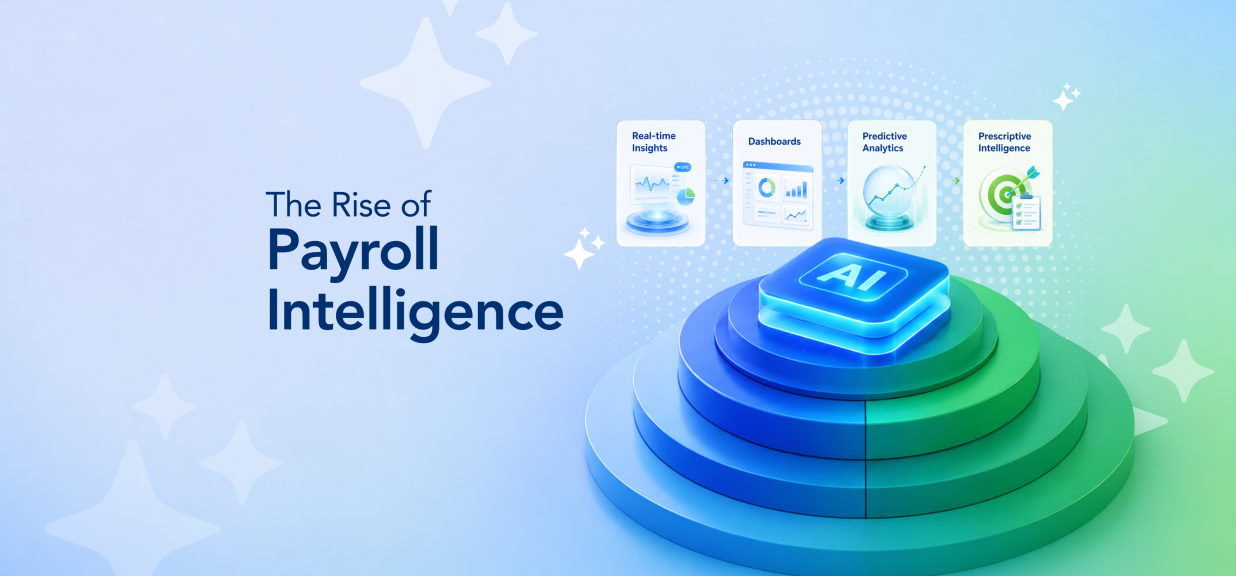
The types of analytics shaping this shift can be understood in four stages:
Descriptive analytics establishes the baseline: what happened, when, and at what cost. This is the reporting layer most organizations already have.
Diagnostic analytics goes a step further, not just documenting variance, but explaining it. Why did overtime spike in a specific region? Why did the headcount cost increase despite a freeze?
Predictive analytics uses historical patterns to model what is likely to happen next, such as flagging compliance risk before a violation occurs, or forecasting payroll cost increases before they hit the budget.
Prescriptive analytics is the frontier. This is where AI systems that not only predict outcomes but also recommend actions, such as adjusting staffing levels, revising pay structures, and triggering compliance reviews. This is where payroll stops being reactive and starts being genuinely strategic.
The organizations that recognize this shift are repositioning payroll, not as a back-office cost center, but as a source of real-time workforce intelligence that informs planning, budgeting, and talent strategy.
What Payroll Professionals Should Prioritize Now
As AI becomes more deeply embedded in payroll operations, the priority is no longer simply processing payroll efficiently. It is building the capabilities to interpret data, govern intelligent systems, and drive better business decisions.
Payroll professionals should focus on
- Strengthening data quality
- Embracing predictive analytics
- Developing the necessary skills needed to translate payroll insights into strategic decisions
- Ensuring that the processes operate within the compliance and governance frameworks required in the global environment.
AI can automate repetitive tasks and surface insights at scale, but human expertise remains essential for applying judgment, managing exceptions, and guiding organizational decisions.
The future of payroll is not defined by humans competing with AI. It is defined by payroll teams using AI to elevate their impact, shifting from transactional execution to strategic leadership.
ALSO READ | Redefining AI in Payroll with Neeyamo's ARIA
The Road Ahead: Continuous, Insight-Led Payroll
The trajectory from reporting to dashboards, from dashboards to predictive analytics, and from predictive analytics to prescriptive intelligence is not a straight line. It is a compounding curve.
The next phase is not a monthly payroll run followed by a quarterly analytics review. It is continuous intelligence where payroll data feeds real-time insights, compliance alerts surfacing the moment a regulatory change is enacted, and workforce cost signals updating the moment headcount decisions are made.
The organizations investing in payroll intelligence today are not simply upgrading a back-office system. They are building the data infrastructure that will define their workforce competitiveness for the entirety of the next decade.
Neeyamo: Building the Intelligent Payroll Foundation
Neeyamo has been building toward this moment for years.
With a global payroll engine spanning 180+ countries and a unified platform architecture that eliminates the data fragmentation that undermines most multi-vendor payroll environments, Neeyamo gives organizations the one thing AI-powered analytics requires above all else: clean, connected, and consistent payroll data.
The philosophy is direct: payroll should not require leaders to wait for a report to know what is happening in their workforce. It should be always-on, always-aware, and always-actionable.
For organizations navigating global complexity, managing distributed workforces, and demanding more from their payroll investments, the evolution of payroll analytics is not a trend to observe from a distance. It is a capability to build now!
To learn more about how Neeyamo is shaping the future of intelligent global payroll, reach out to us at irene.jones@neeyamo.com.