Global Capability Centers (GCCs) are no longer built simply to centralize back-office work. As their responsibilities expand into technology, finance, analytics, tax, and enterprise transformation, another complex function is coming into focus: global payroll.
The shift is significant. Deloitte reported in a study that India had more than 1,800 GCCs, with projections indicating the ecosystem could reach 2,400 to 5,000 centers by 2030. GCCs are also evolving from cost-focused operations into strategic value creators.
As this evolution continues, organizations are rethinking not just where payroll is processed, but who owns the global payroll capability.
The Fragmentation Problem Behind Global Payroll
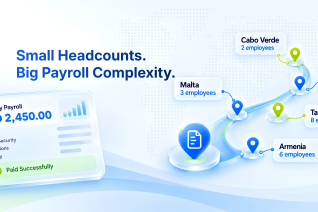
For a multinational organization, payroll rarely operates as one unified function. Different countries may have different payroll calendars, tax rules, statutory requirements, employee data structures, technologies, and local processes. The result is a network of country-level operations that work independently but lack a common global operating model.
Deloitte's Global Payroll Benchmarking research illustrates the scale of the organizations dealing with this complexity. Its latest survey covered 15 global companies with between 25,000 and 240,000 active employees, across technology, financial services, media and entertainment, telecommunications, consumer, and life sciences and healthcare. The research examined payroll structure, operations, technology integration, and cost.
At that scale, payroll is no longer simply an administrative process. It becomes an enterprise capability that requires governance, visibility, consistency, and accountability.
Why GCCs Are Well Positioned to Take Ownership
The evolution of GCCs provides an important context for this shift. Payroll can become part of this transformation rather than every country operating as a separate payroll island; a GCC can establish ownership of the global framework while allowing country teams to retain the expertise required for local execution. That distinction is important. Global ownership does not have to mean global uniformity.
From Country-Level Payroll to a Global Operating Model
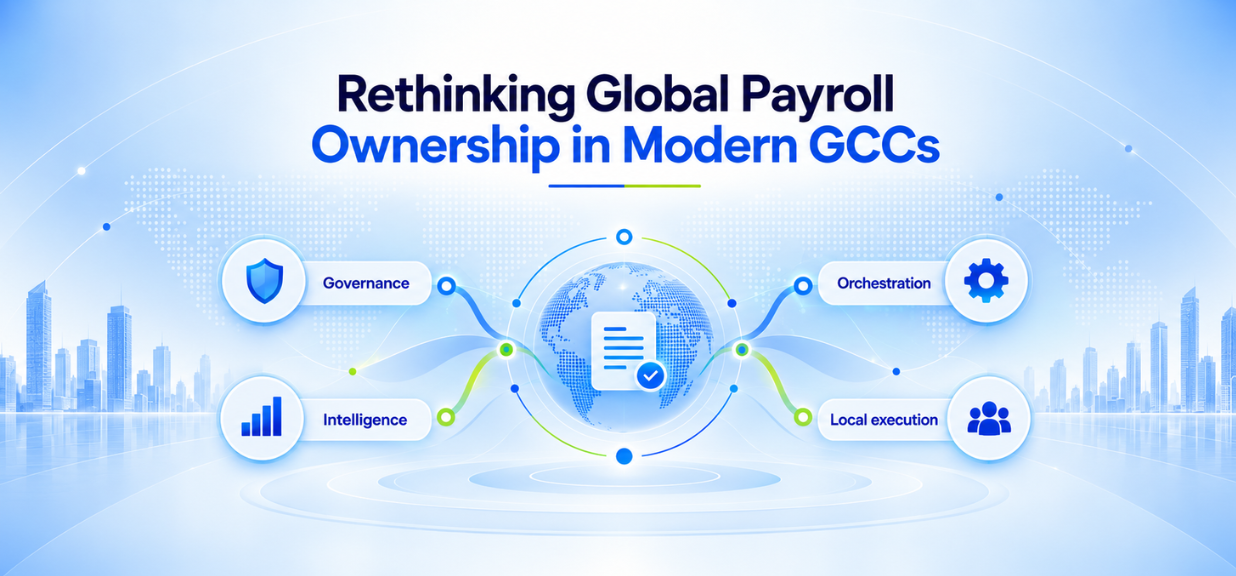
A more mature approach to Global Payroll for Global Capability Centers can be structured around three interconnected layers:
Orchestration: Connecting countries, processes, systems, data, and stakeholders through a coordinated operating model.
Governance: Establishing global standards, controls, accountability, and performance measures while accommodating country-specific requirements.
Intelligence: Bringing together payroll data, analytics, automation, and regulatory information to create greater visibility and support faster decisions.
This becomes particularly relevant as tax and regulatory complexity increases. Deloitte's 2026 Global Tax Policy Survey, which gathered responses from more than 1,100 tax and finance executives across 28 countries, found that 40% identified compliance demands as an area of concern. For global organizations, payroll therefore sits at the intersection of workforce operations and compliance.
A New Question for GCC Leaders
The question is no longer simply, “Who processes payroll in each country?” A more strategic question is emerging: “Who owns the capability that connects global payroll across countries?”
As GCCs continue moving toward enterprise-wide ownership of complex functions, global payroll represents another opportunity to establish common governance, connect fragmented operations, and build a capability designed for global scale. The future of global payroll may not be defined by how many countries an organization can process payroll in. It may be defined by how effectively those countries operate as one connected global capability.
To know more about this feel free to read the GpCC framework. Also, you could reach out to irene.jones@neeyamo.com for any queries.