For many short-time workers in Japan, crossing the social insurance threshold can reduce take-home pay because health insurance and Employees’ Pension Insurance premiums begin to apply. Japan’s new Insurance Premium Adjustment System is designed to soften that transition for eligible workers.
To solve this, Japan is launching its new Insurance Premium Adjustment System on October 1, 2026. The core goal is humane and straightforward: prevent short-time employees from taking a sudden, steep hit to their net pay when they first enroll in national health insurance and Employees' Pension Insurance.
While the policy acts as a gentle financial shock absorber for workers, it introduces an intricate new workflow for employers. Your payroll team will need to identify eligible staff, apply dynamic multi-year contribution ratios, temporarily front cash on behalf of employees, track rolling state reimbursements, and maintain strict filing deadlines.
Here is what global employers need to know to handle this transition smoothly, accurately, and compassionately.
What Is Changing, and Why?
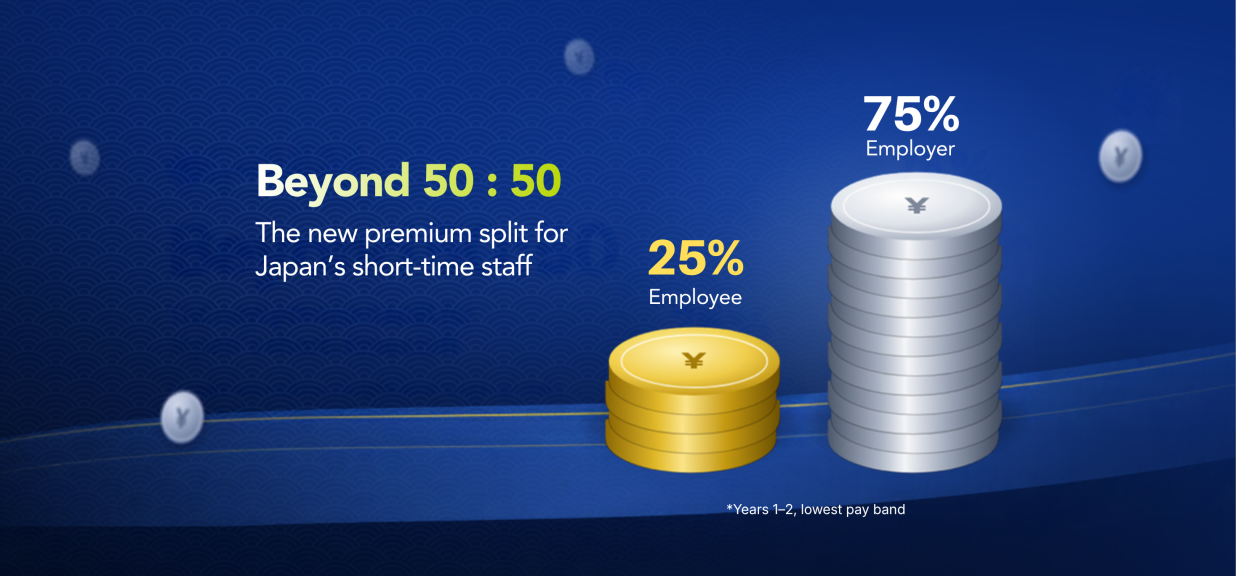
Normally, Japan’s social insurance premiums are split 50:50 between the employer and the employee. When short-time workers cross the threshold into mandatory coverage, that sudden 15% deduction from their paycheck can create serious financial friction. To cushion this transition, the new system allows eligible employers to temporarily absorb a larger portion of the worker's share.
How it works in practice:
- Three-Year Sliding Scale: The employee’s individual burden is reduced for up to three cumulative years.
- Temporary Employer Fronting: The employer pays the extra portion upfront on behalf of the employee.
- Three-Month Reimbursement: The Japan Pension Service (JPS) returns this additional money by deducting it from your total employer premium bill three months later. Net cost to the employer? Zero, provided all statutory conditions are met.
- Protected Pension Benefits: Crucially, the worker’s future pension payout is not reduced because of this temporary relief.
Following pension reform legislation, the Japan Pension Service published its formal operational guidance on September 11, 2026. This is an enacted final measure taking effect on October 1, 2026, not a tentative proposal.
Who Qualifies for the Relief?
This system isn't an automatic blanket policy for every business or part-time staff member in Japan. Both the establishment and the individual worker must meet specific criteria.
Eligible Workplace Criteria The relief is open to specified applicable workplaces. The initial cohort starting October 2026 targets workplaces that voluntarily register according to JPS establishment guidelines. As Japan continues expanding social insurance coverage, additional employer tiers will become eligible.
Eligible Employee Criteria The relief is strictly targeted at short-time insured workers whose standard monthly remuneration is ¥126,000 or less.
Important Warning Participation is strictly opt-in, not automatic. You must submit a prescribed commencement notification within the specified deadline. Retroactive claims are strictly prohibited. If you miss the window, your employees miss out on the relief.
Because determining eligibility requires matching workplace status with individual pay thresholds, always verify your standing with a Japanese legal or payroll specialist before changing payroll calculations.
Moving Beyond 50:50: The Dynamic Contribution Split
Instead of a single flat discount, the system replaces Japan’s standard 50:50 split with banded, sliding-scale ratios based on an employee's exact standard monthly remuneration.
- Years 1 & 2: Ratios range from 25:75 (employee/employer) for the lowest pay bands up to 48:52 at the ¥126,000 ceiling.
- Year 3: The relief drops by half, adjusting ratios to between 37.5:62.5 and 49:51.
For payroll teams, this means one-size-fits-all calculations will not work. Your payroll engine must map each employee to official JPS remuneration bands and automatically step down the relief level at the 24-month mark.
The 5 Operational Pillars for Payroll Teams
If your organization decides to adopt the system, your teams must prepare for five practical operational shifts:
- Smart Eligibility Tracking: Establish dynamic logic to flag short-time workers under the ¥126,000 cap and track when their earnings fluctuate across thresholds.
- Precision Deduction Rules: Configure banded ratios, exact rounding algorithms, and automated schedules to transition employees seamlessly from Year 2 to Year 3 rules.
- Finance & Treasury Coordination: Because employers front cash for 90 days before the JPS offsets the amount on monthly billing statements, Finance and Payroll must set up tight reconciliation controls.
- Ruthless Filing Discipline: Timely filing for employee qualification, loss-of-status, and pay changes is critical. Late or incorrect submissions directly disrupt eligibility calculations and offset timing.
- On-Time Payment Integrity: A critical catch: If an employer fails to pay monthly insurance premiums by the statutory deadline (or a subsequent formal demand date), reimbursement rights for that period are permanently forfeited.
Can You Opt Out Once You Start?
No. Entering the system is a long-term commitment. The Japan Pension Service explicitly states that voluntary opt-outs or early cancellations are not permitted once you begin.
While certain events (such as an employee crossing the ¥126,000 pay cap) temporarily pause relief, you cannot arbitrarily stop participating. Before submitting your commencement notification, evaluate your team's operational bandwidth, cash-flow buffer for the three-month offset delay, and reporting capabilities.
Action Plan for Global HR & Payroll Leaders
To prepare for the October 1, 2026, launch date, follow this checklist:
- Establishment Audit: Confirm if your Japanese corporate entity falls within an eligible workplace category.
- Employee Mapping: Identify short-time workers earning a standard monthly remuneration of ¥126,000 or less.
- Strategic Alignment: Decide whether applying for this optional relief aligns with your employee value proposition and operational capabilities.
- System Configuration: Configure payroll software to handle tiered contribution tables and multi-year time tracking.
- Cross-Departmental Ledger: Build a reconciliation process between Payroll (deductions) and Finance (JPS three-month credit statements).
- Filing Audit: Review internal SLAs to ensure employee qualification, loss-of-status, and pay changes are filed with JPS without delay.
- Empathy-Led Communication: Draft clear notices for affected workers explaining that lower paycheck deductions will not reduce their future pension entitlements.
Navigating Regulatory Shifts with the Right Payroll Tech Stack
Japan’s Insurance Premium Adjustment System highlights a fundamental reality of modern HR: policy changes are designed to protect people, but their success depends on precise, agile execution behind the scenes. Adapting to tiered deduction schedules, tracking rolling state reimbursements, and managing complex eligibility logic manually is an invitation to compliance errors and operational bottlenecks.
To keep pace with evolving statutory mandates across global jurisdictions, organizations need more than a legacy system. You need a flexible payroll tech stack that adapts seamlessly to regulatory updates in real time.
Neeyamo Payroll’s unified HR and technology stack empowers global enterprises to simplify multi-country operations, automate complex compliance logic, and deliver accurate, human-centered payroll every time.
Facing upcoming regulatory changes in Japan or looking to strengthen your global payroll tech stack? Reach out directly to irene.jones@neeyamo.com to continue the conversation.