Why Payroll Transformation Needs More Than AI
AI in payroll has quickly become one of the most discussed topics.
Across the industry, conversations often focus on familiar outcomes: faster processing, fewer manual interventions, improved efficiency, and more streamlined operations.
But according to payroll analyst and strategic advisor Pete Tiliakos, those outcomes represent only the beginning of what is possible.
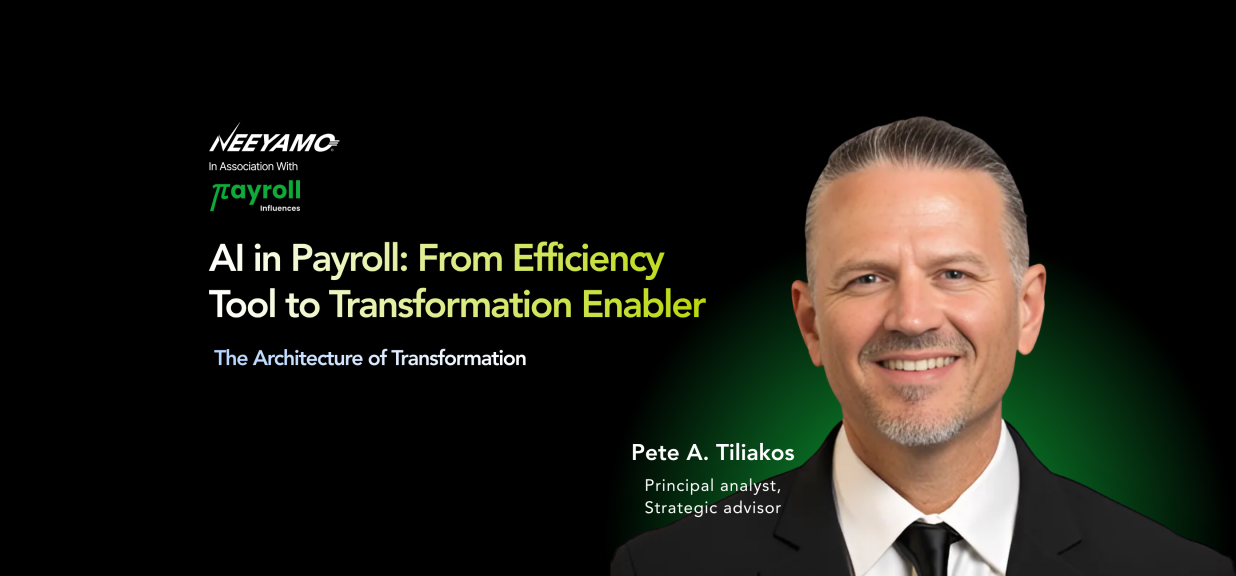
In Part 02 of Neeyamo’s masterclass series, AI in Payroll: From Efficiency Tool to Transformation Enabler – The Architecture of Transformation, Pete introduced a broader perspective on where payroll is headed and what organizations need to rethink to get there.
Because while AI continues to dominate the conversation, the bigger question is not whether payroll will become intelligent.
It is whether the environment supporting payroll is built to enable that intelligence.
The future of payroll is not being shaped by AI alone.
It is being shaped by the operating models, infrastructure, governance, and decision-making frameworks that allow technology and people to work together in entirely new ways.
Payroll Is Evolving Beyond Execution
For years, payroll has been evaluated through a relatively consistent lens.
- Accuracy.
- Timeliness.
- Compliance.
These outcomes remain essential. But increasingly, they are becoming the baseline rather than the differentiator.
Organizations today expect payroll to contribute far beyond execution.
- Business leaders want better visibility into workforce costs.
- Employees expect more modern pay experiences.
- Expansion strategies require faster workforce activation across geographies.
- Compliance expectations continue to increase.
Payroll now sits at the center of many of these business priorities.
As Pete explained throughout the session, this evolution changes how organizations should think about payroll’s role.
Payroll is becoming more than a processing function.
It is emerging as a strategic business capability that supports organizational agility, enables workforce growth, strengthens governance, and creates greater resilience across operations.
But unlocking that role requires more than introducing AI.
It requires a stronger foundation.
Transformation Requires More Than Technology
One of the most important themes from Pete’s session was that organizations often rush into AI discussions before preparing the environment AI needs to succeed.
Technology alone does not create transformation.
Organizations can introduce automation, deploy intelligent tools, and improve individual workflows. But without connected systems, trusted data, and clear operating models, those gains often remain isolated.
This is where architecture becomes critical.
Pete described transformation as something built through multiple connected layers working together.
At the foundation sits the governance frameworks, controls, payroll expertise, and data protection.
These create the trust required for intelligent operations.
On top of that sits modern payment infrastructure and centralized payroll execution that improve visibility and consistency.
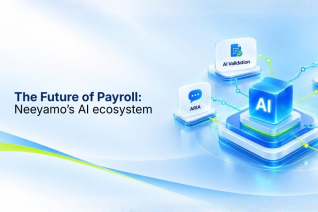
Then comes the orchestration layer.
This is where AI in payroll begins creating meaningful value.
Instead of simply accelerating tasks, intelligent systems begin coordinating activity, surfacing anomalies, identifying risk, generating recommendations, and supporting better decisions.
Importantly, this model does not remove people from payroll.
Human expertise remains essential.
Technology creates capacity.
People provide context, judgment, and accountability.
That combination is what enables transformation to scale.
Why Infrastructure Determines What Becomes Possible
Another major takeaway from Pete’s session was that many organizations continue to operate payroll through fragmented environments.
- Multiple vendors.
- Regional systems.
- Disconnected technologies.
- Distributed ownership.
These models can improve coordination, but they often make transformation harder.
As organizations introduce AI into fragmented environments, intelligence becomes limited by inconsistent data and disconnected execution.
Pete emphasized that unified infrastructure creates stronger conditions for transformation.
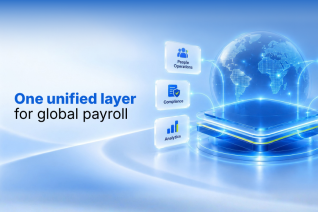
When payroll operates through connected data and centralized execution, organizations gain greater visibility, stronger controls, faster implementation of changes, and improved readiness for intelligent automation.
This shift moves payroll from reacting to issues toward proactively shaping outcomes.
And that changes what payroll can contribute to the business.
The Exact Type of AI in Payroll Your Business Actually Needs
Another important point from the session was that not all AI solves the same problem.
Some AI models are designed to generate possibilities.
Others are designed to generate certainty.
Pete introduced the distinction between probabilistic AI and deterministic AI.
Probabilistic AI supports areas such as forecasting, employee support, communication, and pattern recognition.
But payroll operates in environments where precision and repeatability matter.
That is where deterministic AI becomes essential.
Payroll requires intelligence that can produce traceable outcomes, follow governed rules, support compliance requirements, and maintain trust.
The goal is not simply introducing AI.
The goal is enabling intelligence that organizations can confidently operate at scale.
Watch on demand, part 2 series
Payroll Data Is Becoming a Strategic Asset
Toward the end of the session, Pete shifted the conversation beyond automation and toward business impact.
Payroll contains some of the richest operational and workforce data inside an organization.
Historically, much of that insight remained locked inside processing systems.
But modern architecture changes that.
When payroll data becomes connected and orchestrated intelligently, it becomes a source of decision-making.
Organizations can begin using payroll insight to support workforce planning, evaluate expansion decisions, improve cost visibility, and strengthen operational strategy.
Payroll no longer simply reports outcomes.
It helps shape them.
The Real Outcome Is Organizational Agility
The strongest message throughout the session was that payroll transformation is ultimately about creating agility.
Organizations can invest in growth, technology, and workforce initiatives.
But if payroll infrastructure cannot support that movement, scaling becomes difficult.
The future payroll model is not defined by automation alone.
It is built to be intelligent, governed, connected, and adaptable.
AI in payroll accelerates that journey.
Architecture makes it sustainable.
At Neeyamo, this belief continues to shape how global payroll transformation is approached. By combining intelligent automation, trusted execution, and globally connected payroll operations, organizations can move beyond processing and unlock payroll as a strategic business capability.
Pete’s session reinforced an important reality.
AI in payroll may drive the conversation. But architecture determines what transformation actually becomes.
Reach out to us at irene.jones@neeyamo.com to know more.