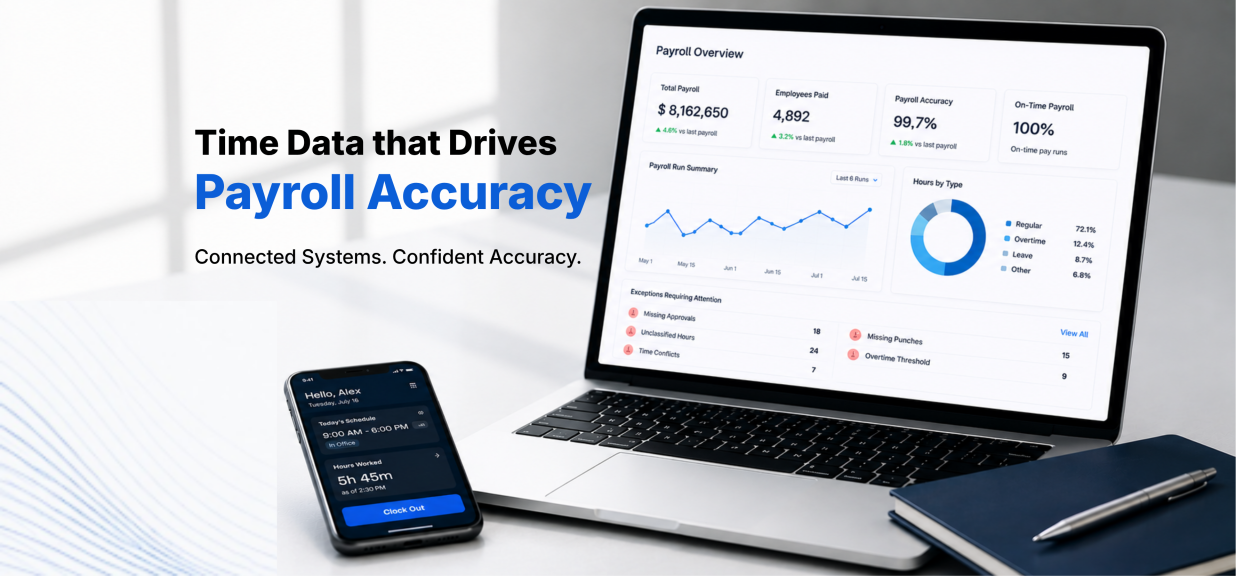
Payroll accuracy does not begin on payday. It begins the moment an employee clocks in, takes leave, works overtime, swaps a shift, or gets scheduled against a local holiday calendar.
For global enterprises, time data is more than an attendance record. It is a key input into payroll accuracy, compliance, cost control, and employee trust. Yet in many organizations, time and payroll still operate like distant cousins: connected by spreadsheets, emails, manual uploads, and last-minute corrections.
That gap is expensive. EY found that time/attendance and expense errors were the most common payroll errors, occurring on average 1,139 times per 1,000 employees per year and costing about $250,000 per 1,000 employees annually. While this data is U.S.-based, the operational risk becomes even more complex for organizations managing payroll across multiple countries, currencies, pay frequencies, and compliance regimes.
The question is no longer whether time and payroll should talk. It is how intelligently they should work together.
What Time and Payroll Integration Really Means
Time and payroll integration connects time capture, attendance, absence, scheduling, approvals, and payroll processing. But true integration is not just a file transfer at the end of the pay period.
It means time data is captured correctly, validated against policy, approved by the right manager, mapped to the right pay codes, checked for exceptions, and sent to payroll in a format payroll can trust.
In simple terms, payroll does not need “hours.” Payroll needs context. Was the time regular work, overtime, holiday work, paid leave, unpaid absence, shift premium, or on-call time? Was it approved before the cutoff? Does it comply with local rules? Is it mapped to the right cost center?
That is the difference between raw data and payroll-ready time data.
Why Global Enterprises Can’t Afford Disconnected Systems
Disconnected time and payroll systems create invisible friction. Payroll teams reconcile timesheets. HR fields employee complaints. Managers chase approvals. Finance struggles to understand labor cost leakage. IT maintains fragile integrations that often break when rules change.
For CHROs, the problem shows up as employee distrust. For payroll leaders, it shows up as rework, retro payments, off-cycle runs, and pressure-filled cutoffs. For CTOs, it becomes a data architecture issue: multiple systems, duplicate records, inconsistent workflows, and limited visibility into the origins of errors.
For CFOs, the problem is cost. Every manual correction, missed overtime calculation, or unapproved absence has a financial impact. The same EY survey reported that the average organization makes 15 corrections per payroll period. That is operational leakage.
Time Data Is the First Payroll Control
Payroll outcomes are only as reliable as the time data feeding them.
That is an important shift in thinking. Many organizations treat payroll errors as payroll problems. In reality, many payroll errors begin upstream: missed punches, incorrect leave entries, delayed manager approvals, inconsistent overtime rules, or unclassified absences.
A strong time-to-payroll process acts as a control layer before payroll processing begins. It identifies exceptions early, ensures approvals are complete, and prevents incomplete or non-compliant data from entering payroll. This moves organizations from payroll correction to payroll control.
The Technical Foundation Behind Better Payroll Outcomes
Integration only works when the technical foundation is strong. Enterprises should look beyond basic connectivity and assess whether their time and payroll environment can support scale, compliance, and change.
Key capabilities include API-based or native integration, scheduled or near-real-time data sync, pay-code and wage-type mapping, country-specific rules, approval workflows, exception management, cutoff controls, audit logs, role-based access, and pre-payroll validation.
Before the time data reaches payroll, the system should flag missing punches, overlapping shifts, unapproved overtime, leave conflicts, holiday mismatches, and rule violations. A single hour worked may need to be interpreted differently depending on the country, employee type, day of week, shift, collective agreement, or local regulation. The goal is not just automation. It is trusted data flow across HRIS, payroll, finance, workforce management, and reporting systems.
Global Compliance Makes Integration Non-Negotiable
In a single-country environment, disconnected time and payroll systems are painful. In a global enterprise, risky.
Each country may have different rules for overtime, rest periods, statutory leave, public holidays, working-time limits, record keeping, and payroll cutoffs. Add collective agreements, contractors, remote teams, and multiple pay frequencies, and the complexity multiplies quickly.
Manual interpretation cannot scale to this level of variation. Integrated systems help enterprises apply local rules earlier, before payroll is finalized. Compliance failures are often the result of small, repeated data issues: an overtime rule applied inconsistently, a leave balance not updated, a holiday calendar missed, or a rest-day premium calculated incorrectly.
KNOW MORE | Neeyamo Compliance
Business Outcomes Leaders Actually Care About
The value of time and payroll integration is not “less admin,” though that is certainly a benefit. The real value is business control.
Integrated systems help reduce payroll errors, shorten payroll cycles, lower spreadsheet dependency, improve audit readiness, and improve labor cost visibility. Payroll admins can focus less on chasing data and more on resolving true exceptions. Managers get clearer approval workflows. Employees gain confidence that their pay reflects the time they worked.
For HR and payroll leaders, this means fewer employee escalations. For finance, it means more reliable labor cost reporting. For IT, it means fewer brittle workarounds. For the business, it means payroll becomes predictable, governed, and scalable.
That is why time and payroll integration is workforce infrastructure.
From Payroll Processing to Payroll Intelligence
The next evolution is making time data intelligent and how conversational, guided, and voice-enabled experiences can simplify time and attendance interactions for employees, managers, and payroll teams.
This is where workforce operations are headed: fewer complex screens, fewer manual follow-ups, and faster access to the information people need. Employees can check leave, managers can act on approvals, and payroll teams can see what needs attention before errors become payments.
LEARN MORE | Making Time Data Intelligent: The ARIA Approach
Where Neeyamo Time Fits In
For global enterprises, the right time solution must do more than record attendance. It must create payroll-ready data.
Neeyamo Time is designed as a global time and absence management platform with unified calendars, time and absence visibility, instant notifications, native payroll integration, and pre-built connectors to third-party and finance systems. It supports the operational need to bring workforce time, absence, approvals, and payroll data closer together.
The advantage is confidence that the time data is complete, compliant, visible, and ready for payroll.
Connected Time Data Builds Payroll Confidence
Time and payroll integration is no longer a technical preference. It is a business requirement for global enterprises seeking accurate payroll, stronger compliance, greater employee trust, and cleaner visibility into workforce costs.
When time data is fragmented, payroll teams fix problems after they happen. When time and payroll are connected, enterprises prevent many of those problems before payroll runs.
That is the integration enterprises cannot ignore.
Reach out to us here or write to us at irene.jones@neeyamo.com to know more!