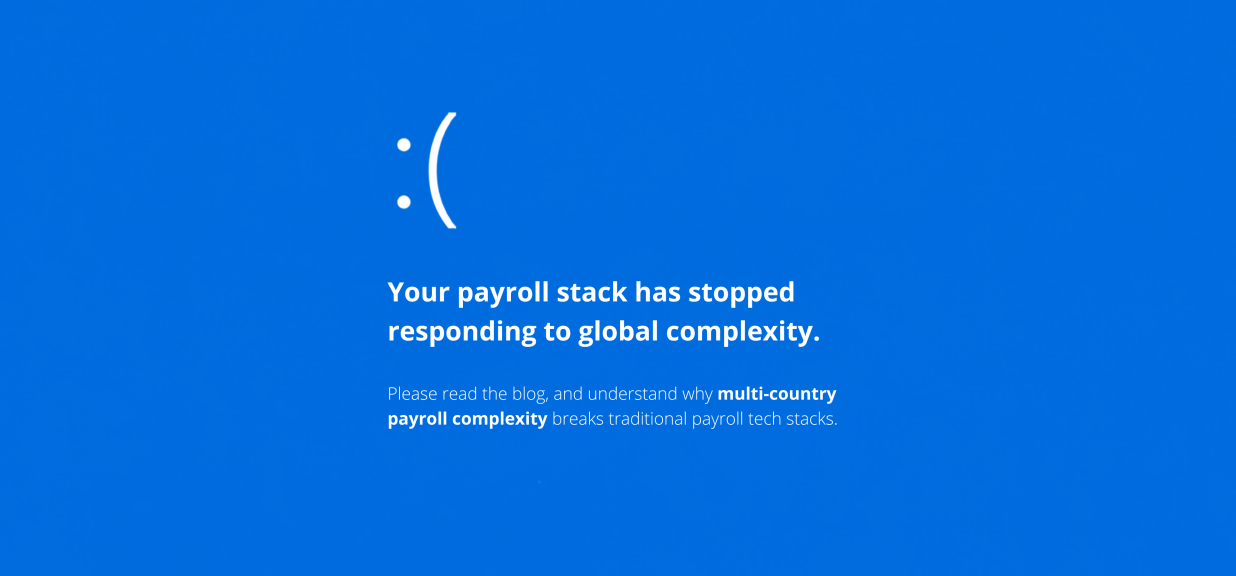
Ask a global payroll leader for a real-time view of operations across 50 countries, and you will rarely get a straight answer. It is not a lack of effort; it is a structural limitation of traditional HR and payroll technology
When a company expands globally, employee data quickly scatters across separate local legacy systems, regional vendors, and mismatched software platforms. This fragmentation is more common than many organizations realize. Deloitte’s 2025 Payroll Benchmarking Survey found that 84% of organizations manage more than 20 payroll system integrations, highlighting the sheer complexity of today’s global payroll environments. The result is an increasingly complex web of integrations, governance challenges, and disconnected processes. What seems like a simple executive request for an organization-wide headcount cost report turns into a multi-day operational nightmare of chasing down spreadsheets, manually converting currencies, and correcting mismatched data formats.
This breaking point isn't a reflection of poor management. Traditional technology stacks fall apart under global expansion because they were originally engineered to support localized payroll execution within rigid geographic boundaries, rather than to coordinate extreme operational complexity across multiple jurisdictions at scale.
Complexity Is Driven by Rule Variability, Not Headcount
The core breakdown occurs because global payroll is driven more by rule variability than by employee headcount. Processing payroll for 10,000 employees in a single country is relatively straightforward because the underlying data models and laws remain constant. But managing smaller pockets of people across dozens of different countries introduces unique, localized variables that rigid database templates cannot ingest without massive manual workarounds.
For instance, while a US payroll run focuses on standardized pre-tax deductions like 401(k) plans, France’s Bulletin de Paie requires calculating dozens of specific, fluctuating social security lines, transit allowances, and mandatory health insurance policies directly on the payslip.
Timelines vary just as drastically. Germany’s complex collective bargaining agreements require organizations to continuously monitor evolving pay scales and labor provisions, while Brazil’s eSocial framework turns compliance into a continuous reporting exercise, requiring employers to submit workforce and payroll events to government systems throughout the employee lifecycle.
Flying Blind: The Gaps in Visibility, Compliance, and Analytics
When standard platforms are forced to deal with this localized variability, they fracture. This fragmentation introduces critical operational blind spots that extend far beyond the math of a payslip, leaving international enterprise teams lacking three critical capabilities required for corporate oversight:
- A Unified Compliance Calendar: Without a single source of truth for global tracking, international teams must rely on local reminders and regional spreadsheets to monitor critical tax filing deadlines, statutory reporting dates, and local banking cutoffs across dozens of time zones. Missing just one regional cutoff can result in heavy regulatory fines.
- A Global Control Dashboard: Operationally, traditional setups function as a black box. Leadership has no real-time visibility into the payroll lifecycle. Finding out whether Japan’s payroll has been funded or Germany’s run has been approved requires endless rounds of status calls, emails, and manual follow-ups just to verify basic monthly progress.
- Centralized Spend Analytics: When workforce costs, time-tracking tools, and actual payroll execution live in completely separate regional silos, generating accurate global financial insights becomes nearly impossible. Payroll teams must spend valuable hours executing manual processes just to stitch together diverse Excel formats. If a CFO asks for the exact total burden cost of a global team on a Tuesday afternoon, the lack of instant spend analytics prevents a fast, data-driven answer. Payroll is forced to remain a slow, reactive back-office function rather than a strategic asset. This is particularly significant given that payroll typically accounts for 40% to 60% of an organization's operating expenses, making it one of the largest cost centers for multinational enterprises.
ALSO READ | How a Unified Tech Stack Simplifies Global Payroll Integrations
The Architecture Trap of Traditional Payroll Technology Stack
Historically, organizations have tried to address these visibility and compliance gaps by treating them as isolated regional problems. They hired a local provider in Japan, engaged a regional bureau for Latin America, and built custom software bridges to connect those pieces back to a central Human Resources Information System (HRIS).
Individually, these decisions seemed practical. Financially and architecturally, however, this patchwork creates severe long-term debt.
Connecting a central HRIS to ten different local payroll platforms requires ten separate software integrations. If a local government updates a tax rule or the central HRIS modifies its platform, those fragile pipelines break. Furthermore, because most local providers still rely on asynchronous, legacy file transfers, global data constantly lags. A mid-month salary adjustment made centrally might take weeks to be reflected in a local provider's run, leading to calculation delays and retroactive errors. The architecture becomes burdened by the very mechanisms introduced to manage its growth.
Overcoming Friction with a Native Engine
Eliminating operational friction requires moving away from the complexity of disconnected point solutions. When global infrastructure is stitched together using fragile middleware or aggregators, gaps in visibility are inevitable. Organizations are increasingly recognizing that solving these challenges requires more than additional integrations. It requires a fundamentally different architectural approach.
Neeyamo addresses this by delivering a native, single-platform architecture that changes the game. By consolidating international payroll and compliance into a unified ecosystem, data flows naturally and securely. When your core HRIS, time tracking, and compliance tools live natively within the same platform, the journey from a time clock punch to a finalized paycheck happens seamlessly. The underlying system calculates payroll directly through native engines, automatically running AI-powered validations, processing the payroll, signing off on the register, and completing final reporting.
The need to route data through local In-Country Providers completely disappears. This eliminates the technology stack bloat that hinders corporate growth, turning fragmented regional silos into an agile, continuous data pipeline built for the modern global workforce.
If your organization has yet to achieve a truly unified environment, it is time to rethink your strategy. Reach out to irene.jones@neeyamo.com to kickstart your global payroll transformation and build a stronger foundation with a unified global payroll platform :)