Payroll is no longer confined to just its operations.
For global organizations, payroll now sits at the intersection of employee experience, compliance, workforce planning, finance, and technology. It is no longer just about calculating salaries and releasing payments on time. It is about making sure every employee, in every country, is paid accurately, compliantly, securely, and consistently.
That is easier said than done.
As companies expand across borders, the associated complexity multiplies. Every country brings its own tax rules, statutory deductions, social security requirements, leave policies, pay cycles, reporting formats, banking norms, and data privacy expectations. Add multiple HR systems, time tools, finance platforms, local vendors, and spreadsheets into the mix, and this quickly becomes a maze of disconnected processes.
The scale is significant. The World Bank’s labor force data, based on International Labor Organization estimates, places the global labor force at around 3.73 billion people in 2025. For businesses operating across geographies, that scale translates into one clear reality: payroll technology must be built for complexity, not patched together around it.
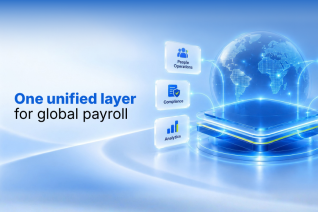
A modern payroll tech stack helps organizations move from fragmented operations to a connected, governed, and scalable model.
What is a modern global payroll tech stack?
It is an integrated ecosystem of systems and capabilities that connects employee data, time inputs, payroll calculations, compliance rules, workflows, payments, reporting, and employee self-service.
In simple terms, it helps organizations answer three critical questions:
Are our people being paid accurately?
Are we compliant in every country where we operate?
Do leaders have the visibility they need to make better workforce decisions?
A strong payroll tech stack is not just an engine. It is the infrastructure that allows HR, payroll, finance, and IT teams to work from reliable data, automated workflows, and clear controls.
Why an integrated tech stack matters
Traditional setups often grow country by country. One vendor here, another tool there, a spreadsheet in between, and a few manual checks to keep things moving. This works for a while, until the business expands faster than the process can handle.
The result is familiar: payroll teams chase inputs, HR teams struggle with data accuracy, finance waits for reports, IT manages brittle integrations, and employees raise queries when something goes wrong.
An integrated payroll tech stack changes the outcome. It reduces manual effort, improves accuracy, strengthens compliance, enables faster payroll cycles, and provides leadership with better visibility into workforce costs and risks.
For CHROs, this means greater employee trust.
For CTOs, it means cleaner architecture and stronger data governance.
For CFOs, it means better cost control and audit readiness.
For payroll teams, it means fewer exceptions and more predictable operations.
KNOW MORE | How a Unified Tech Stack Simplifies Global Payroll Integrations
Step 1: Map your current payroll ecosystem
Before building a modern tech stack, understand what you already have.
Start by mapping every system, vendor, file, process, and approval involved. This may include your HRIS, time and attendance system, benefits platform, expense tool, finance or ERP system, banking partners, statutory portals, local providers, reporting tools, and employee helpdesk.
Then ask practical questions:
Where is employee data manually entered?
Where do spreadsheets still drive payroll inputs?
Where are time-and-attendance exceptions corrected manually?
Where do approvals happen outside the system?
Where do local teams interpret compliance changes on their own?
Where does the data get reconciled after processing?
This exercise usually reveals that payroll challenges are not caused by one broken system. They are caused by too many systems operating in silos.
Step 2: Standardize data before automating
Automation is only useful when the underlying data is clean.
A modern system needs consistent employee master data, job codes, pay components, cost centers, tax identifiers, bank details, leave categories, and country-specific fields. Without this foundation, automation simply accelerates the spread of bad data.
The goal is not to force every country into the same template. Global payroll needs both standardization and localization. The global layer should define common data structures, controls, governance, and reporting. The local layer should support statutory rules, pay practices, languages, currencies, and country-specific exceptions.
This balance helps organizations scale globally without losing local compliance accuracy.
Step 3: Connect HR, time, payroll, and finance
Payroll accuracy depends heavily on upstream data.
A salary change in HR, overtime captured in a time system, a leave update from workforce management, or a cost center change from finance can all affect payroll outcomes. When these systems are disconnected, the respective teams spend valuable time validating, correcting, and reconciling data.
A modern tech stack should integrate with:
HRIS and employee master data systems
Time and attendance platforms
Benefits and expense systems
Finance and ERP tools
Banking and payment systems
Compliance and statutory reporting tools
Employee self-service platforms
The more connected the ecosystem, the fewer manual interventions the teams need to manage.
Step 4: Build compliance into the stack
Global payroll compliance is not a one-time checklist. It is a continuous operating requirement.
Tax laws change. Social security limits shift. Statutory benefits evolve. Filing formats get updated. Working time rules differ by country. Data privacy expectations continue to rise.
A modern payroll tech stack should support compliance through automated validations, configurable rules, audit trails, country-specific reporting, role-based access, and secure data handling. It should also make compliance activity visible, so teams can track what is pending, what is completed, and where risk is building.
This is especially important because payroll holds some of the most sensitive data in the enterprise: salaries, bank details, tax IDs, addresses, employment records, and personal information. IBM’s 2024 Cost of a Data Breach Report found that the average global cost of a data breach reached USD 4.88 million. For leaders, security is not an IT footnote. It is central to trust.
Step 5: Use APIs and integrations wisely
APIs are the connective tissue of a modern payroll tech stack. They allow systems to exchange data securely, consistently, and at scale.
But integration is not just about connecting platforms. It is about ensuring the right data moves at the right time, in the right format, with the right validation.
A strong integration layer should support pre-built connectors, API-based data exchange, data transformation, error handling, integration monitoring, secure authentication, and audit logs.
The objective is not to create a complex web of custom integrations. It is to build a repeatable integration model that supports new countries, new systems, and new business requirements without disrupting payroll operations.
Step 6: Automate workflows, not just calculations
Payroll calculation is only one part of the process.
The broader workflow includes input collection, validation, approvals, exception management, funding, reporting, payslip generation, statutory submissions, and employee queries.
A modern payroll tech stack should automate repetitive steps and guide teams through the payroll cycle. This includes pre-payroll validations, anomaly alerts, approval workflows, cut-off reminders, post-payroll checks, and reconciliation.
For payroll admins, this reduces firefighting. For leaders, it improves confidence. For employees, it means fewer errors and faster resolutions.
Step 7: Make payroll visible to leadership
Payroll contains valuable workforce intelligence, but many organizations still rely on delayed reports or country-level spreadsheets.
A modern payroll stack should provide dashboards and reporting that show payroll status, payroll cost, exception trends, compliance activity, off-cycle payments, and country-level performance.
This visibility helps leaders answer important questions:
Which countries have the highest payroll exceptions?
Where are payroll cycles taking longer?
How much manual intervention is required each month?
Are statutory submissions completed on time?
What is the cost by region, entity, or business unit?
When data becomes visible, payroll becomes strategic.
Step 8: Measure success with the right metrics
A payroll tech stack should improve measurable business outcomes. Track metrics before and after modernization to understand the impact.
Useful metrics include payroll accuracy rate, payroll cycle time, number of manual interventions, off-cycle payment volume, compliance incidents, employee queries, integration failures, reconciliation effort, and cost per transaction.
These metrics help HR, payroll, finance, and IT teams align around a shared view of success.
Common mistakes to avoid
Many transformation projects fail because they are treated as software replacement exercises. A modern payroll tech stack is not just another tool. It is an operating model.
Avoid choosing point solutions that cannot scale globally. Avoid over-customizing every country process. Avoid ignoring time and attendance integration. Avoid treating compliance as a manual responsibility. Avoid keeping payroll data separate from workforce analytics. And most importantly, avoid building integrations without governance.
The best payroll stacks are designed for both global control and local flexibility.
ALSO READ | Why Multi-Country Payroll Complexity Breaks Traditional Payroll Technology Stack
Where Neeyamo fits in
The need for unified systems and multi-country payroll complexity highlights a recurring truth: fragmented technology cannot keep pace with modern global workforce needs.
For organizations managing payroll across multiple countries, Neeyamo brings together technology, compliance, and global payroll expertise through an integrated platform approach.
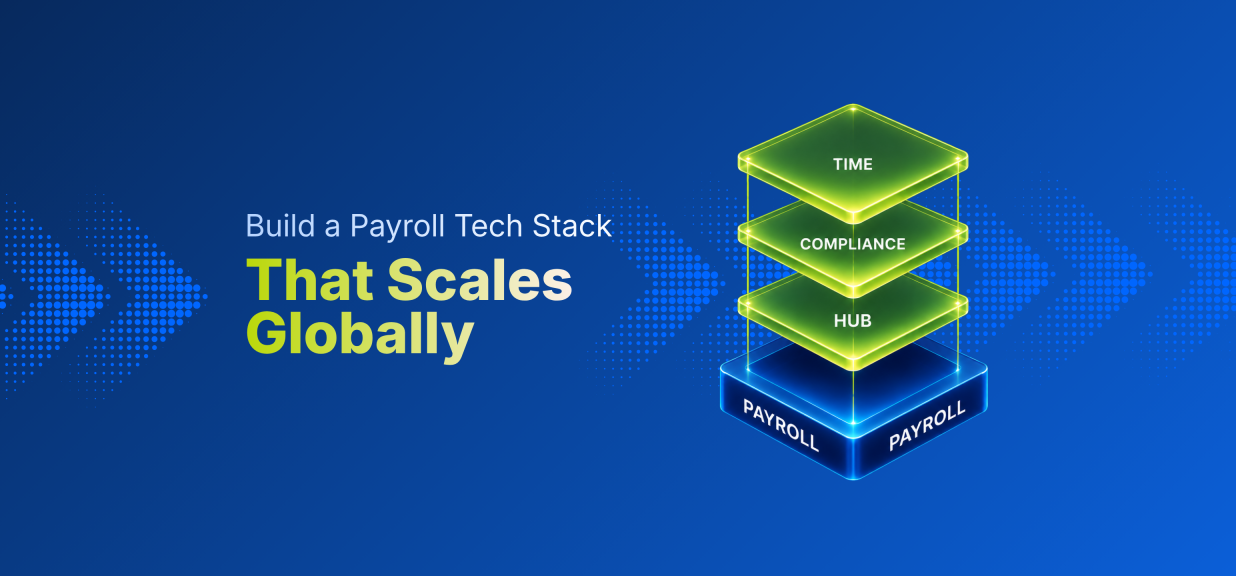
Neeyamo Payroll supports global operations across 180+ countries, helping organizations manage multi-country payroll through a technology-first model. Neeyamo Time helps improve payroll accuracy by connecting workforce time inputs with payroll processes. Neeyamo Compliance helps teams track statutory and regulatory requirements across jurisdictions. Neeyamo eHub acts as a centralized employee data foundation, helping teams work with cleaner, more connected data.
Together, these capabilities help organizations move from fragmented operations to a more integrated, automated, and insight-driven ecosystem.
Conclusion
A modern payroll tech stack is not just a technology investment. It is a growth enabler.
It helps global organizations pay employees accurately, stay compliant, reduce manual effort, improve visibility, and build trust across the workforce. For companies expanding into new markets or managing complex global teams, payroll modernization is no longer optional.
The future belongs to organizations that can integrate data, systems, compliance, and people into a single intelligent operating model. For more information, contact us at irene.jones@neeyamo.com