Global payroll has become significantly more complex than simply ensuring employees are paid accurately and on time. As organizations expand into new markets, payroll teams must navigate diverse regulatory frameworks, multiple vendors, evolving compliance requirements, and increasing expectations for transparency and operational excellence.
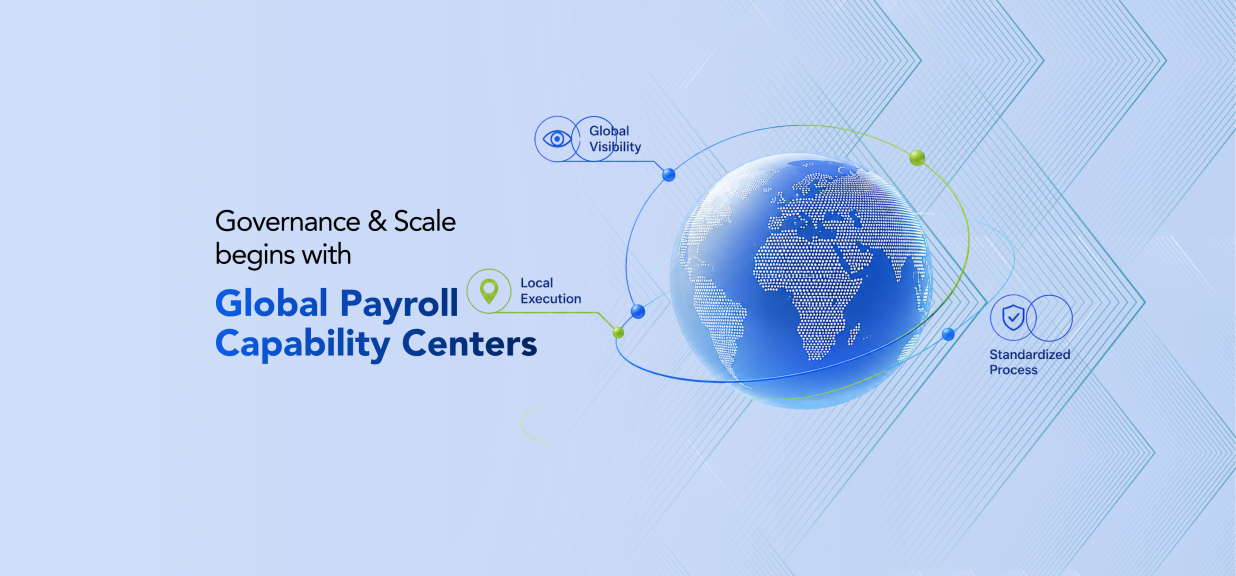
A GpCC helps payroll operate less like a set of country-level activities and more like one governed enterprise capability that brings together payroll governance, expertise, processes, technology, and operational oversight under a unified framework. Rather than simply acting as a delivery center, a GpCC serves as the foundation for a well-orchestrated payroll ecosystem in which responsibilities are clearly defined, decisions are made efficiently, and accountability is embedded in every layer of the organization. The result is a payroll function that is not only scalable and compliant but also resilient, standardized, and future-ready.
The Governance Challenge in Global Payroll Capability Center
As organizations grow, responsibilities often become scattered across headquarters, shared services teams, country payroll teams, external providers, and specialist functions. Without clear ownership, organizations can find themselves dealing with duplicated efforts, inconsistent processes, slow decision-making, and compliance risks. According to an EY survey, 1 in 5 payrolls contains errors, and organizations make an average of 15 payroll corrections per pay period, creating additional operational costs, compliance exposure, and employee experience challenges. Clear accountability and well-defined ownership structures are therefore essential to ensure payroll operates efficiently and consistently across the organization.
And hence, a common question emerges: Who owns what?
Should payroll policy sit with corporate leadership? Should process improvements be managed by operational teams? Who is responsible for local compliance decisions? Where should automation initiatives be driven from?
The answers to these questions determine whether payroll operates as a coordinated global function or as a collection of disconnected activities.
This is where the GpCC model provides a more structured approach. To get more information on different frameworks related to GpCC, feel free to read Neeyamo’s Executive Handbook for GCC Leaders.
Building Governance Around Purpose
The most effective payroll organizations organize responsibilities by purpose rather than by geography. Instead of concentrating all activities in one location or spreading accountability across multiple teams, the GpCC model assigns ownership according to the nature of the work.
The guiding principle is straightforward:
Keep governance and standards centralized, keep execution scalable, keep proximity activities local, and concentrate specialist capabilities within Centers of Excellence.
This structure creates clarity while allowing payroll operations to scale globally without sacrificing compliance or local responsiveness.
ALSO READ | What are Global Payroll Capability Centers and Why it Matters Now
Defining the Right Roles
At the enterprise level, corporate or functional leadership provides strategic direction and oversight. This group establishes payroll policies, governance frameworks, control objectives, and global standards. Their role is to determine how payroll should operate, not to manage daily execution.
Key responsibilities include:
- Establishing payroll policies and governance frameworks
- Defining control objectives and global standards
- Providing strategic direction and oversight
- Ensuring alignment with organizational goals
The GpCC becomes the operational engine of the payroll organization. It is responsible for delivering payroll services consistently across regions, managing payroll runs, administering standardized processes, coordinating vendors, executing controls, and producing operational reporting. By consolidating these activities, organizations gain greater visibility, efficiency, and process consistency.
Key responsibilities include:
- Delivering payroll services across regions
- Managing payroll runs and standardized processes
- Coordinating payroll vendors
- Executing operational controls
- Producing operational reports
Alongside the GpCC sits the Payroll Center of Excellence (CoE). While operations focus on execution, the CoE focuses on improvement. Process standardization, compliance impact assessments, control design, analytics, automation initiatives, training, and continuous improvement typically reside within this specialist function. The CoE ensures that payroll capabilities evolve alongside changing business and regulatory requirements.
Key responsibilities include:
- Process standardization
- Compliance impact assessments
- Control design and governance
- Analytics and reporting
- Automation initiatives
- Training and continuous improvement
Local country or business unit teams continue to play a critical role. Certain activities require in-country knowledge, local approvals, employee interactions, and regulatory engagement. These responsibilities remain closest to the business, ensuring that local requirements are met without compromising global standards.
Key responsibilities include:
- Managing local approvals and interactions
- Supporting country-specific regulatory requirements
- Engaging with local authorities and stakeholders
- Ensuring compliance with local regulations
- Maintaining alignment with global standards
Creating Clear Accountability
One of the biggest advantages of the GpCC model is that it eliminates ambiguity.
When ownership is clearly defined, decision-making becomes faster and more effective. Operational teams know what they are accountable for. Leadership teams can focus on governance rather than firefighting. Specialists can focus on driving long-term improvements rather than being pulled into transactional activities.
This clarity also strengthens risk management. Payroll controls become more consistent, compliance obligations are easier to monitor, and escalation paths are better defined. Rather than relying on individuals to bridge gaps in the process, accountability is built directly into the operating model.
Governance Beyond Organizational Structure
Effective governance is not just about assigning responsibilities. It also requires a framework that supports decision-making at different levels.
Strategic governance forums focus on policy, risk, investments, and long-term priorities. Tactical governance reviews evaluate performance, compliance readiness, process effectiveness, and improvement initiatives. Operational governance meetings ensure payroll readiness, manage exceptions, and address service delivery issues before they become larger problems.
Together, these governance layers create transparency across the payroll ecosystem and ensure that decisions are made by the right stakeholders at the right time.
Simple Rules for Smarter Payroll Design
Organizations designing a GpCC model can benefit from a few practical principles:
- If an activity sets standards, it belongs with corporate leadership or the CoE.
- If an activity scales execution, it belongs within the GpCC.
- If an activity requires local context or approvals, it belongs with the country or business unit teams.
- If an activity repeatedly improves the system, it belongs within the CoE.
These rules help organizations avoid overlapping responsibilities while creating a model that remains scalable as payroll complexity increases.
Looking Ahead
As payroll continues to evolve into a strategic business function, governance will become increasingly important. Technology can automate processes, analytics can provide deeper insights, and service delivery models can improve efficiency, but none of these capabilities can deliver their full value without clear accountability and structured decision-making.
The GpCC model offers a smarter approach to global payroll governance by aligning ownership with purpose. By separating strategic oversight, scalable execution, specialist expertise, and local accountability, organizations can create a payroll function that is more efficient, more compliant, and better equipped to support global growth.
In a world where payroll complexity continues to increase, governance is no longer a supporting capability. It is the foundation upon which successful global payroll operations are built.
For more information on the GpCC model, feel free to reach out to irene.jones@neeyamo.com.