Payroll is one of the oldest outsourcing industries in the world, with over 75 years of history. And yet, for all that time, no one had built a single software platform capable of running payroll for any country on earth. Compliance was complex. Country-specific rules multiplied. Employee expectations evolved. But the fundamental experience of interacting with payroll, asking questions, understanding deductions, and reading a payslip stayed stubbornly unchanged.
That changed when a global conglomerate came to Neeyamo with a question that had no good answer: how do we give payslips to our visually impaired employees?
It was a deceptively simple requirement. But it pointed to something much larger, a gap in how payroll technology had always thought about its users. For Ashok Bildikar, Chairman and Managing Director of Neeyamo, it was also the spark that gave birth to ARIA.
The Moment That Reframed Everything
In a recent episode of The Payroll Powerlist, Neeyamo's podcast spotlighting the people and ideas shaping global payroll, Ashok spoke candidly about how ARIA came to be. The trigger was not a technology roadmap or a product vision document. It was a real inclusion challenge, faced by a real organisation, with employees who could not access information that affected their lives every month.
"When AI came in together, we realized that yes, this is a problem which can be solved very easily and in a much better way. And ARIA's birth came from that as a basic requirement." - Ashok Bildikar
That framing matters. ARIA was not built to demonstrate AI capability. It was built to solve a human problem. And that distinction shapes everything about how it works.
What ARIA Actually Is
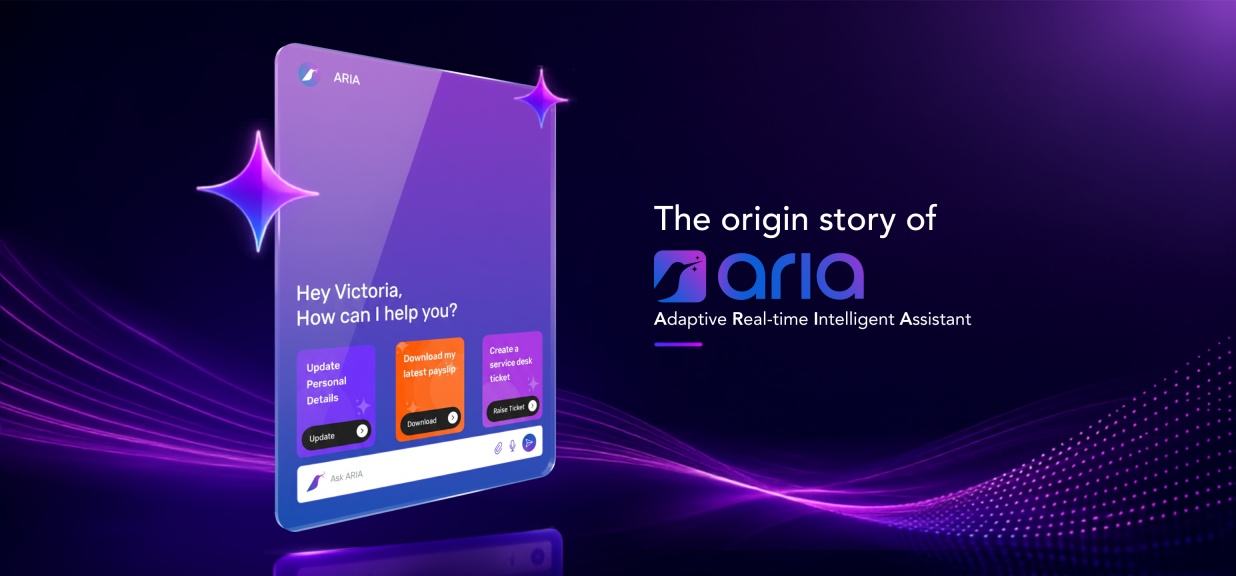
ARIA stands for Adaptive Real-time Intelligent Assistant. Each word in that name was chosen deliberately.
Where many enterprise AI tools function as standalone modules sitting beside a platform, ARIA was designed to be fully embedded within Neeyamo's payroll ecosystem. It understands the user's persona, whether they are an employee, a payroll processor, an HR manager, or a global finance head. It knows exactly where in the application that user currently sits. And it uses both pieces of context to anticipate what they are likely to need next, before they even ask.
This context-awareness is what Ashok calls the "adaptive" dimension of ARIA. Rather than waiting for a user to type a question and retrieve a generic answer, ARIA reads the room. If a payroll processor is in the compliance management section of the platform, ARIA is already primed with the most relevant information for that location and that role. The experience does not feel like switching to a chat interface. It feels like the platform got smarter.
"We wanted to create something which is very, very adaptive. So if you look at ARIA, its adaptiveness in terms of the way it intelligently determines what possibly the questions will come up or what interactions will come up and it responds to that."
ALSO READ | Introducing ARIA: Neeyamo’s Vision to Transform Global Payroll Engagement
Experience as the Core Design Principle
Payroll has long been treated as a transactional system, important to finance teams but rarely a priority for experience investment. Ashok pushes back on that framing directly.
From an employee's perspective, payroll is the most important system they interact with. The volume of payroll-related queries that employees raise, questions about deductions, variations in pay, the impact of compliance changes, reflects just how much that relationship matters. Yet the experience of getting those answers has historically meant waiting for a response from an HR or payroll manager, navigating a static FAQ, or reading a payslip that offers numbers without explanation.
ARIA changes that equation. Employees can now ask ARIA to explain their payslip in plain language: why did their take-home change this month, what compliance update affected their tax, what would their salary look like under a different scenario. These are not complex requests. But for most employees in most organisations, they have historically required a person to answer.
As Ashok put it, irrespective of how long payroll teams have been doing things a certain way, ARIA is fundamentally about feasibility and flexibility. "You need not wait for your HR manager or your payroll manager to come and figure out things for you. As an employee, you can just go ahead and do that."
DOWNLOAD NOW | Meet ARIA, Your Payroll Companion
The Integration Advantage
One of ARIA's defining characteristics is that it is not an add-on. It is 100% integrated at the experience level, the functionality level, and the data level within Neeyamo's Payroll platform, the only global payroll engine capable of running native payroll across 160+ countries from a single source code.
That integration is paired with a deliberate approach to customer choice. Neeyamo made ARIA fully configurable, meaning organisations can activate it or not, and can choose which specific capabilities they want to enable. Some customers are ready to lean into AI-powered interaction. Others are still evaluating their readiness. ARIA accommodates both, without forcing a decision.
Data security was treated with equal seriousness. Payroll data sits under some of the strictest regulatory frameworks in the world, including GDPR and its equivalents. Neeyamo's approach ensures that no customer data is shared with any external model for any purpose. Everything happens within a closed environment. A dedicated internal team from Neeyamo's CISO function was engaged in parallel with ARIA's development, building the security policy and data protection architecture alongside the product itself.
What Adoption Actually Looks Like
Ashok is candid about the pace at which different users will embrace ARIA's more advanced capabilities. Voice-commanded payroll processing is technically possible today within the platform. Whether large enterprises will move to it quickly is a different question. Payroll teams are experienced professionals who have built reliable processes over many years, and change management in that context requires patience.
But on the employee side, the picture is different. The ability to simulate salary scenarios, understand payslip variations, and get compliance changes explained in real time are capabilities that employees can start using immediately, without waiting for their organisations to retrain entire processing teams.
That distinction, between what is technically possible and what will be widely adopted, reflects the kind of thinking that runs through ARIA's design. Neeyamo built with awareness of where the market actually is, not only where it might eventually go.
Building Responsibly at Scale
For CXOs considering the move toward AI in payroll, Ashok's advice is grounded and practical. Internal alignment has to come first. Regulatory requirements, compliance frameworks, and data security policies need to be in place before AI is deployed at scale. AI introduces new categories of organisational risk, and those risks need to be understood before they are encountered in production.
From there, the recommendation is to start small. For an organisation running payroll across 80 countries, starting with one or two is not a limitation. It is a strategy. Test, gather feedback, and expand gradually. The organisations that will benefit most from AI in payroll are those that approach adoption with the same rigour they apply to payroll itself: carefully, systematically, and with a clear view of the compliance landscape.
Neeyamo has already absorbed a significant volume of that learning on behalf of its customers. Over ten years of data from queries raised by employees and processing teams has been incorporated into ARIA's model. Around 80% of the repetitive questions that have historically required human intervention are already handled.
A Different Kind of Innovation
What makes ARIA worth paying attention to is not the technology itself. It is the question the technology was built to answer.
Payroll has existed for over 75 years as an outsourced function. In that time, no one built a platform that could run any country's payroll from a single codebase. No one built an AI layer that treated employee experience as a genuine design priority. And no one started from the premise that a visually impaired employee deserved the same access to their own payslip as anyone else.
ARIA started from exactly that premise. And that is what makes it different.
To hear Ashok walk through the full story, including the challenges of building ARIA, the thinking behind its security architecture, and his vision for what autonomous payroll looks like next, the conversation is available in full on The Payroll Powerlist on YouTube.
For more information, email us at irene.jones@neeyamo.com