Payroll errors rarely begin on payday. They begin days or weeks earlier, when an employee forgets to clock out, a manager approves a timesheet after the cutoff, an absence is left unclassified, or overtime is calculated without accounting for the applicable local rule.
By the time payroll runs, those small failures may have already compounded into corrections, off-cycle payments, compliance exposure, and employee complaints.
For CHROs, CFOs, and global leaders, that chain of events is frustratingly familiar. The payroll engine may be functioning exactly as it should. The problem is what gets fed into it.
Accuracy starts long before processing begins. It starts with the quality, consistency, and timeliness of time and absence data.
Payroll Accuracy Starts Before Processing
Payroll depends on upstream workforce data. Before any calculation runs, teams rely on time entries, absence records, leave balances, shift classifications, overtime rules, and manager approvals.
If that data is late, incomplete, or inconsistent, the engine cannot compensate. It will calculate precisely what is given.
This reframes where accuracy really lives. It is not solely a payroll engine issue. It is a data quality issue, a process control issue, a compliance issue, and ultimately an employee trust issue.
Organizations that treat payroll accuracy only as a downstream concern will keep correcting the same upstream problems.
The Hidden Source of Payroll Errors: Inaccurate Time Data
Time data touches nearly every component of payroll. Regular hours, overtime rates, shift premiums, paid and unpaid leave, public holidays, absence deductions, cost-center allocations, and cutoffs all depend on time and attendance inputs being accurate and ready.
Systems calculate pay. Time tracking determines what needs to be paid.
When a punch is missed, the system cannot determine whether the employee worked or was absent. When a manager approves time after the cutoff, payroll either runs without that data or must be reopened and reprocessed. When absence types are misclassified, deductions and accruals are wrong from the start.
According to EY’s payroll error research, time, attendance, and expense errors are among the most common categories of mistakes, with missed or incorrect time punches being a frequent and costly source of rework. The study reveals that payroll errors average $291 each when both direct and indirect labor costs are factored in.
Across a global workforce, those costs accumulate quickly.
Why Time Tracking Remains a Market Problem
Despite wide investment in HR technology, time and attendance management remains one of the weakest links in the chain. The reasons are structural.
The PayrollOrg 2025 Global Payroll Week survey identifies poor-quality data inputs, late or inaccurate time-tracking data, and inputs received after cut-off as major root causes of decreased accuracy. The same research notes that while many organizations use global HR systems, time and attendance systems are often more localized or fragmented, creating gaps in data quality and integration.
The issues that surface most consistently include:
- Fragmented systems: Time data lives in separate tools that are not connected to payroll, creating manual handoffs and reconciliation gaps.
- Manual timesheets and spreadsheets: These introduce data entry errors, version confusion, and limited auditability.
- Late manager approvals: When approvals arrive after cutoff, teams are forced to either run payroll on incomplete data or delay and reprocess.
- Disconnected absence management: Leave requests and absence records outside the time system cause classification errors.
- Local labor law complexity: Overtime thresholds, rest-break rules, premium pay requirements, and leave entitlements vary by country and sometimes by site or agreement.
- Limited visibility: Workforce operations teams often cannot see time data status in real time, so problems are discovered after the cutoff.
- Post-cutoff changes: Retroactive edits made without controlled processes create untracked variances and additional correction work.
The U.S. Department of Labor requires covered employers to maintain accurate records of hours worked and wages earned. Comparable obligations exist across most jurisdictions globally. Fragmented or inconsistent time data puts organizations at risk not only of overpayment or underpayment, but also of regulatory non-compliance.
What Payroll-Ready Time Data Really Means
Not all time data is payroll-ready.
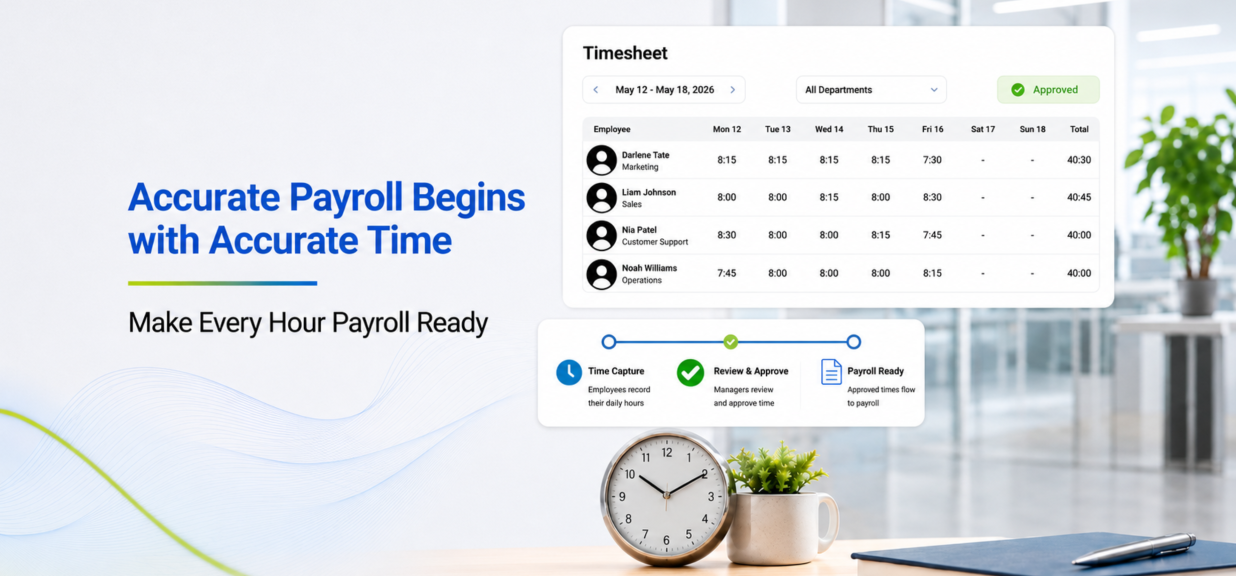
Captured data is not the same as validated data. Submitted data is not the same as approved data. Approved data is not the same as locked, mapped, and integrated data.
Payroll-ready time data has passed through a defined set of controls before the process begins.
| Stage |
What it means |
| Capture |
Employees record time through approved methods |
| Validate |
Missing punches, overlaps, exceptions, and rule violations are flagged |
| Classify |
Hours are categorized as regular, overtime, leave, absence, premium, or holiday |
| Approve |
Managers review and approve time before the cut-off |
| Lock |
Data is protected from uncontrolled post-cutoff edits |
| Integrate |
Payroll receives mapped, structured inputs |
| Audit |
The organization can trace who entered, changed, approved, and submitted data |
When all seven stages are completed consistently, teams receive inputs that are clean, traceable, and defensible. When stages are skipped or handled manually, gaps appear in payroll output.
Why This Matters to HR, Finance, and Payroll Leaders
Time tracking is often seen as an administrative process, but its impact reaches far beyond attendance. Inaccurate time and absence data can affect labor cost visibility, accuracy, compliance readiness, employee trust, and the efficiency of every pay cycle.
For HR, it can increase employee queries and reduce confidence in outcomes. For finance, it can distort workforce cost reporting and overtime visibility. For payroll teams, it can lead to rework, corrections, and off-cycle payments.
Accurate time tracking gives every stakeholder a cleaner foundation to work from. It helps organizations reduce manual effort, improve governance, and build greater confidence in results.
The Global Challenge: Accuracy Across Countries
Across jurisdictions, organizations must account for different overtime thresholds, statutory leave entitlements, public holiday calendars, rest-break requirements, pay frequencies, data-retention expectations, collective bargaining agreements, worker classifications, and approval processes.
A time rule that works in Germany may not apply the same way in Malaysia. An absence classification used in the United States may need different treatment when mapped to statutory leave requirements in Brazil.
Global organizations need time systems that can apply the right rules in the right country, consistently, without requiring manual local workarounds.
This is precisely where many organizations find themselves exposed. They may have a global payroll platform, but the time data feeding into it is being managed locally, inconsistently, and often manually.
How Neeyamo Time Helps Make Time Data Payroll-Ready
Neeyamo Time is designed to manage time and absence as a connected, payroll-ready process. Rather than treating time tracking as a standalone attendance function, it brings together the controls, workflows, rules, and integrations that global organizations need to deliver cleaner time data.
Neeyamo Time supports:
- Time and absence management across multiple capture modes
- Intelligent configurable workflows with multi-level routing
- Delegation and mass approvals to reduce approval bottlenecks
- Country-specific real-time rules applied at the point of capture
- Pre-configured pay-rule frameworks to reduce manual classification
- Statutory leave management and global leave policy guidelines
- Native integration and connectors to third-party and finance systems
- Dashboards, notifications, and visibility for workforce operations teams
With Neeyamo Time, organizations can move from reactive correction to proactive control. The goal is not just faster time collection. It is structurally better time data that payroll can rely on with less manual intervention.
ALSO READ | What Is Time Tracking and Why Does It Matter in Payroll
From Time Tracking to Payroll Confidence
Without connected time tracking, payroll teams are often in a constant reactive mode. They chase missing inputs, follow up on late approvals, reconcile absence data from separate systems, apply local rules manually, and run corrections after every cycle.
With payroll-ready time data, the dynamic changes. Exceptions are flagged before cutoff. Approvals happen on schedule. Local rules are applied consistently at the point of capture. Payroll receives structured, validated inputs. Employees experience more predictable, accurate pay outcomes.
The difference between these two states is not primarily about the technology in place. It is about what happens upstream of payroll.
Accuracy improves when organizations stop treating errors as pay-period problems and start treating them as workforce data problems.
Conclusion
Payroll teams cannot correct their way to accuracy if the inputs they receive are late, incomplete, or inconsistent. The most capable system in the world still depends on the quality of the data that enters it.
Accurate payroll starts with accurate time.
Neeyamo Time strengthens this first control point by helping organizations make time and absence data more visible, compliant, and payroll-ready. For global organizations managing workforce complexity across multiple countries and systems, that foundation is not optional. It is where accuracy is actually built. Contact us for more info @irene.jones@neeyamo.com