Most GCCs have a people problem. Not a headcount problem, but a placement problem.
They have built teams. They have filled roles. And yet, when a compliance gap surfaces, when an audit arrives, and evidence has to be assembled manually, when an exception spirals into an escalation, the answer is almost always the same: the wrong people were doing the wrong things, and the right things had no clear owner.
That is not a talent failure. It is a structural one.
Building a Global Payroll Capability Center (GpCC) that delivers predictable control across geographies, handles complexity without drama, and scales without fragmentation begins with one design decision: where does each type of work belong, and who owns each outcome?
Get that right, and governance, compliance, and efficiency will follow. Get it wrong, and the GpCC grows in headcount while control quietly unravels.
The Design Principle That Changes Everything
The instinct in most GpCC build-outs is to focus on what work to move, which processes, which countries, and which vendors. That question matters. But it comes second.
The first question is: who owns what?
In global payroll, this carries particular weight. Payroll is not a payment process. It sits at the intersection of HR, finance, compliance, and technology simultaneously. At a global scale, that complexity demands clarity of ownership, not just the volume of effort.
When ownership is unclear, the symptoms are predictable. Controls become individual-dependent instead of role-embedded. Evidence is assembled under pressure during audits rather than produced by design throughout the workflow. A few people end up "holding the center together", until they don't.
These are not inefficiencies. They are governance failures waiting to surface.
The principle that resolves this is to keep governance and standards centralized, keep execution scalable, keep proximity activities local, and concentrate specialist capability in Centers of Excellence.
What Is a Global Payroll Capability Center?
Payroll is one of the few enterprise processes that must be right every time, across every geography. Yet in most global organizations, it has grown into a patchwork: multiple providers, multiple platforms, varying controls, and uneven visibility, especially across the long tail of smaller markets.
A Global Payroll Capability Center is the structure that brings order to that complexity. It is not "more processing." It is a governance and intelligence layer that enables the enterprise to operate payroll like one system, that is standardized where possible, orchestrated where necessary, and controlled by design.
What the GpCC enables is specific: predictable control across geographies, governed long-tail payroll, and fewer exceptions with faster resolution. It creates a single source of truth for performance, exceptions, and exposure, thereby replacing manual reporting with near real-time visibility. And it engineers controls, and evidence by design, so audit readiness is built into the workflow, not assembled after the fact.
The GpCC is not a technology deployment. It is an operating model decision. And like any operating model, its success depends entirely on how it is structured, which brings us to roles.
Four Layers, Four Purposes
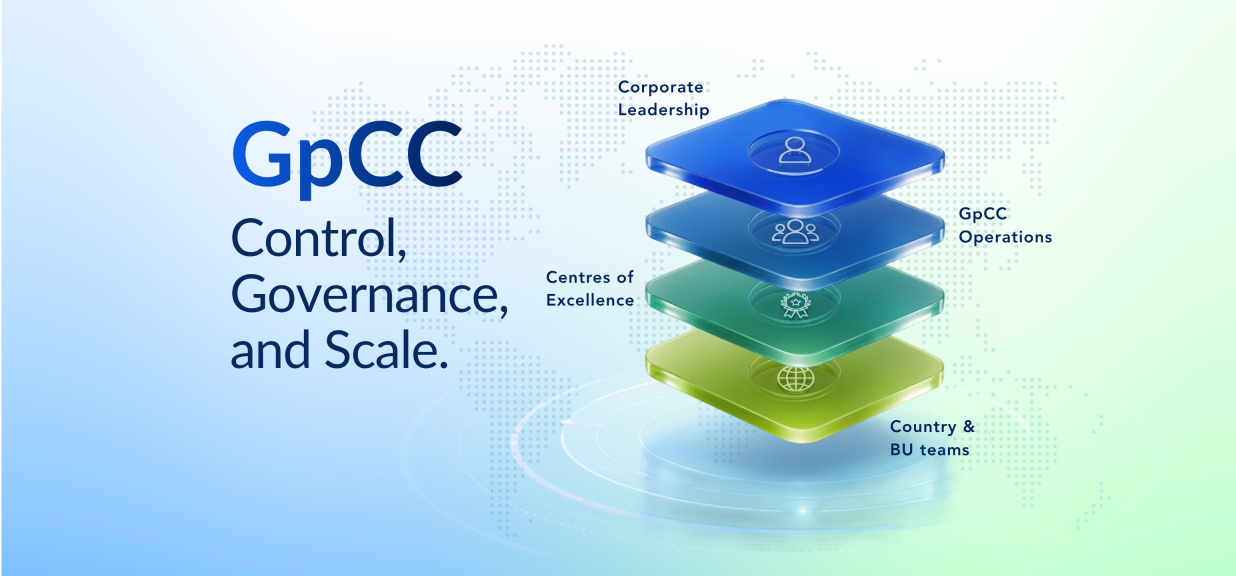
A GpCC structured for control operates across four accountability layers. Each has a defined purpose and defined boundaries.
Corporate and Functional Leadership (HQ) owns enterprise stewardship: payroll strategy, risk appetite, vendor selection principles, global control objectives, and escalation authority. What it should not be doing is case handling, tactical firefighting, or processing. When HQ is pulled into daily operational noise, the standards it exists to set go unguarded.
GpCC Operations is the engine room of scaled execution. This layer coordinates payroll runs, manages validations and reconciliations, governs vendor operations, triages exceptions, and produces reporting packs that provide leadership with a single view of performance and risk. Its mandate is to scale execution, not to set enterprise standards or make country-specific statutory calls. The discipline of staying within that boundary is precisely what makes scale possible.
Payroll Centers of Excellence (Process, Controls, Data, Automation) is the layer most frequently under-invested in early builds, and the one that determines whether the GpCC improves over time or merely sustains itself. CoE's own process design, the controls library, compliance change impact assessment, analytics, automation pipelines, and the knowledge base that prevents expertise from sitting in individuals rather than in systems. When the CoE is active, the GpCC improves each quarter. When it is advisory-only, improvement becomes person-dependent and fragile.
Country and BU Teams exist to enable proximity, time capture, local approvals, statutory interactions that require an in-country context, and local employee communications. The boundary matters here, too. When local teams fill gaps in global standards, often with good intentions, the result is fragmentation that appears coordinated.
ALSO READ | How GCCs Optimize Payroll Delivery for Multinationals
Four Rules of Thumb
Role-placement debates are common in GpCC design. Four questions cut through most of them:
- If it sets standards → Corporate or CoE.
- If it scales execution → GpCC Operations.
- If it requires local context → Country or BU teams.
- If it improves the system repeatedly → CoE.
These are orientation tools, not rigid rules. The tension between centralization and local autonomy is real, and in decentralized, BU-led enterprises, trying to force uniformity where the business is built for market-by-market variation creates resistance that stalls GpCC expansion entirely.
The resolution: centralize what must be consistent, federate what requires proximity, and orchestrate what cannot yet be consolidated.
Unified global payroll does not require a single vendor across all locations. It requires a single operating model above the ecosystem, with a common process, common data, orchestrated execution, and a single view of performance and risk. That model can coexist with a multi-vendor reality. What it cannot coexist with is the absence of clear role ownership.
What Role Clarity Actually Unlocks
When accountability is structured correctly, three things become possible.
Controls become role-embedded, not individual-dependent. Every control has an owner by role and not by name. Evidence is a designed output of the workflow, not something assembled when the auditor calls. Personnel changes do not create control gaps.
The CoE generates continuous improvement. An active CoE runs a pipeline of standardization, automation, and compliance change management. Exception patterns are resolved at the root cause. The system gets better through the work, not despite it.
Governance drives decisions, not updates. Forums that produce status reports without landing decisions are a structural failure. A decision-rights map that is actually used across daily operations, weekly reviews, monthly operating committees, and quarterly SteerCo is the difference between governance and theater.
ALSO READ | The Capabilities That Make GpCCs Possible
How Neeyamo Supports GpCC Structuring
At Neeyamo, the Global Payroll Capability Center is not a concept we advise on from a distance. It is a model we have developed, refined, and delivered over more than a decade of working at the front lines of global payroll complexity, spanning 180+ countries, multi-vendor ecosystems, long-tail markets, and the full spectrum of enterprise operating models.
Neeyamo Payroll™ provides the operating layer that makes GpCC governance real: orchestrating multi-country execution as one system, creating a single view of performance and exposure, and engineering controls and evidence by design, so that audit readiness is built into the workflow, not assembled after the fact.
For leaders shaping what their GpCC looks like on the other side of fragmentation, we are ready to build it with you.
The GCC advantage is not scale. It is an operating system that delivers predictable, controlled outcomes. Structure is where that operating system begins.
To explore how Neeyamo supports GCC-led payroll transformation and GpCC operating model design, visit neeyamo.com/gcc or connect with us at irene.jones@neeyamo.com.