Payroll has spent years being defined by one thing: Efficiency.
For decades, the processing teams have been measured on how quickly they process salaries, how accurately they manage compliance, and how effectively they reduce manual effort. Automation became the goal. Faster cycles became the benchmark. Cost reduction became the success metric.
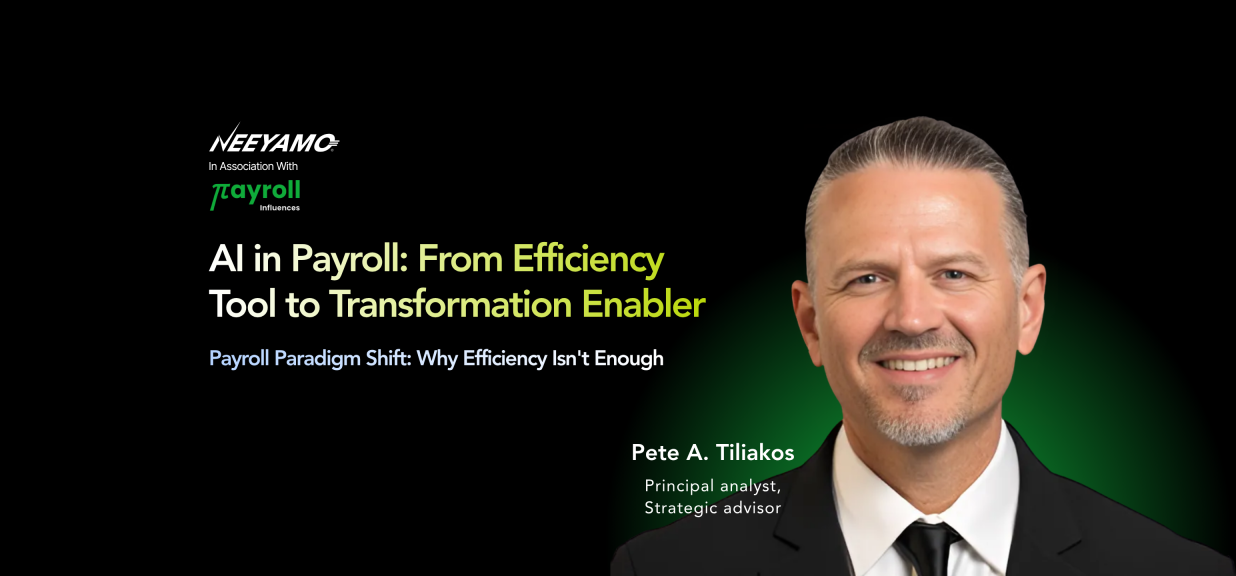
But according to payroll analyst and strategic advisor Pete Tiliakos, the industry has reached a turning point.
During the session of Neeyamo’s masterclass series, AI in Payroll: From Efficiency Tool to Transformation Enabler, Pete introduced a larger conversation that many organizations are beginning to recognize. Today, it is no longer just an operational function. It is becoming a strategic business capability.
The shift toward AI is not happening because organizations want another tool. It is happening because the traditional model is no longer sufficient to meet the complexity, speed, and expectations of modern business.
Payroll Has Been Stuck in the Efficiency Trap
One of the strongest themes from Pete’s session was what he described as the “efficiency trap.” Teams have spent years optimizing existing processes without fundamentally changing how payroll operates.
Organizations invested heavily in automation, standardization, and process improvement. While these efforts improved operational stability, they often kept the system focused on transactional work rather than on business impact.
The challenge is that payroll today operates in a completely different environment than it did even a few years ago.
Global workforces are growing more distributed. Compliance requirements continue to evolve across countries and regions. Employees expect consumer-grade experiences from workplace systems. Leadership teams want real-time visibility into workforce costs and operational risks.
At the same time, professionals are being asked to do more with fewer resources.
This is where AI becomes important.
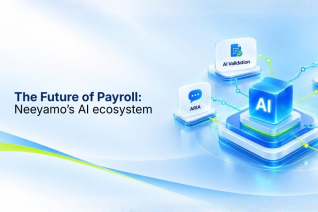
AI is not simply another layer of automation. It represents a shift from reactive operations to intelligent ecosystems that can predict issues, surface insights, improve decision-making, and reduce dependency on manual intervention.
As Pete emphasized throughout the session, the conversation is no longer about processing payroll faster. It is about transforming payroll into a more adaptive, intelligent, and connected business function.
Why the Current Model Is Under Pressure
Payroll has traditionally operated behind the scenes. If employees were paid correctly and on time, the system was considered successful.
That model worked when processes were simpler, and organizations operated within limited geographic boundaries.
Today, organizations are managing highly complex environments involving multiple vendors, fragmented systems, regional compliance requirements, and growing workforce expectations.
The pressure is no longer isolated to payroll teams alone.
Business leaders now expect data to support larger organizational decisions involving workforce planning, financial forecasting, employee experience, and operational governance.
This creates a major disconnect.
Many traditional systems were designed primarily for transaction processing, not intelligence or strategic visibility. As a result, payroll teams often spend significant time fixing issues, validating data, reconciling inconsistencies, and responding to compliance risks instead of contributing strategic insights.
Pete highlighted that this growing complexity is one of the biggest reasons organizations are reevaluating the role of AI in payroll.
AI enables a shift from manual oversight to intelligent orchestration.
Instead of relying entirely on human intervention, these intelligent systems can identify anomalies earlier, proactively flag compliance risks, detect unusual patterns, and assist teams in faster decision-making.
The value is not just operational efficiency. The value is resilience, visibility, and scalability.
AI Changes the Role of Payroll Teams
A major concern surrounding AI is whether it will replace professionals.
Pete addressed this directly during the session.
The future of payroll is not about removing people from the process. It is about changing the type of work payroll professionals spend time on.
Today, many teams are consumed by repetitive operational tasks, leaving little room for strategic contributions.
AI has the potential to reduce the administrative burden that limits the system's ability to evolve.
When routine validation, issue detection, data analysis, and workflow management become more intelligent, the respective professionals gain more capacity to focus on governance, workforce insights, employee support, and business alignment.
This is an important shift because payroll sits at the intersection of finance, HR, compliance, and employee experience.
Organizations increasingly need leaders who can interpret workforce trends, support enterprise decision-making, and guide transformation initiatives.
AI supports that transition by enabling payroll teams to become more proactive instead of constantly reacting to operational friction.
The Real Reason AI Matters in Payroll
The most important takeaway from Pete’s session was simple.
AI matters because payroll itself is changing.
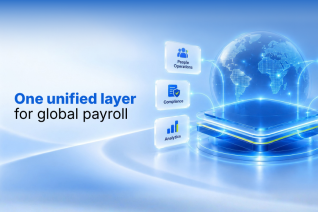
Organizations are entering an era where the system can no longer function as a disconnected back-office process. It must become more integrated, intelligent, and responsive to the wider needs of the business.
The companies that approach AI purely as a cost-saving exercise will likely miss the larger opportunity.
The real value lies in building operations that are scalable, resilient, data-driven, and capable of supporting long-term business transformation.
This is why the conversation around AI in payroll feels different today.
It is no longer about future possibilities or experimental innovation. The shift is already happening.
Payroll leaders are now being asked to rethink operating models, evaluate workforce intelligence, modernize governance structures, and prepare their teams for a more technology-enabled future.
As Pete framed it during the session, this is not simply a technology evolution. It is a paradigm shift.
And for organizations willing to embrace that shift, AI has the potential to elevate payroll from an operational necessity into a strategic advantage.
Enterprises continue to navigate global complexity, AI is becoming a critical enabler of that transformation. The conversation is no longer about replacing payroll processes. It is about reimagining the system as a more connected, data-driven, and strategic function.
At Neeyamo, this shift is central to how global payroll transformation is approached. By combining technology, global expertise, and intelligent automation capabilities, Neeyamo is helping organizations move beyond transactional models toward smarter and more scalable ecosystems.
Pete’s session reinforced an important reality. AI in payroll is no longer a future concept. It is becoming the foundation for how modern operations will evolve in the years ahead.
Reach out to us at irene.jones@neeyamo.com to know more!