Establish your presence globally with Neeyamo as we help you go beyond borders to manage your international payroll and hire new talent in South Africa using its highly efficient payroll system.

Overview
Situated at the southern tip of Africa, South Africa has long been a meeting point for African, Asian, and European cultures. This history of migration and exchange has produced a highly diverse society and a workforce known for its adaptability, strong community ties, and practical skills across key sectors like mining, manufacturing, agriculture, and technology.
Do your organization's expansion plans require hiring employees in South Africa? Do you lack a physical entity in the country – a key requisite to hire local talent? Neeyamo, one of the top Global payroll providers, assists organizations worldwide with onboarding and managing employees in South Africa - processing payroll, managing local compliance requirements, benefits, and more.
Our Presence
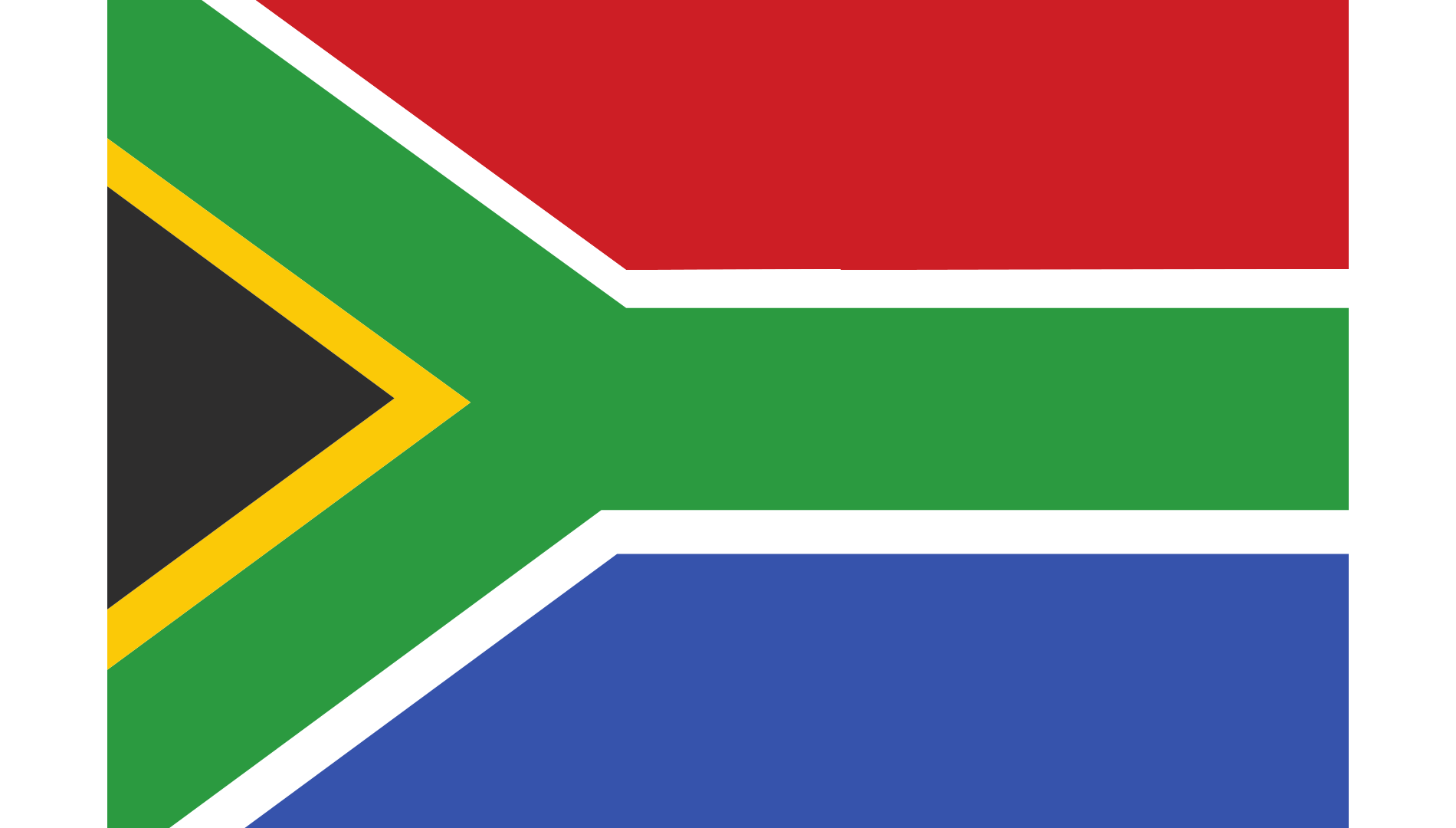


Facts And Stats
Capital
Cape Town, Bloemfontein, Pretoria
Currency
South African Rand (R)
Official Languages
English, Afrikaans, Ndebele, Xhosa, Zulu, Swati, Southern Sotho, Sepedi, Tsonga, Tswana and Venda
Fiscal Year
01 April - 31 March
Date Format
DD/MM/YYYY
Country Calling Code
+27
Time Zone
South African Standard time (UTC +2:00)
Global Payroll
Overview
What is payroll?
Payroll means the list of compensation to be paid to employees of a company or organization for a set period or date.
Handling payroll for a widespread workforce can pose a significant challenge for any organization, and the added complication of compliance can make things worse. If companies spend more time processing payroll, it directly impacts day-to-day operations and their overall productivity.
Over the years, Neeyamo has observed these complexities and strived to provide a global payroll solution through a single technology platform - Neeyamo Payroll. Neeyamo's in-house payroll software allows you to process payroll online in 5 clicks or less, making processing payroll in South Africa significantly easier.
What is Global Payroll?
Global payroll is the management of the entire payroll function of an organization across all countries of operation. Organizations use a single solution capable of doing this from one central location.
Payroll Taxes
Payroll tax is the percentage amount retained from an employee's salary and paid to the government to invest in the general population's welfare. These are statutory in nature and are levied from both the employer and employee. Additional statutory contributions are made by employers towards aiding both short-term and long-term benefits for their employees.
Employee Taxes
The employee taxes in South Africa are computed as follows:
- 1.00% - Unemployment Insurance
- 1.00% - Total Employee Cost
Effective March 1, 2026, the updated Personal Income Tax (PIT) Brackets for the 2026/27 tax year is:
| Taxable Income (R) | Rate of Tax |
| 1 – 245,100 | 18% of taxable income |
| 245,101 – 383,100 | 44,118 + 26% of taxable income above 245,100 |
| 383,101 – 530,200 | 79,998 + 31% of taxable income above 383,100 |
| 530,201 – 695,800 | 125,599 + 36% of taxable income above 530,200 |
| 695,801 – 887,000 | 185,215 + 39% of taxable income above 695,800 |
| 887,001 – 1,878,600 | 259,783 + 41% of taxable income above 887,000 |
| 1,878,601 and above | 666,339 + 45% of taxable income above 1,878,600 |
- Below 65 years: R99,000
- 65 to below 75 years: R153,250
- 75 years and above: R171,300
- Monthly credits increased for the 2027 tax year:
- Taxpayer (single): R376
- Taxpayer + 1 dependant: R752
- Each additional dependant: R254
- Overnight travel – meals and incidentals: R595
- Overnight travel – incidentals only: R184
- Day trips – meals and incidentals: R184
- Motor vehicle reimbursement rate: increased to R4.95 per kilometre.
- Updated travel allowance cost tables based on vehicle value also apply for the 2026/27 tax year.
- The annual deduction cap has been increased to R430,000 (previously R350,000).
- The limit remains the lower of R430,000 or 27.5% of remuneration/taxable income.
Employer Taxes
The employer taxes in South Africa are computed as follows:
- Skills Development Levy (SDL) - 1.00%
- Unemployment Insurance (UIF) - 1.00%
- Total Employment Cost- 2.00%
Payroll Cycle
Overview
Undoubtedly, payroll is a critical process for any organization. Pay cycle in South Africa refers to the period for which an organization pays its employees, and this can vary depending on the pay frequency that the organization chooses to adopt.
Frequency
In South Africa, there is no set payroll cycle. The payroll cycle is typically stipulated in the employment contract, which is to be agreed upon by the employee and employer. The payroll cycle can run monthly, weekly, or bi- weekly.
13th and 14th Month Cycle
In South Africa, a 13th-month salary is not legally mandated but is a common, customary payment made at the end of the year, often in December. A 14th-month salary is not a customary practice in South Africa and is generally not offered.
Global Work
Overview
An Employer of Record services (EOR) provider helps you eliminate the hassle of handling complexities while onboarding a new employee in an international location. They help bridge the gap that otherwise mandates organizations to have a local registered entity and a local bank account, prior to making a job offer to an international hire.
An Employer of Record services (EOR) provider acts as a legal employer, facilitates salary payments, and manages other statutory requirements such as health insurance, payroll taxes, and employee benefits ensuring compliance with local tax laws and regulations.
This allows organizations to focus on collaborating with the employee in South Africa for operational tasks, with the knowledge that they have a cost-effective solution support their global payroll & HR requirements, as they continue their global expansion.
HR Mandates and Practices
Minimum wage
Effective 1 March 2026, the National Minimum Wage is increased to R30.23 per ordinary hour worked.
Overtime
- Maximum 3 hours of overtime per day.
- Maximum 10 hours of overtime per week.
Overtime pay rates
- Alternatively, by agreement:
- Ordinary wage + 30 minutes paid time off per overtime hour. OR
- 90 minutes paid time off per overtime hour.
- Time off must be granted within one month (or within 12 months by agreement).
- Overtime agreements made at the start or within 3 months of employment lapse after one year.
Data Retention Policy
- Personal information will be retained only for as long as necessary to fulfil the purpose for which it was collected.
- Where retention is required by law (e.g., labour, tax, payroll, or financial-record requirements), personal information will be kept for the legally prescribed periods (typically 5–7 years depending on the record type).
- After the retention period expires, records will be securely destroyed or de-identified so that they cannot be reconstructed or accessed.
- Longer retention may occur where:
- Required for legal or contractual obligations,
- Necessary for legitimate business operations,
- Consent for extended retention has been provided, or
- Retained for historical, statistical, or research purposes with appropriate safeguards.
- Data subjects may request deletion or de-identification of their personal information when it is no longer required.
Hiring and Onboarding Requirements
Hiring
- Employers may give preference to candidates from designated groups—Black people (African, Coloured, Indian), women, and people with disabilities—to promote workplace equality. This is not unfair discrimination when it is part of a lawful affirmative action plan.
- During hiring, employers are legitimately entitled to rely on a candidate’s race, gender, or disability for the purpose of achieving their Employment Equity Plan (EEP) targets.
Onboarding
- Proof of identity (ID for citizens; passport for foreigners)
- Valid work permit/visa (foreign nationals only)
- Tax number (SARS)
- Bank details (for lawful wage payments)
- Employee’s personal details (required for UIF and COIDA registrations)
- Written particulars of employment issued by employer
- EE self-report form (only if employer is designated under the EEA)
Probation
Employers in South Africa may place new employees on probation to assess their performance and suitability before confirming permanent employment. Probation periods must be reasonable and agreed in the employment contract. While the law does not prescribe a specific duration, three-month probation is standard practice in South Africa, with longer periods used for more senior or technical roles
Leave
National Holidays
- New Year’s Day
- Human Rights Day
- Good Friday
- Family Day
- Freedom Day
- Workers' Day
- Youth Day
- National Women’s Day
- Heritage Day
- Day of Reconciliation
- Christmas Day
- Day of Goodwill
Payments over holidays:
If employees are required to work on an official public holiday due to the nature of work or business necessity, they are entitled to overtime compensation.
In such cases, they must be paid double or normal pay plus hours worked, whichever is higher. When a public holiday falls on a non-working day but the employee is asked to work, they receive their normal daily wage plus pay for hours worked
Annual Leave
The annual leave cycle means the period of 12 months’ employment with the same employer immediately following an employee’s commencement of employment or the completion of that employee’s prior leave cycle.
- Employer must grant one of the following, per leave cycle:
- 21 consecutive days of annual leave on full pay; or
- By agreement:
- 1 day for every 17 days worked or entitled to be paid; or
- 1 hour for every 17 hours worked or entitled to be paid..
Sick Leave
All employees—permanent or fixed-term—are entitled to sick leave based on a 36-month cycle. After the first six months, an employee receives the full allocation equal to the number of days they normally work in six weeks.
- An employee who works 5 days per week is entitled to 30 days' sick leave every 36months.
- An employee who works 6 days per week is entitled to 36 days’ sick leave every 36 months.
- An employee who works Monday to Friday plus every second Saturday, is entitled to 33 (30 + 3 Saturdays) days’ sick leave every 36 months.
Family Responsibility Leave
Family Responsibility Leave applies to employees who’ve worked more than four months and at least four days a week, giving them 3 days of paid leave per annual cycle. It may be used for a child’s illness or the death of a close family member (spouse/partner, parent, grandparent, child, grandchild, or sibling). Unused leave expires at the end of the cycle, unless a collective agreement provides otherwise.
Maternity Leave
Female employees are eligible for 4 consecutive months of maternity leave of which benefits are paid by the Unemployment Insurance Fund. Pregnant employees are entitled to start the leave within 4 weeks of the due date, or on a date from which a medical practitioner certifies that it is necessary for the employee’s health or that of her unborn child.
Shared Parental Leave
Employed parents (biological, adoptive, or commissioning) jointly receive 4 months + 10 days of parental leave, taken concurrently or consecutively, with each parent using their portion in one continuous block. A single parent gets the full period, and adoption/surrogacy leave starts at placement or adoption order. Pregnant employees may start leave 4 weeks before birth and cannot work for 6 weeks after, unless medically certified fit.
Termination
Overview
- Mutual agreement
- Expiry of a fixed-term contract
- Retirement (as per agreed/normal retirement age)
- Death of the employee
- Incapacity (illness, injury, or disability after assessment and reasonable accommodation)
- Operational requirements (retrenchment due to economic, technological, or structural reasons)
- Misconduct (after a fair disciplinary process)
- Poor performance (after counseling and a chance to improve)
- Probation non-confirmation (after fair evaluation)
- Dismissal for incompatibility (only if attempts to resolve the conflict were made)
Notice Period
- If employed 6 months or less: 1 week notice
- If employed more than 6 months but less than 12 months: 2 weeks’ notice
- If employed 12 months or more: 4 weeks’ notice
- Farm workers and domestic workers: 4 weeks’ notice after 6 months of employment
Severance Pay
Under Section 41 of the Basic Conditions of Employment Act (BCEA), severance pay is owed only when an employee is dismissed for operational requirements (retrenchment), or in certain cases of employer insolvency/closure.
- Minimum: 1 week’s remuneration for each completed year of continuous service.
- “Remuneration” includes wage/salary plus regular allowances as defined in the BCEA.
Visa
General Requirements
- All foreign nationals must obtain the appropriate South African visa or temporary residence visa before entering or working in the country (Immigration Act 13 of 2002).
- Standard processing time varies by mission but is generally 5–10 working days, depending on documentation and checks.
- Passport must be valid for at least 30 days after the intended departure date and must contain at least two blank pages (Immigration Regulations, Reg. 2).
Work Visa
- Required for foreigners intending to work in South Africa under the Immigration Act Sections 19 & 21.
- Applicants must provide:
- Completed visa application form (BI-1738).
- Valid passport meeting the legal validity requirements.
- Employment contract signed by employer and employee (Reg. 18).
- Proof of qualifications, evaluated by the South African Qualifications Authority (SAQA) where applicable.
- Police clearance certificate from all countries where the applicant has lived for 12+ months since age 18 (Reg. 11).
- Medical report and radiological (X-ray) report (Reg. 18).
- Work permit type–specific documents, such as:
- Critical Skills Visa: Proof of listing on the Critical Skills List.
- General Work Visa: Department of Labour certificate confirming no suitable South African is available.
- Intra-Company Transfer Visa: Proof of transfer from a foreign branch.
Types of Visas in South Africa (as per Immigration Act 13 of 2002)
- Visitor Visa – tourism, family visits, short business travel
- General Work Visa
- Critical Skills Work Visa
- Business Visa
- Study Visa
Employee Background Checks
Overview
- Not explicitly prohibited or mandated by a single law; however, checks are governed by:
- Protection of Personal Information Act (POPIA) – requires employee consent and lawful processing.
- Employment Equity Act (EEA) – prohibits unfair discrimination (e.g., criminal record discrimination must be job-related).
- Employers may legally conduct background checks with the candidate’s informed consent.
Common Types of Checks Conducted
- Identity Verification: Validation of South African ID or passport; verification via DHA systems where allowed.
- Right to Work / Immigration Verification: Required under Immigration Act Section 38, which obligates employers to verify visa and work authorization.
- Educational Background Verification: SAQA verification of foreign qualifications (mandatory for many work visas).
- Employment History & Reference Checks: Allowed with consent; must comply with POPIA.
- Criminal Record Check:
- Through SAPS (South African Police Service) with the applicant’s consent.
- May be required for sensitive roles (finance, security, government, childcare).
Last updated on March 12, 2026
If you have any queries or suggestions, reach out to us at irene.jones@neeyamo.com
Recommended Resources & Insights





Have Queries? Get In Touch With Us
Get in touch with one of our experts and take a quick demo of our services