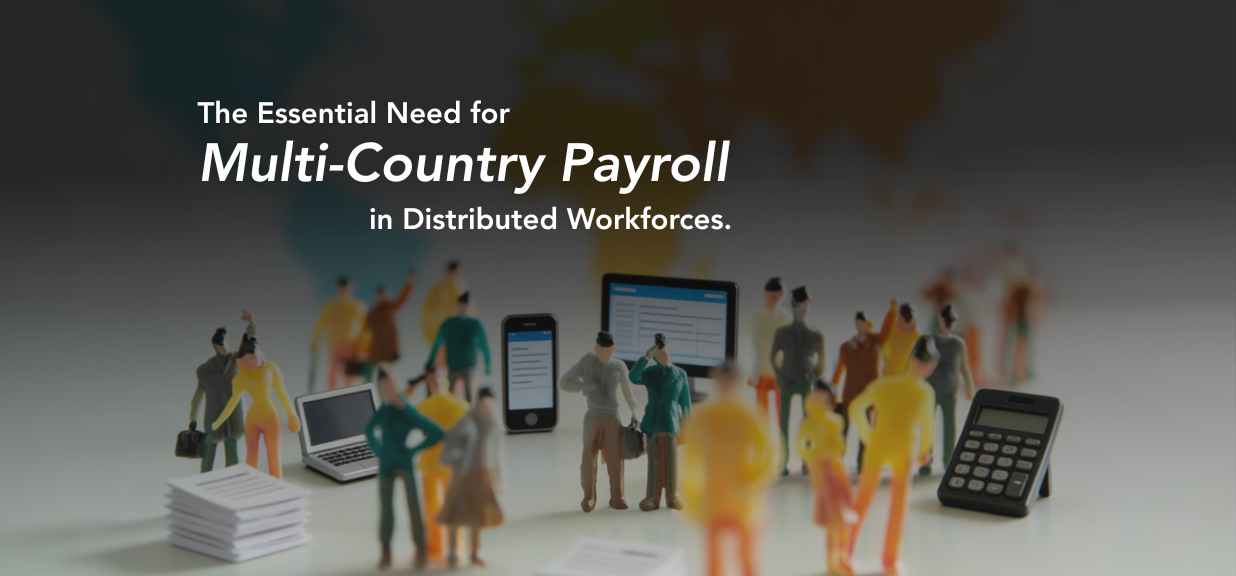
As organizations continue to expand across borders, the nature of work has changed dramatically. Talent is no longer limited to geography. Businesses now hire teams across continents, time zones, and employment models, from remote engineers in India to sales teams in Europe and contractors in LATAM regions. And in this global environment, one traditional system constantly falls short, i.e., payroll. This is where multi-country payroll steps in as a strategic necessity, not just an administrative function.
Understanding Multi-Country Payroll
Multi-country payroll refers to a unified, centralized platform or framework that manages payroll processing for employees in multiple countries. Instead of running separate payroll operations with different vendors, tools, and compliance workflows, companies use one solution that integrates global data, automates calculations, and ensures each country’s payroll is processed accurately and on time.
In essence, it brings standardization, transparency, and compliance to the complex world of global workforce management.
Why Multi-Country Payroll Matters for Distributed Teams
As global teams become the norm, organizations often find it challenging to navigate the diverse payroll requirements that come with operating across multiple countries. In the following sections, we explore why an integrated system matters and how Neeyamo’s focus on multi-country payroll helps bring order to this complexity through a structured, compliant framework. Below are five key factors that highlight the value of having a unified multi-country payroll system in place.
Ensures Consistent, Reliable Employee Experience Globally
When a workforce spans several countries, inconsistency becomes a major problem. Different pay cycles, formats, currencies, and documentation create confusion and frustration.
Multi-country payroll eliminates this by providing a uniform employee experience. Regardless of where they operate, employees receive timely payments, clear payslips, and a transparent understanding of earnings and deductions.
In a talent market where experience is everything, this consistency builds trust and reduces churn.
Simplifies International Payroll Compliance
Global expansion comes with increasing complexity. Every country has its own rules related to:
- Income tax slabs
- Social security contributions
- Statutory benefits
- Overtime and leave policies
- Mandatory reporting formats
- GDPR and data protection requirements
Staying compliant in one country is hard enough; doing it across ten or twenty becomes a genuine risk.
A multi-country payroll system embeds country-specific compliance engines that automatically adjust calculations and formats to local laws. This reduces the likelihood of penalties, audits, or reputational damage.
For fast-growing companies, this level of compliance automation is invaluable.
Offers Unified Visibility and Better Financial Control
When payroll data is scattered across countries and vendors, leadership loses visibility into costs and performance.
Multi-country payroll consolidates data into a single dashboard, allowing organizations to see:
- Total global payroll costs
- Country-wise headcount distribution
- Labor cost trends
- Contractor vs. employee ratios
- Budget variances
This enables HR, finance, and leadership teams to make smarter decisions, manage budgets more effectively, and forecast with accuracy.
Accelerates Global Expansion and Scalability
One of the biggest challenges of entering new markets is setting up local payroll. It can take months to understand the country’s statutory rules, hire local vendors, and integrate systems.
A centralized multi-country payroll structure turns this into a plug-and-play process. Most of the frameworks, compliance modules, and data integrations already exist.
This enables faster, smoother scaling into new countries and significantly lower costs.
Reduces Manual Work and Operational Errors
Managing separate payroll files, spreadsheets, and reporting systems for each country often leads to duplicate work and miscalculations.
Multi-country payroll introduces automation across:
- Data entry
- Salary calculations
- Tax deductions
- Benefits administration
- Reporting and audits
This reduces human error, eliminates repetitive tasks, and frees up HR and finance teams to focus on strategic initiatives rather than day-to-day administration.
Why Multi-Country Payroll Is Now a Strategic Priority
Global talent strategies are evolving. Businesses want to hire the best people, not just those nearby. With the rise of remote work, contractor ecosystems, and distributed teams, the demand for global payroll transformation is higher than ever.
Multi-country payroll is no longer just an efficiency tool used for simple operations. It has become a strategic enabler that allows organizations to:
- Compete for global talent
- Reduce compliance risks
- Create standardized global processes.
- Gain real-time workforce insight.
- Support long-term international growth.
Companies adopting centralized, tech-driven multi-country payroll systems are better positioned to operate with agility, maintain compliance, and deliver a world-class employee experience across every region.
As global workforces grow, organizations can no longer rely on fragmented or country-isolated payroll processes. Neeyamo’s experience in managing multi-country payroll helps bring structure and consistency to an increasingly complex international landscape, whether a company already operates with distributed teams or is preparing for global expansion. A unified payroll framework provides the clarity, accuracy, and compliance needed to function confidently across borders. With this approach, businesses are better equipped to move efficiently, minimize operational risk, support employees in every location, and establish a scalable foundation for the evolving world of work.
To learn more about how Neeyamo supports multi-country payroll operations, you can contact our team for guidance.
If you’d like personalized assistance, reach out to irene.jones@neeyamo.com, and we’ll help you get started.