Designing Payroll Calendars by Working Backwards from Pay Day
A payroll calendar is not built by marking dates on a spreadsheet. It is engineered methodically, sequentially, and always by working backwards from the pay date.
Regardless of pay frequency, geography, or payroll volume, the fundamental principle of payroll calendar design remains the same: first define when employees get paid, then trace every dependency back from that moment.
This backward design approach is what distinguishes stable, predictable payroll operations from those that operate under constant pressure.
The Pay Date as the Anchor
Every payroll calendar begins with a single, non-negotiable decision: when employees will be paid. This might be the 28th of the month, the last working day, the last Friday, or every Friday for weekly payrolls. Once this date is set, the rest of the calendar begins to take shape.
If employees must be paid on the 28th, the payroll calendar has to accommodate bank file submission timelines, internal sign-offs, and review cycles before that date. Bank files usually need to be submitted at least a couple of working days in advance. Payroll registers must be approved before that. Draft outputs need to be shared even earlier so that discrepancies can be identified and corrected. Each of these steps pushes the calendar backward, creating a realistic timeline instead of an aspirational one.
This is how payroll calendars evolve from abstract schedules into operational plans with clearly defined milestones.
But first, what is a Payroll Calendar?
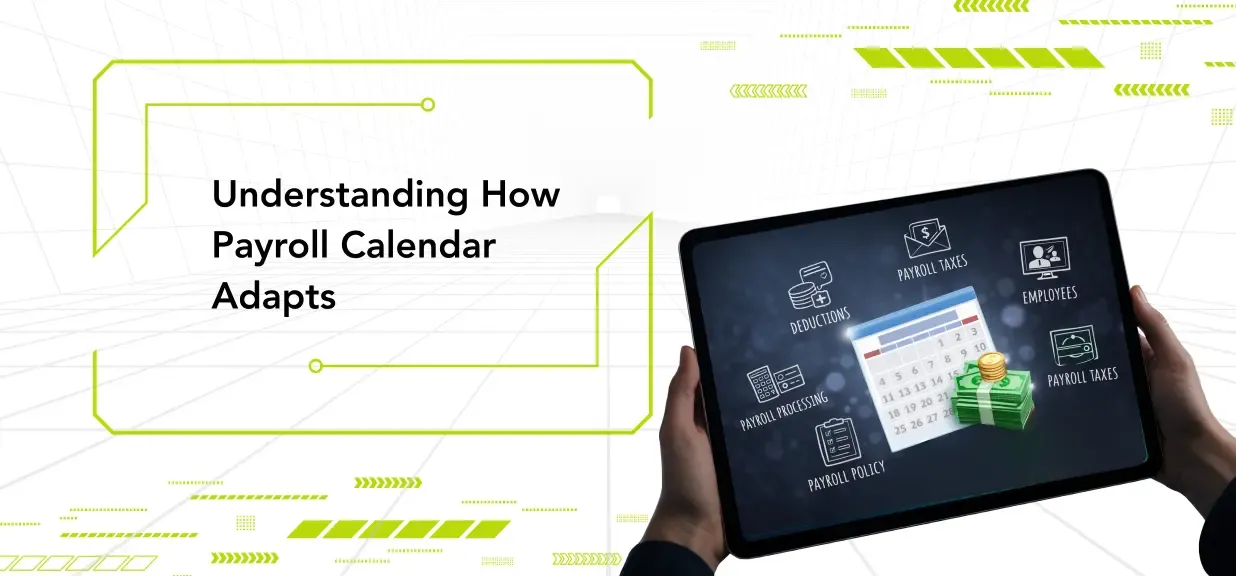
A payroll calendar is a structured timeline that outlines all activities required to deliver payroll accurately and on time. It is built by working backward from the pay date and maps key dependencies, including input cut-offs, payroll processing, validations, approvals, bank file submissions, and statutory timelines. More than a schedule, a payroll calendar functions as an operational control that brings predictability, accountability, and consistency to payroll execution across pay frequencies and regions.
Why Payroll Calendars Are Built Backwards
Payroll is not a process that can recover easily from missed deadlines. Banking cut-offs are fixed, statutory timelines are immovable, and employees expect to be paid exactly when promised. A payroll calendar designed forward from the start of a pay period to payday often looks neat, but it fails to account for these constraints.
Working backwards forces payroll teams to confront reality early. It highlights where buffer time exists, where it does not, and where dependencies could become risks. This approach reduces last-minute escalations and ensures that approvals and validations happen by design rather than by urgency.
Why Payroll Calendars Are Critical to Month-End Close and Filings
Payroll calendars do not stop at payroll execution. In mature operating models, they are deliberately designed to support month-end financial close and statutory filings, both of which depend directly on payroll accuracy and timing.
Once payroll is finalized, payroll outputs feed into general ledger postings, accruals, cost allocations, and reconciliations required for financial close. Delays in payroll do not remain a payroll issue; they immediately spill into finance, compressing close timelines and increasing the risk of manual corrections, restatements, or control exceptions. As a result, finance closure deadlines often dictate how much buffer a payroll calendar must build in before payday.
Statutory filings introduce an equally critical constraint. Tax remittances, social security contributions, and regulatory submissions are subject to non-negotiable deadlines that follow closely after payroll runs. Missed or rushed filings expose organizations to penalties, interest, and audit scrutiny. Effective payroll calendars, therefore, treat statutory timelines as fixed anchors, not afterthoughts.
How Pay Frequency Changes the Calendar Experience
While the logic of building a payroll calendar remains the same, the pressure it creates varies significantly by pay frequency. Weekly payrolls are the most compressed. When employees are paid every Friday, the entire cycle from collecting inputs to submitting bank files may need to be completed within just a few days. In these cases, the payroll calendar becomes tightly controlled, with little tolerance for delays.
Bi-weekly and semi-monthly payrolls provide more time, but they introduce different challenges. Bi-weekly payrolls shift pay dates from month to month and occasionally result in an additional pay cycle within a year, which affects deductions and employee expectations. Semi-monthly payrolls fix pay dates but often split workweeks across periods, complicating overtime and variable pay calculations. In both cases, the payroll calendar must balance administrative efficiency with clarity for employees.
Monthly payrolls offer the longest processing window, but they are not necessarily simpler. Month-end payroll calendars tend to be dense, with multiple data sources closing simultaneously and statutory deadlines following closely after payroll is run. Any delay in inputs or approvals can quickly cascade across the calendar.
ALSO READ | Year-End Payroll Reconciliation: What Payroll Leaders Need to Know
Regional Realities That Shape Payroll Calendars
Pay frequency is only one part of the equation. Geography introduces another layer of complexity that payroll calendars must absorb.
In Europe, payroll timelines often tighten during July and August due to widespread vacations, and again in December when pay dates move earlier around Christmas. In regions such as the Middle East, differences in working weeks and banking days influence submission timelines, while in Latin America, certain months require special handling due to region-specific payroll events.
Similarly, in India, payroll timelines often tighten around long public holiday clusters and the financial year-end in March, when compliance and payroll activities peak simultaneously. In APAC markets such as Japan, strict cut-off discipline and bank processing timelines drive earlier payroll closures, while in Africa, varying public holidays and banking infrastructure across countries require wider buffers in the payroll calendar.
These are not one-off exceptions. They are recurring patterns that need to be embedded into the payroll calendar itself. When payroll teams are not given advance notice, they are left managing predictable disruptions reactively.
The Principle That Applies Everywhere
Regardless of whether payroll runs weekly or monthly, locally or globally, one principle remains constant. The pay date must be defined first. Everything else follows by working backward until every dependency has a clear deadline. This is what makes payroll calendars realistic, defensible, and scalable.
Payroll technology may automate calculations and workflows, but the payroll calendar governs execution. Consistent payroll outcomes are rarely the result of last-minute effort. They are the outcome of careful planning and calendars designed to protect the most important commitment payroll makes: paying employees accurately and on time.
Conclusion
As payroll operations mature, the payroll calendar becomes far more than a scheduling reference. It functions as an operational control that aligns payroll, HR, finance, and banking teams around a shared, predictable timeline. Reducing dependence on individual experience and institutional memory, it brings consistency to payroll execution and clarity during audits, escalations, and change.
Ultimately, reliable payroll is not driven by last-minute effort or heroics. It is the result of deliberately designed, regionally aware, system-driven calendars. In payroll, predictability is not accidental; it is planned. For more information, contact us at irene.jones@neeyamo.com